

What exactly is Salesforce Service Cloud Voice? Think of it as the ultimate unifier for your customer service team. It’s a powerful solution that integrates telephony directly into the Salesforce Service Cloud console, turning it into a single, intelligent command centre.
By bringing together voice calls, digital channels, and your CRM data, Service Cloud Voice empowers agents to deliver smarter, faster service. For businesses, it transforms every customer call into a data-rich interaction that builds stronger relationships and drives better decisions. The days of frantically switching between apps are over.
Unifying Conversations and Data in One Console
For years, many customer service teams have faced a significant business challenge: a clunky, disconnected workflow. An agent answers a call on one system, pulls up customer history in their CRM on another screen, and types notes into a third application. This constant juggling act creates friction, slows down resolutions, and leaves both agents and customers frustrated.
This fragmented process doesn't meet modern expectations. Today's customers demand service that’s fast, personal, and intelligent. They don’t want to repeat their story to three different people or sit on hold while an agent digs for their records. The Salesforce solution, Service Cloud Voice, solves this problem head-on by creating a single, unified workspace.
The Power of an Integrated Experience
When a call comes in, the agent’s screen instantly populates with the caller's complete history—every past interaction, open case, and relevant detail from your CRM is right there. This gives agents the context they need to deliver smarter, more empathetic service from the moment they say "hello."
Let's look at a case study style comparison. A traditional call centre forces agents to piece together information, often leading to mistakes and delays. But with Service Cloud Voice, the entire experience is seamless.
Traditional Support vs Service Cloud Voice Experience
| Feature | Traditional Call Centre (The Challenge) | Service Cloud Voice (The Solution) |
|---|---|---|
| Call Handling | Agent answers on a separate phone system, then searches for the customer in the CRM. | Incoming call automatically triggers a screen pop with the customer's full profile. |
| Data Entry | Manual note-taking, often in a separate app. High risk of incomplete or lost data. | Real-time call transcription is automatically saved against the customer's record in Salesforce. |
| Agent Support | Supervisors must physically listen in or rely on post-call coaching. | AI provides real-time agent guidance and prompts during the live call. |
| Reporting | Disconnected data sources make it difficult to get a full picture of performance. | All call data, notes, and outcomes are captured in Salesforce for unified reporting and analytics. |
The results and benefits are stark. By bringing everything into one platform, you're not just making things easier for your team; you're fundamentally improving the quality of every customer conversation, a key goal of digital transformation.
By pulling voice communications into the heart of the CRM, you turn every call into an opportunity. It stops being just a conversation and becomes a data-rich interaction that builds stronger relationships and drives smarter business decisions.
AI at the Core of Modern Service
This setup isn't just about connecting systems; it’s supercharged with artificial intelligence. To really grasp what Service Cloud Voice offers, it helps to understand the broader industry trend of the Voice AI Agent revolution. AI-powered tools like real-time transcription and next-best-action suggestions are built right into the console, giving agents a helping hand exactly when they need it.
This move towards AI-driven service isn't just a passing trend—it's a strategic must-have. Projections show that AI is set to handle 50% of all customer service cases in Australia and New Zealand by 2027. That's a huge leap from 31% in 2025. This rapid uptake shows just how critical AI has become for boosting speed and freeing up human agents to tackle the complex, high-value problems where they shine.
As a Salesforce partner, we've seen firsthand how a unified communications strategy solves real-world business headaches. By centralising voice and data, companies are building more efficient, intelligent, and customer-focused service operations from the ground up.
Exploring the Core Features and Architecture of Service Cloud Voice
To really understand what makes Service Cloud Voice so powerful, you need to look past the high-level concept and dive into the tools that make it all tick. At its heart, the platform is built to turn every phone call into a goldmine of actionable data, giving your agents intelligent tools right inside their Salesforce console. It’s less about just plugging in a phone line and more about engineering a smarter conversation from start to finish.
This is all powered by a set of core features that work together seamlessly. Instead of an agent frantically searching a knowledge base while a customer is on hold, they get instant, context-aware suggestions popping up on their screen. The result is a smoother, faster, and far more effective service experience.
Key Features That Empower Your Agents
The real magic of Service Cloud Voice is how it uses AI to give agents a helping hand during live calls. These aren’t just shiny add-ons; they are fundamental tools that completely change the game for customer support teams.
- Real-Time Call Transcription: As a customer speaks, their words are instantly turned into text and displayed on the agent's screen. This eliminates the need for messy note-taking, reduces errors, and creates a searchable record of the conversation that’s automatically saved to the Salesforce case file.
- Einstein AI Recommendations: Salesforce’s AI, Einstein, analyzes the live conversation, picking up on keywords and customer sentiment. It then feeds the agent real-time suggestions, like relevant knowledge articles, next-best-action steps, or even pre-written responses to guide them toward a quick and consistent resolution.
- Supervisor Listen-In and Whisper Coaching: Managers can discreetly monitor live calls to maintain quality. If an agent is struggling, a supervisor can "whisper" guidance that only the agent can hear, providing on-the-spot coaching without the customer ever knowing.
- Unified Omni-Channel Console: All your customer interactions—whether it's a phone call, chat, email, or social media message—are managed from a single, unified screen. This gives agents a complete picture of the customer's journey and ensures a consistent experience, no matter how they choose to get in touch.
These capabilities are always improving, so it pays to keep an eye on updates like the highlights of Salesforce Winter ’25 Release to see how AI continues to get smarter.
Understanding the Technical Architecture
Demystifying how Service Cloud Voice actually works is key to understanding its value. The architecture is smartly designed to create a seamless flow of information between your telephony provider, your Salesforce CRM, and your agent's workspace.
This diagram shows how the Unified Console acts as the central hub, bringing together voice, digital channels, and all your precious CRM data.
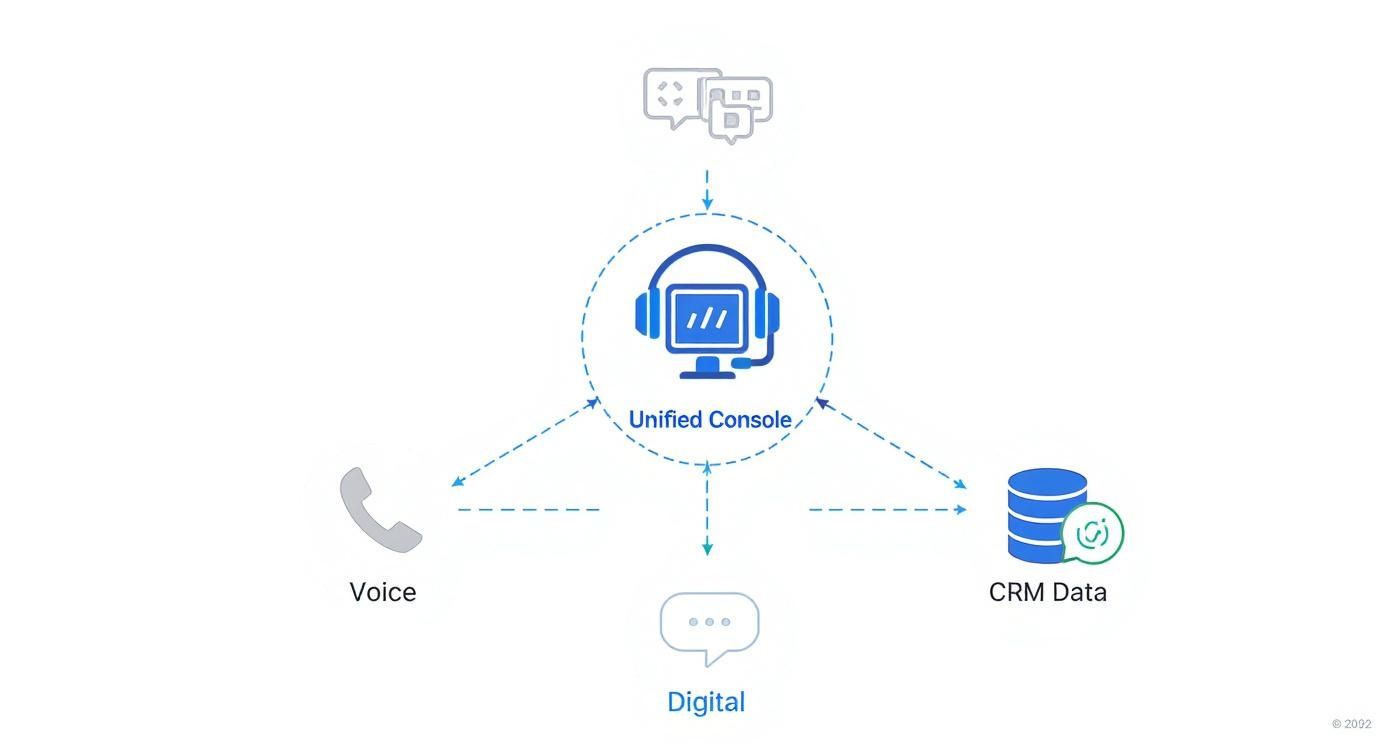
What this really shows is that the agent’s console is no longer just a CRM screen but a true command centre for every customer interaction.
Here’s a lesson learned from our projects: the architecture is designed for integration. Here’s how it works:
- A customer calls your business, and the call is routed through your chosen phone system (like Amazon Connect or another partner provider).
- The telephony system instantly communicates with Salesforce with the call information.
- Salesforce matches the phone number to a customer record and presents their entire history on the agent’s screen before they even say "hello."
- During the call, AI services get to work, transcribing the audio in real-time and feeding insights straight into the agent's console.
This integrated architecture means your call data is no longer stuck in a separate phone system. It becomes a native part of your CRM, ready to be used for reports, analytics, and ultimately, a better customer experience.
As a Salesforce partner with extensive project experience, we’ve seen firsthand how this connected system breaks down data silos and empowers service teams. It transforms the contact centre from a simple cost centre into a strategic hub for business intelligence, where every single conversation helps build a smarter, more responsive organisation.
Calculating the Business Impact and ROI of Service Cloud Voice
Adopting new technology is one thing, but understanding how it translates into measurable business growth is what truly matters. For Australian organisations, the case for investing in Service Cloud Voice is built on tangible, financial outcomes that go far beyond just modernising the contact centre.
It’s about creating a powerful engine for efficiency, customer loyalty, and strategic insight.
The business impact is felt in two key areas: the direct, operational efficiencies that immediately affect the bottom line, and the indirect benefits that build long-term value. By unifying voice data directly within your Salesforce CRM, you unlock a new level of intelligence that can inform business strategy and create a powerful competitive advantage.

Driving Direct ROI Through Operational Efficiency
The most immediate returns from implementing Service Cloud Voice come from streamlining your service operations. When agents have every tool they need in one console, they can resolve issues faster and more effectively. This isn't just a minor tweak; it's a fundamental improvement to your team's productivity.
From our project experience, we consistently see clients achieve significant gains in key performance indicators (KPIs) that directly impact costs.
- Reduced Average Handle Time (AHT): With instant access to customer history and AI-powered recommendations, agents spend less time searching for information and more time solving problems. This automation can reduce AHT by 15-20% or more.
- Improved First-Call Resolution (FCR): When agents have the right context and tools, they can solve issues on the first attempt more often. A higher FCR rate means fewer costly callbacks and happier customers.
- Lowered Agent Training Time: A single, intuitive interface simplifies the onboarding process. New hires can become proficient faster, reducing training overhead and getting them productive sooner.
These efficiencies compound over time, leading to substantial cost savings and allowing your team to handle higher call volumes without needing to expand headcount.
Unlocking Indirect ROI with Enhanced Experiences
Beyond the direct cost savings, the real long-term value of Service Cloud Voice lies in its ability to improve both the customer and agent experience. These indirect benefits are often even more impactful, fostering loyalty and a more stable, motivated workforce.
A better agent experience directly leads to a better customer experience. When agents feel supported by intelligent tools instead of being frustrated by clunky systems, they are more engaged and better equipped to provide empathetic, high-quality service.
Investing in your agent experience is one of the most effective ways to invest in your customer relationships. A happy, empowered agent is your best brand ambassador, turning routine service calls into opportunities to build lasting loyalty.
This improved environment leads to critical long-term gains, like higher customer satisfaction scores (CSAT), which boost retention and lifetime value. It also helps reduce agent attrition. A less stressful, more supportive work environment means your best agents are more likely to stay, saving you significant recruitment and training costs.
You can explore real-world examples of these outcomes in our collection of Salesforce case studies.
The Strategic Value of Voice Data in Australian Industries
The true competitive advantage of Service Cloud Voice comes from unlocking the strategic insights hidden within your customer conversations. The Australian market has strongly embraced Salesforce's cloud solutions to power digital transformation and AI-driven service. In fact, Salesforce's cloud services are a major growth engine, contributing to $9.1 billion in revenue for fiscal year 2025. The rapid adoption is clear, with Salesforce closing 5,000 Agentforce deals—a key AI service integration—since October 2024, showing strong commercial momentum.
For industries like construction and healthcare, this voice data is invaluable. A construction firm can analyse call transcripts to identify common project roadblocks mentioned by clients, while a healthcare provider can spot trends in patient queries to improve service delivery.
This turns your contact centre from a cost centre into a strategic intelligence hub, providing real-world feedback that informs product development, marketing, and overall business strategy.
Choosing Your Service Cloud Voice Licensing and Telephony Model
Figuring out the commercial side of Service Cloud Voice can feel overwhelming at first, but it really boils down to one key decision. You need to pick the telephony model that makes the most sense for your business’s current setup, technical expertise, and future goals. This choice is the foundation for how you’ll integrate voice into your Salesforce CRM.
Salesforce offers two main pathways. Each has its own strategic perks and operational quirks, so understanding the difference is crucial for making a smart, confident investment.
Service Cloud Voice with Amazon Connect
The first option is the all-in-one, native solution where Salesforce bundles Amazon Connect as the telephony provider. Think of it as the "out-of-the-box" model, built for simplicity and rapid deployment. Salesforce manages the relationship with Amazon Web Services (AWS), so you get a single contract and one support channel for your entire voice system.
This model is a fantastic choice for organisations that:
- Are new to cloud telephony and want a straightforward, pre-integrated solution.
- Prefer dealing with a single vendor for billing and tech support to keep things simple.
- Want to launch quickly without needing a deep bench of in-house telephony experts.
Following this path gives you a powerful, ready-to-go contact centre where the AI features, call transcription, and phone system are all tightly woven together from day one.
Service Cloud Voice with Partner Telephony
The second option is the Partner Telephony model, often called "Bring Your Own Telephony" (BYOT). This route offers greater flexibility by letting you integrate a different compatible telephony provider with Service Cloud Voice. It’s perfect for businesses that already have a strong relationship with a specific provider or require specialized features.
When weighing your options, it's a good best practice to see what else is out there, including the various top VoIP providers for call centers. The BYOT approach means you can keep your existing phone numbers, calling rates, and carrier relationships, all while tapping into the incredible CRM integration and AI power of Service Cloud Voice.
This model is all about choice and control. It’s perfect for organisations with established telephony infrastructure or specific compliance needs that require a particular provider, giving them the freedom to build a more customised Salesforce solution.
The move towards cloud-based communications is a significant industry trend in Australia. While the traditional fixed voice market is still projected to generate around US$897.7 million in 2025, it's also expected to shrink annually by 3.9% through 2029. This shift away from legacy phone networks towards integrated VoIP and cloud solutions like Service Cloud Voice highlights the importance of these modern systems. You can learn more about the trends shaping the Australian fixed voice market and what it means for businesses.
To make things clearer, let's break down how the two models stack up.
Service Cloud Voice Telephony Models Compared
| Aspect | Service Cloud Voice with Amazon Connect | Service Cloud Voice with Partner Telephony |
|---|---|---|
| Integration Model | Native, all-in-one solution. | "Bring Your Own Telephony" (BYOT). |
| Vendor Management | Single contract and support from Salesforce. | Separate contracts with Salesforce and your chosen telephony provider. |
| Setup Complexity | Simpler and faster to deploy. | More complex, requires integration expertise. |
| Flexibility | Less flexible; uses Amazon Connect exclusively. | High flexibility to choose from a list of compatible partners. |
| Best For | Businesses wanting simplicity and a quick start. | Businesses with existing telephony or specialised needs. |
| Expertise Needed | Minimal in-house telephony expertise required. | May require in-house or Salesforce partner expertise for integration. |
Ultimately, the right choice depends on your specific business context. As a Salesforce partner, we help businesses weigh these options to ensure the model you choose is a perfect fit for both your daily operations and your long-term vision for customer service.
Your Practical Service Cloud Voice Implementation Roadmap
Getting a Service Cloud Voice deployment right is about much more than just the tech; it demands a solid strategy that brings your people, processes, and technology into alignment. A well-planned approach means you don't just get the system live—you get your team using it effectively to achieve your business goals. Drawing from our experience across more than 110 Salesforce projects, we've honed a phased implementation plan designed to minimise risk and accelerate your time-to-value.
We find it’s best to break this journey down into four clear, manageable stages. Each phase builds logically on the one before it, taking you from initial idea to a fully functioning, high-performing contact centre. Think of it like building a house: you need the blueprint before you pour the foundation.
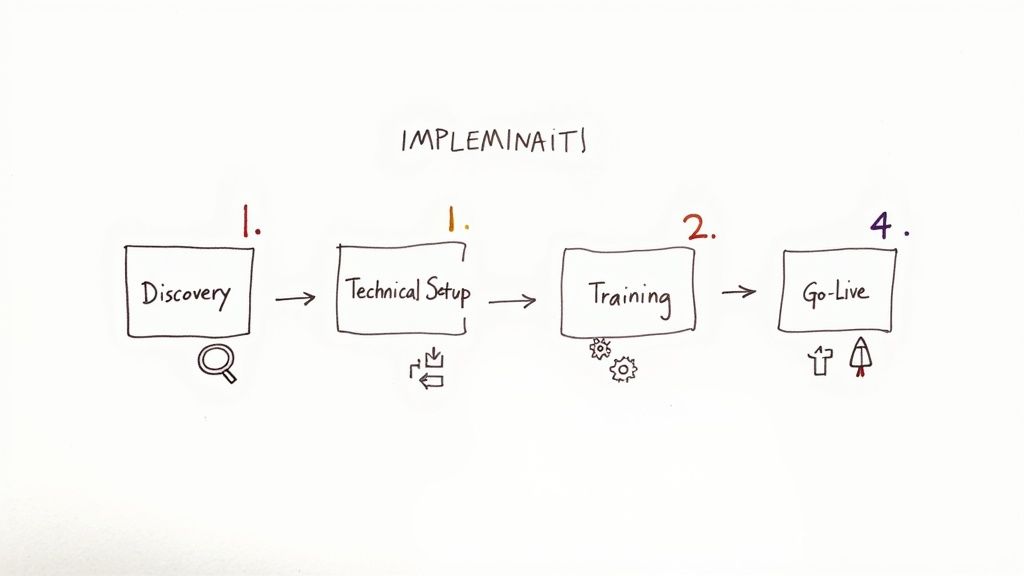
Phase 1: Discovery And Planning
This first stage is all about laying the groundwork for success. Before any technical work begins, we need to be crystal clear on what you want to achieve and how we’re going to measure it. We collaborate with your key stakeholders to map out your current service processes, pinpoint the business challenges, and agree on tangible success metrics.
Here’s what we focus on:
- Defining Business Objectives: What specific problems are you trying to solve? Are you looking to reduce average handle time by 15%, or boost first-call resolution by 10%? Let's define it.
- Stakeholder Workshops: We bring together IT, customer service leaders, and agents. It’s vital to gather requirements and ensure the entire team is aligned with the vision.
- Technical Assessment: We conduct a thorough review of your existing setup—your network readiness, your current phone system—to identify potential roadblocks early on.
Getting this planning phase right is non-negotiable. For a broader look at project planning, our Salesforce Implementation Guide for Australia offers valuable insights.
Phase 2: Technical Setup And Configuration
With a solid plan locked in, it’s time for the technical build. This is where your vision starts taking shape inside the Salesforce platform. Our team configures the solution to fit your unique workflows, ensuring the technology serves your processes—not the other way around.
The heavy lifting here involves connecting the telephony, setting up call flows in Amazon Connect (or your chosen provider), and customising the Service Console. The goal is simple: when a call comes in, it gets to the right agent instantly, with all the right customer information on their screen.
A lesson learned from many CRM projects is to avoid simply copy-pasting old processes into the new system. The real win comes from rethinking your workflows to leverage the automation and AI that Service Cloud Voice brings to the table.
Phase 3: User Enablement And Training
A powerful new tool is useless if nobody uses it properly. This phase is all about getting your team ready and confident. We focus on practical, role-based training that shows agents not just how to use the tools, but why the new process is better for them and for your customers.
We always recommend a pilot group of tech-savvy agents to start. This best practice lets you gather real-world feedback, smooth out any wrinkles, and create internal champions who will help get the rest of the team excited. It’s a great way to build momentum for a smooth, company-wide launch.
Phase 4: Go-Live And Optimisation
Going live is just the beginning. Once the system is up and running, our focus shifts to monitoring performance against the KPIs defined in Phase 1. We dig into the call data, agent feedback, and customer satisfaction scores to find opportunities for continuous improvement.
This ongoing optimisation is where Service Cloud Voice really proves its worth. By analyzing call transcripts and performance dashboards, you can make smart tweaks to call routing, update knowledge articles, and provide targeted agent coaching. It’s an iterative loop that ensures your investment keeps delivering more value long after launch day.
How a Salesforce Partner Ensures Your Success
Implementing a solution like Service Cloud Voice is a major project. While the technology is impressive, its true power is only unlocked through expert planning, thoughtful customisation, and a clear business strategy.
This is where engaging an experienced Salesforce partner makes all the difference. It turns a complex technical rollout into a genuine business asset that delivers a strong return on investment.
A good partner is your guide, helping you sidestep common pitfalls that can derail projects. With deep experience in both the Salesforce platform and the real-world business challenges it solves, a partner ensures your setup is not just technically sound, but perfectly aligned with your unique workflows and long-term goals.
Beyond Technical Deployment
A successful Service Cloud Voice project is about much more than just flicking a switch. It requires a strategic eye that considers everything from your current processes to how your team will use the new tools. A strong Salesforce partner brings a proven methodology to the table, ensuring every stage is handled with precision.
Think of it as a collaborative effort, focused on building something that truly fits your organisation.
- Strategic Consulting: We start by getting to the heart of your business objectives. We help you define what success looks like and map out a clear path to get there, ensuring the technology serves your strategy.
- Tailored Customisation: Your business isn't a one-size-fits-all template, and your CRM shouldn't be either. We configure Service Cloud Voice to match your specific service processes, agent workflows, and reporting needs.
- Seamless Integration: We handle the complexities of connecting Service Cloud Voice with your other critical systems. This creates a cohesive tech stack where data flows freely, giving you a single source of truth.
The real value of a partner isn't just in the initial setup; it's in building a scalable foundation for future growth. We make sure your Service Cloud Voice implementation is robust enough to evolve right alongside your business.
A Long-Term Partnership for Growth
Getting a fast, measurable return on investment is always a top priority. Our project experience means we can navigate complexities efficiently, accelerating your time-to-value so you can see the benefits sooner. This hands-on expertise is a core part of our Salesforce consulting services, which are all about maximising what the platform can do for you.
From the first strategy session to technical deployment and ongoing support, we’re committed to your success. Our goal is to see you not only go live without a hitch but also continue to innovate and optimise your customer service operations for years to come. By building a strong, long-term partnership, we help you get the most out of your entire Salesforce ecosystem, turning your investment into a sustained competitive advantage.
FAQ: Your Service Cloud Voice Questions Answered
Here are a few of the most common questions we get about Salesforce Service Cloud Voice. We've put together some quick, clear answers to help you get a better handle on what it is and what it can do for your business.
Can I Keep My Existing Business Phone Number?
Yes, in most cases, you absolutely can. Service Cloud Voice was built to make the switch as smooth as possible, allowing you to port your existing business phone numbers over to the new system.
This works whether you go with the bundled Amazon Connect option or choose another Partner Telephony provider. Keeping your numbers means zero disruption for your customers—they can just keep calling the number they already know and trust.
How Does Service Cloud Voice Help with Compliance?
The platform has robust, built-in features for call recording that can be configured to meet strict compliance standards, including regulations that are critical for Australian businesses.
All recordings are stored securely within Salesforce and are automatically linked to the relevant customer record, such as a case or contact file. This setup makes it incredibly easy to retrieve specific calls for quality assurance, dispute resolution, or a formal compliance audit. It creates a crystal-clear audit trail that’s always accessible.
Tying recordings directly to CRM records turns compliance from a headache into a streamlined, integrated part of your customer service workflow. It's not just about reducing risk; it's about making your quality management a whole lot more efficient.
Is Service Cloud Voice a Solution Just for Big Companies?
Not at all. It's designed to scale perfectly for businesses of all sizes. While it has powerful, enterprise-level features that large contact centres need, its cloud-based design and flexible licensing make it an accessible and valuable tool for smaller service teams too.
For small and medium businesses, Service Cloud Voice is a genuine game-changer. It gives your agents a massive efficiency boost and helps you deliver a more connected, professional customer experience. It’s the kind of cloud solution that lets smaller teams punch well above their weight, giving them a level of service intelligence that used to be reserved only for large corporations.
Ready to see how Adaptal can shape a Service Cloud Voice solution around your business goals? As a leading Salesforce Consulting Partner in Australia, we help businesses in Melbourne, Sydney, and beyond get the absolute most out of their CRM investment. Let's chat about how we can help you grow. Contact us for a consultation today.