

A Salesforce implementation consultant is more than a technical expert; they are the strategic architect behind a successful CRM transformation. Think of them as the specialist who translates your business challenges—like fragmented customer data, inefficient sales cycles, or disconnected service teams—into a powerful, unified Salesforce solution that drives measurable growth.
The Architect Behind Your CRM Success
A Salesforce implementation consultant doesn't just install software. Their primary mission is to deeply understand your business goals and configure the world's #1 CRM to fit your unique strategy, not the other way around. They move beyond a basic setup to build a system that becomes a genuine competitive advantage, solving real-world business problems.
This requires a unique blend of technical expertise and sharp business acumen. The consultant's role is to bridge the gap between your operational needs and the capabilities of the Salesforce platform. A critical part of their work involves performing a thorough gap analysis to ensure the final technical solution is perfectly aligned with your strategic objectives.
Core Mission and Responsibilities
Throughout your project, the consultant acts as your guide, translator, and strategist. Every responsibility is geared towards ensuring the implementation is not just technically sound but a strategic success that delivers tangible results.
Here's what they focus on:
- Strategic Discovery: This is where they immerse themselves in your operations to uncover the real pain points. They identify opportunities for impact through smart automation, streamlined processes, and better data management.
- Solution Design: They architect a scalable and future-proof Salesforce solution. This involves selecting the right mix of products—like Sales Cloud to accelerate sales or Service Cloud to enhance customer support—and customising it to your precise needs.
- Change Management: They prepare your organisation for the transition. This means focusing on user adoption from the outset, ensuring your team is not only trained on the new tools but also understands the value they bring to their roles.
In short, a Salesforce implementation consultant ensures your CRM investment pays off. They help you avoid costly mistakes, build a system that can scale with your business, and deliver a final product your team will embrace.
Their strategic work is foundational. It’s a distinct role from an in-house admin or developer, whose focus is on day-to-day maintenance rather than the initial strategic build. For a deeper look at how other experts fit into this ecosystem, you can explore the role of Salesforce development consultants in our related article. Getting this partnership right is the first and most critical step toward unlocking your CRM’s true potential and achieving a significant return on investment.
Your Step-By-Step Salesforce Implementation Journey
A successful Salesforce implementation isn't a happy accident; it’s the outcome of a structured, proven methodology designed to minimise risk and maximise results. A Salesforce implementation consultant is your expert guide through this entire process, turning a potentially overwhelming technical project into a series of manageable, collaborative stages.
Understanding this roadmap from the beginning helps you align resources, set expectations, and partner effectively with your consultant for a seamless launch.
The journey with a skilled Salesforce partner typically unfolds across three core phases: discovery, design, and adoption. This structured approach ensures the final solution is built on a solid strategic foundation, solving the real-world problems your business faces.
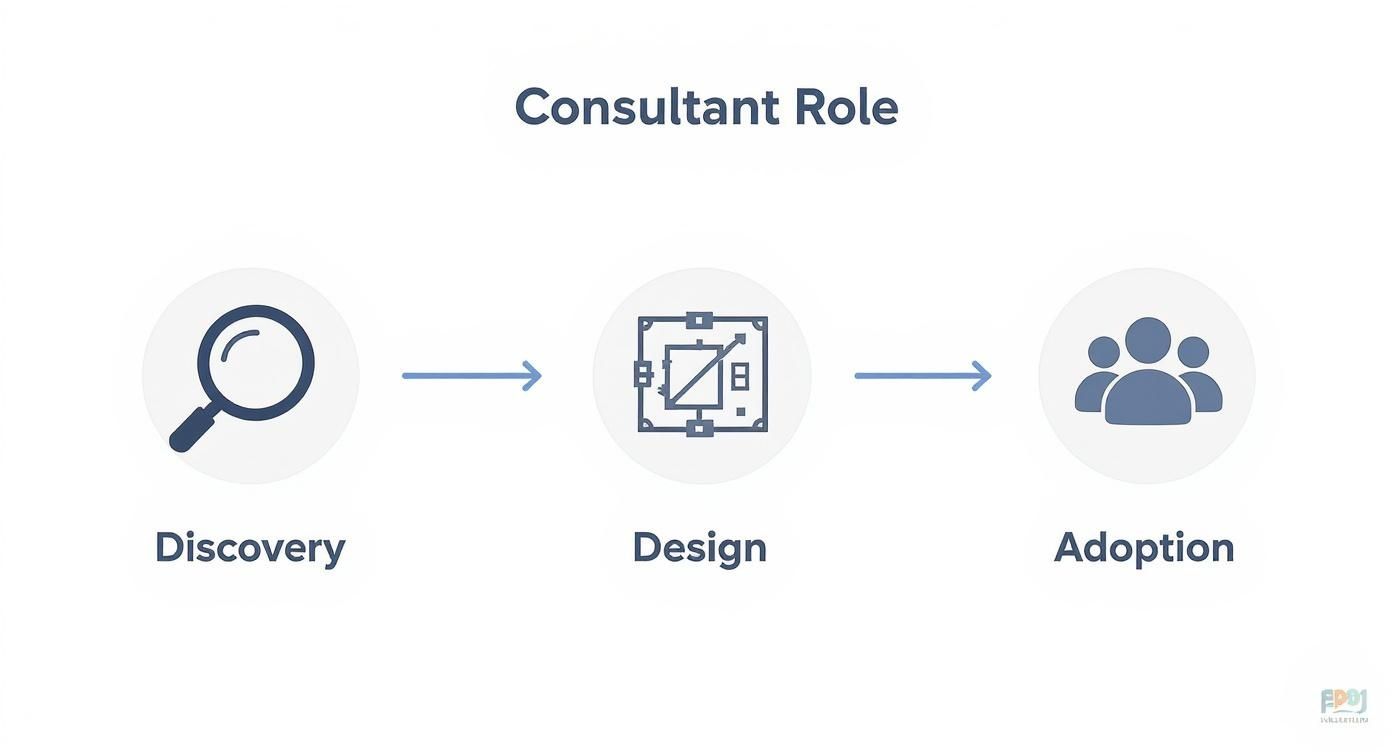
This framework ensures every decision made during the build is directly tied to the challenges uncovered in discovery. It’s the key to driving strong user adoption and achieving your business objectives.
Phase 1: Discovery and Strategy
This initial phase is arguably the most critical. Before a single line of code is written, your consultant must get under the hood of your business. This involves collaborative workshops with key stakeholders from sales, marketing, service, and operations to map current processes and pinpoint friction points.
The primary goal here is to define what success looks like in concrete terms. This means setting clear, measurable objectives. A great goal is specific, such as "reduce average sales cycle duration by 15% within six months" or "improve first-contact resolution by 20%." These metrics become the North Star guiding the entire project.
Phase 2: Design and Build
Armed with deep insights into your needs, the consultant moves to the design phase. They create a detailed blueprint for your Salesforce environment, often called a solution design document. This maps out the technical architecture, specifies the Salesforce products to be used, outlines necessary customisations, and details how data will flow between systems.
Once you approve the design, the build begins. This is where the technical configuration, automation rules, and integrations are developed. An experienced Salesforce partner uses an agile methodology, delivering work in iterative sprints. This allows your team to provide feedback early and often, preventing costly rework and ensuring the final product meets expectations.
Phase 3: Testing and Deployment
Rigorous testing is non-negotiable for a confident launch. Your consultant will lead a comprehensive testing process, which typically includes:
- Unit Testing: Ensuring individual components and features function as designed.
- System Testing: Verifying that all parts of the Salesforce solution work together seamlessly.
- User Acceptance Testing (UAT): This is where your team gets hands-on, testing the system to confirm it solves the business problems identified during discovery.
Following a successful UAT, the consultant manages the deployment—the "go-live." They migrate the new configuration to your live environment, meticulously planning the process to minimise disruption to your daily operations.
Phase 4: Adoption and Optimisation
The project doesn't end at go-live. A top-tier consultant knows the ultimate measure of success is user adoption. They will focus heavily on change management, developing tailored training materials and conducting sessions to ensure every user feels confident and empowered from day one.
In Australia, this structured methodology delivers results. Recent data shows that 82% of organisations reported their projects finished on time and within budget when working with certified consultants. These projects often take between six to nine months for most businesses.
The ultimate goal is not just to deliver technology. It’s to deliver a business solution that empowers your team and drives measurable growth. True success is when the system becomes an indispensable part of your daily operations.
This phased journey brings clarity and control to every step. To prepare for what’s ahead, dive into our comprehensive Salesforce implementation guide for Australian businesses for more practical insights.
Unpacking Salesforce Project Costs and Timelines
Two questions are always top of mind for business leaders: “How much will this cost?” and “How long will it take?”
With a Salesforce implementation, the honest answer is, “It depends.” However, a skilled Salesforce implementation consultant can cut through the ambiguity to help you map out a realistic budget and timeline tailored to your business needs.
There is no one-size-fits-all price. Your total investment is shaped by the unique complexity of your operations and the specific business outcomes you need to achieve. A straightforward Sales Cloud setup for a small team is entirely different from a multi-cloud implementation for a national enterprise that requires complex data migration and multiple system integrations.
What Really Drives Your Budget?
Several key factors directly influence the final cost. Understanding these helps you see where your investment is going. An experienced consultant will break down each element to build a transparent and accurate quote.
The main cost drivers include:
- Project Complexity: Are you implementing a single product like Sales Cloud, or do you need a combination of Sales, Service, and Marketing Cloud? More products require more configuration, training, and integration work.
- Data Migration: The condition of your existing data is a major factor. Migrating clean, organised data is straightforward. Extracting, cleaning, and consolidating data from disparate spreadsheets and legacy platforms is a much larger undertaking.
- Customisation and Automation: The more you need Salesforce to adapt to your unique business processes, the more development is required. This can include custom objects, sophisticated approval workflows, or bespoke reports and dashboards.
- System Integrations: Connecting Salesforce to your other core business systems is often essential for creating a single source of truth. Integrating with accounting software like Xero or MYOB, or an ERP like NetSuite or SAP, adds another layer of technical complexity.
Realistic Timelines and Cost Estimates
For businesses in Australia, the investment can vary significantly. On average, a Salesforce implementation project typically falls between AUD 50,000 and AUD 200,000. This range covers everything from a smaller business getting started to a larger, more complex digital transformation.
Similarly, hourly rates for a senior Salesforce consultant in Australia generally range from AUD 150 to AUD 300, with mid-level experts charging less. You can get more insights into IT service costs on platforms like Clutch.co.
It's crucial to view the initial implementation cost as an investment in your company's future efficiency and scalability. A well-guided project is designed from day one to deliver a strong return by boosting team productivity and driving revenue growth.
When evaluating partners, you will likely encounter two primary pricing models. A fixed-scope project offers a set price for a clearly defined list of deliverables, ideal if your requirements are well-established. An ongoing retainer provides more flexibility, allowing you to prioritise work and adjust scope as business needs evolve.
Ultimately, the goal is to build a financial and project plan that aligns perfectly with your strategic goals, ensuring you understand the value you're receiving for your investment.
Why Industry-Specific Customisation Matters
An out-of-the-box Salesforce setup is like a standard vehicle; it gets you from A to B, but it’s not equipped for specialised tasks. The true power of the platform is unlocked when it’s meticulously customised to the unique DNA of your industry. This is where a Salesforce implementation consultant with deep sector knowledge becomes an invaluable partner.
A generic CRM doesn't speak the language of your business. It fails to understand the niche workflows, compliance requirements, or customer journeys that define your market. Without proper customisation, your team is forced to adapt its processes to the software, leading to inefficient workarounds, poor user adoption, and a low return on investment.
True success comes from moulding Salesforce to your world. It's about transforming a powerful platform into an intuitive tool that automates core operations and delivers insights relevant to your market.

From Generic CRM to a Competitive Advantage
Industry specialisation is a fundamental requirement for achieving standout results. A consultant who understands your sector's challenges can build a solution that delivers immediate, tangible value. They already know the common pitfalls, regulatory hurdles, and unique customer pathways.
This expertise allows them to configure Salesforce in ways a generalist cannot. They can build custom objects, automated workflows, and reporting dashboards that reflect the day-to-day realities of your operations, making the system feel like a natural extension of your team's work.
When your CRM is tailored to your industry, it transforms from a data management tool into a strategic asset that actively drives your business forward. It provides a genuine competitive edge by enabling you to operate more efficiently and serve customers more effectively.
This level of customisation is what separates a merely functional CRM from one that truly fuels growth.
Real-World Example: Financial Services
The Challenge: In the heavily regulated financial services sector, compliance is paramount. We worked with a wealth management firm struggling with manual, error-prone compliance checks and fragmented client communication. Their generic CRM couldn't handle the intricate workflows for Know Your Customer (KYC) and Anti-Money Laundering (AML) regulations.
The Salesforce Solution: We implemented a deep customisation of Salesforce Financial Services Cloud. We built:
- Automated Compliance Workflows: Step-by-step approval processes with automated checks and alerts to ensure every client interaction met strict regulatory standards.
- Secure Client Portals: Using Experience Cloud, we developed a secure portal for clients to upload documents, track portfolios, and communicate with advisors.
- Unified Client Views: We created a 360-degree view of each client, consolidating their financial goals, risk tolerance, and communication history.
The Results: The firm achieved a 40% reduction in time spent on manual compliance tasks and a significant improvement in client data security and satisfaction.
Real-World Example: Real Estate
The Challenge: The property lifecycle is notoriously complex. We partnered with a real estate agency drowning in a chaotic mix of spreadsheets and basic contact managers to track listings, buyers, and vendors.
The Salesforce Solution: By customising Sales Cloud and Experience Cloud, we completely reorganised their operations. We developed custom objects for Properties, Listings, and Contracts that mirrored their real-world processes, allowing agents to manage the entire property lifecycle from a single dashboard. For a detailed look at this kind of project, see our guide on why Salesforce is the backbone of modern real estate agencies.
This industry-specific approach is what makes a Salesforce implementation consultant a true strategic partner, turning your CRM into a purpose-built engine for your business.
How to Identify a Top-Tier Salesforce Consultant
Choosing the right Salesforce partner is the single most critical decision you will make. This choice directly impacts your project's success and your long-term return on investment. So, how do you distinguish a truly great consultant from a merely adequate one?
It comes down to evaluating two critical areas: proven technical expertise and essential soft skills. A top-tier consultant possesses a rare blend of both, acting not just as a technical architect but as a strategic business advisor.
Assessing Technical Expertise
Technical proficiency is the foundation. Any consultant you consider must have a deep, hands-on understanding of the Salesforce platform. Certifications are more than just badges; they represent specialised, validated knowledge.
Look for a combination of certifications and practical experience relevant to your project. A Sales Cloud Consultant certification is vital for a sales process overhaul, while a Platform Developer I certification is non-negotiable for complex customisations.
When vetting a potential partner, ask specific questions about their technical background:
- Relevant Certifications: Do their certifications align with your project's needs (e.g., Sales Cloud, Service Cloud, Experience Cloud)?
- Integration Experience: Have they successfully connected Salesforce with systems you use, like Xero, MYOB, or NetSuite?
- Industry-Specific Projects: Can they provide case studies of similar work they've completed in your industry?
A great consultant doesn't just know the technology; they know how to apply it to solve real-world business problems. Their technical expertise is a tool to achieve your strategic goals.
Evaluating Essential Soft Skills
This is what truly separates an elite consultant from the rest. A brilliant technical solution is destined to fail if the consultant cannot communicate its value, manage the project effectively, or guide your team through the change.
These soft skills are non-negotiable:
- Strategic Communication: The ability to translate complex technical concepts into clear business language for stakeholders and patiently explain new workflows to end-users.
- Change Management: A proactive approach to user adoption from day one, understanding the human side of a technology project and having a clear plan to get your team on board.
- Business Acumen: Genuine curiosity about your business. A great consultant asks insightful questions to understand your unique challenges and goals before proposing a solution.
Ultimately, you are looking for a strategic partner, not just a contractor. You need someone who can challenge your assumptions, offer insightful advice, and take ownership of your success. To see this in practice, get acquainted with the experts on our Salesforce consulting team and see the blend of skills we bring to every project.
Maximising Your ROI Through a Strategic Partnership
Completing your Salesforce implementation isn’t the finish line; it’s the starting point for long-term growth. The true value of working with a Salesforce implementation consultant extends beyond the go-live date. It's about forging a strategic partnership that ensures your investment continues to deliver business outcomes for years to come.
This ongoing relationship is where your return on investment (ROI) is truly realised. By focusing on continuous improvement and strong user adoption, you transform Salesforce from a static tool into a dynamic engine for business growth.
From Project Delivery to Long-Term Value
A top-tier consultant doesn't just hand over the keys and disappear. They transition into a long-term partner dedicated to helping you extract maximum value from your system. This partnership is built on ongoing support, strategic guidance, and proactive optimisation.
The data in Australia supports this approach. The demand for Salesforce experts has surged, with the number of certified professionals projected to grow by over 40% between 2020 and 2025. Furthermore, 85% of Australian companies reported improved customer service and sales efficiency after implementation, and 70% cited a smoother process when working with a certified consultant. Discover more insights from Salesforce's Australian market research.
Think of your Salesforce platform as a living asset. A strategic partner helps you nurture that asset, ensuring it evolves with your business and consistently drives efficiency, productivity, and customer satisfaction.
This partnership is what converts an initial investment into lasting operational improvements and a stronger bottom line.
Core Pillars of a Strategic Partnership
A successful long-term partnership focuses on several key areas to maximise your ROI:
- Continuous Improvement: Business never stands still, and neither should your Salesforce instance. A proactive partner constantly seeks ways to refine workflows, implement new features, and enhance automation.
- Driving User Adoption: The most powerful system is useless if it's not used correctly. Ongoing training, robust support, and listening to user feedback are essential for making Salesforce an indispensable tool for your team.
- Data-Driven Insights: Your consultant helps translate raw data into actionable intelligence by fine-tuning dashboards and reports, providing the clarity needed for smarter, faster business decisions.
Ultimately, a successful Salesforce implementation is about improving customer relationships and fuelling growth, which hinges on adopting proven customer retention strategies.
Your Partner in Sustainable Success
Choosing a Salesforce implementation consultant is about finding a partner who is as invested in your long-term success as you are. It’s a commitment to continuous growth, ensuring your platform not only solves today’s problems but is also prepared for tomorrow's challenges.
At Adaptal, we don’t just build solutions; we build relationships. We are committed to being your long-term Salesforce partner, helping you achieve sustainable success and maximise the value of your investment every step of the way.
FAQs About Working with a Salesforce Implementation Consultant
It's natural for business leaders to have questions before committing to a significant digital transformation project. Getting clear answers helps build confidence and ensures you make an informed decision. Here are some of the most common questions we hear.
What is the difference between a Salesforce Admin and a Consultant?
This is a critical distinction. Think of it as the difference between a building manager and the architect who designed the building.
A Salesforce Administrator is typically an in-house employee responsible for the day-to-day management of your existing Salesforce system. They handle tasks like adding new users, building reports, and making minor adjustments to keep things running smoothly.
A Salesforce Implementation Consultant, on the other hand, is an external expert engaged for a specific, strategic project. They focus on the big picture: designing and building a new Salesforce solution from the ground up, leading a major system overhaul, or handling complex integrations. Consultants bring a breadth of experience from various industries and projects that an internal admin typically does not have.
Can’t we just handle a Salesforce implementation ourselves?
While it may seem like a cost-saving measure, a DIY implementation is rarely advisable. Even seemingly simple projects can quickly become complex, leading to foundational mistakes that are expensive and disruptive to fix later.
An experienced Salesforce consultant helps you avoid common pitfalls from the start. They ensure your system's architecture is built to scale, manage the complexities of data migration (a common failure point for DIY projects), and implement a proven strategy for driving user adoption. Getting these elements right is crucial for achieving a positive, long-term return on your investment.
What happens after the implementation is finished?
A top-tier consulting partnership doesn’t end at go-live. A quality consultant views the initial implementation as the foundation for a long-term relationship. The goal is to ensure you continue to derive increasing value from your Salesforce investment as your business evolves.
After the project, a good partner will offer ongoing support and optimisation services, which can include:
- Managed Services: Acting as your on-call support team to monitor system health and manage Salesforce's three annual feature releases.
- Further Enhancements: Building out new functionality or custom automations as your business processes change.
- Strategic Guidance: Serving as a trusted advisor to help you map your technology roadmap and leverage new Salesforce innovations for a competitive advantage.
The aim is to become a true extension of your team, providing the strategic expertise you need to ensure your platform remains a powerful engine for growth.
Ready to transform your business with a Salesforce solution designed for growth? The team at Adaptal has successfully delivered over 110 implementations across Australia, helping businesses in real estate, professional services, and more. Let's discuss how we can build a strategic partnership to maximise your Salesforce ROI.