

Disconnected digital marketing & technology stacks are a common challenge we see businesses face. Marketing runs campaigns in one system, sales manages leads in another, and service handles tickets in a third. This separation creates a disjointed customer experience and prevents teams from seeing the full picture. The real magic happens when technology builds an intelligent, 360-degree view of every customer interaction. This is what fuels smarter decisions and, as our clients have discovered, creates lasting relationships.
The Business Case for Unifying Marketing and Technology
From the customer's perspective, they don’t see separate departments; they see one brand. When your teams work from different systems—a marketing platform here, a CRM there, and an ERP in the corner—the experience becomes choppy and inconsistent. This is more than an internal headache; it's a direct inhibitor of growth. It leads to lost opportunities, frustrated teams piecing together data, and a brand message that feels fragmented to the very people you're trying to win over.
Unifying your digital marketing & technology with a platform like Salesforce solves this. Instead of scattered data, you create a single source of truth for every customer interaction. Salesforce becomes the central nervous system for your business, connecting the journey from their first ad click to their most recent support ticket.
Based on our project experience, a unified platform delivers clear business benefits:
- Complete Customer Visibility: We help clients see the entire customer journey, understanding precisely how marketing efforts translate into sales and long-term customer loyalty.
- Data-Driven Personalisation: By linking marketing actions to real-time sales and service data, we enable our clients to deliver messages that are genuinely relevant to what each customer needs.
- Improved Team Collaboration: When sales, marketing, and service teams work from the same playbook in Salesforce, it guarantees a consistent, high-quality customer experience.
- Measurable Marketing ROI: A key outcome of our projects is the ability to draw a straight line from marketing spend to revenue, proving campaign value with hard data.
Lesson Learned: The real power of a unified strategy is that it turns technology from a collection of tools into a strategic asset. It allows you to build a business that’s not just more efficient, but one that is fundamentally built around the customer—the ultimate competitive edge.
To help visualise how these pieces fit together, this table breaks down the core pillars of an integrated strategy we implement for clients.
Key Pillars of a Salesforce-Powered Strategy
| Pillar | Business Challenge Addressed | Key Salesforce Solution |
|---|---|---|
| Single Customer View | Fragmented data across departments leads to inconsistent customer experiences. | Salesforce Customer 360 |
| Automated Journeys | Manual, repetitive marketing tasks drain resources and slow down engagement. | Marketing Cloud Account Engagement |
| Sales & Marketing Alignment | Disconnect between teams results in lost leads and missed revenue opportunities. | Sales Cloud & Marketing Cloud Integration |
| Data-Driven Insights | Inability to measure campaign effectiveness and prove marketing ROI. | Tableau Analytics |
Ultimately, this unified approach allows technology to drive meaningful business outcomes rather than just performing isolated tasks.
Achieving this cohesion is a cornerstone of any successful digital transformation. As a trusted Salesforce partner, we’ve seen firsthand how a well-integrated system breaks down silos and becomes the engine for real growth. To get a deeper look at how this happens, exploring the role of Salesforce development consultants in digital transformation offers practical insights into making this a reality for your organisation.
How Salesforce Creates a Cohesive Customer Journey
A successful digital marketing and technology strategy does more than just fill the pipeline; it orchestrates a seamless customer journey. Without a central hub like Salesforce, this journey shatters, leaving marketing, sales, and service teams in their own data silos. Salesforce acts as the conductor, ensuring every touchpoint works in harmony.
Let’s walk through a real-world project example.
The Business Challenge: A professional services firm struggled to connect their marketing efforts to actual sales outcomes. Leads were generated from various channels but were passed to sales with little context, resulting in inefficient follow-ups and a high drop-off rate.
The Salesforce Solution: We implemented a connected journey using Salesforce Marketing Cloud and Sales Cloud. The journey now begins with a highly targeted LinkedIn ad, powered by pinpoint audience segmentation. This ad directs prospects to a valuable whitepaper. Upon download, they are automatically enrolled in a personalised nurture stream within Account Engagement (formerly Pardot). Every subsequent email is relevant and timed perfectly because their engagement is tracked in real-time. This is no longer email blasting; it's a guided, intelligent conversation.
From Nurtured Lead to Valued Client
As a prospect shows more interest—visiting the pricing page or reading case studies—their lead score in Account Engagement automatically increases. Once they reach a predefined threshold, they are seamlessly passed to the sales team as a marketing-qualified lead (MQL) directly within Sales Cloud.
The Results and Benefits: The sales rep instantly sees a complete history of every interaction, from the initial ad click to every email opened. This context eliminates generic sales calls and allows for a meaningful conversation. The sales process feels smoother and more human, dramatically improving the conversion rate from warm lead to new client.
Unifying Data for a Cohesive Experience
The journey doesn't end when the deal is closed. The client’s information is already in Salesforce, ready for the service team. If a support ticket is raised via Service Cloud, it’s logged against that same customer profile. This gives every team a genuine 360-degree view, ensuring support is always consistent and informed.
This infographic clearly illustrates how our Salesforce implementations transform scattered business data into a single, actionable customer story.
The core benefit of this approach is turning chaotic, siloed information into a clear narrative that helps you create better customer experiences. By bringing every interaction under one roof, you get every department working from the same script.
Best Practice Tip: This connected ecosystem transforms the customer experience from disjointed transactions into a continuous relationship. Each stage of the journey informs the next, building trust and loyalty.
Platforms like Marketing Cloud and Account Engagement are the engines that make this possible. To get these tools delivering maximum value, it's essential to master lead nurturing and scoring. For any business looking to get this right, diving into Account Engagement best practice is a fantastic place to start building sophisticated and effective customer journeys.
Integrating Marketing Automation With Core Business Systems
A powerful customer journey isn't enough if your marketing platform operates in isolation. True success comes from connecting marketing automation with core business systems like Enterprise Resource Planning (ERP) and finance software. Without this link, critical data remains siloed, creating friction that slows growth.
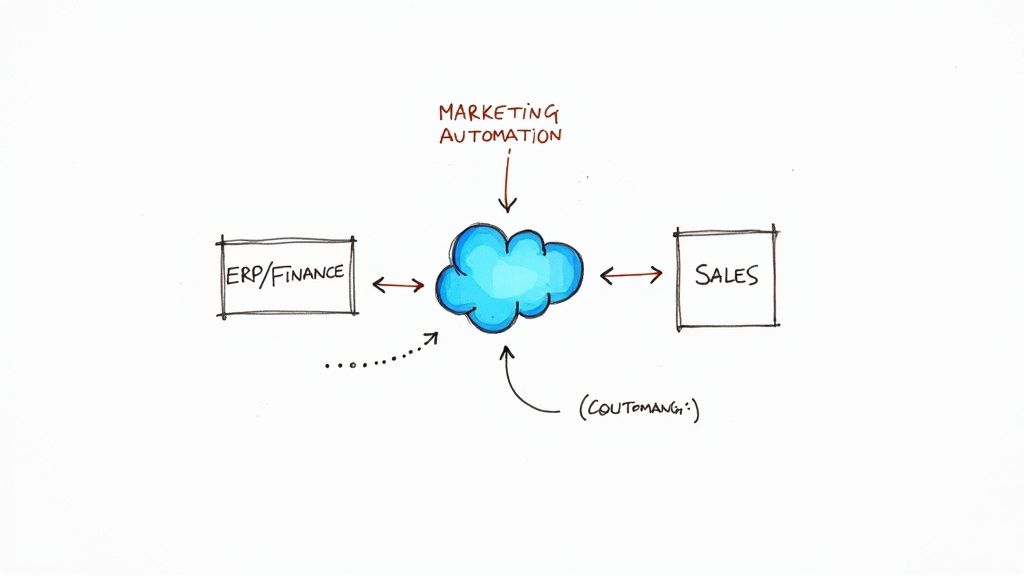
The Business Challenge: We often see clients where marketing generates a qualified lead, but the sales rep has no visibility into the customer’s payment history or order value because that data lives in the finance system. They are flying blind, unable to have a fully informed conversation, which can delay or derail a potential sale.
The Salesforce Solution: As a Salesforce partner, we build the essential bridges between your systems. By integrating platforms like Marketing Cloud with your ERP or accounting software, we create a genuine 360-degree view of the customer. The benefits are immediate:
- Automated Data Sync: This connection drastically reduces the risk of human error and keeps data consistent across the business.
- Enriched Customer Profiles: Sales and service teams get financial context—like credit status or purchase history—directly within the Salesforce interface they use daily.
- Smarter Marketing Triggers: You can trigger campaigns based on what customers do. For example, a large purchase can instantly trigger a thank-you message and a targeted follow-up offer.
This level of integration is a core part of a modern digital strategy. The Australian digital marketing market is expected to rocket to nearly USD 25.39 billion by 2034, propelled by technologies like AI that thrive on unified data. To leverage this trend, it's crucial to understand What Is Marketing Automation and how it can be the engine for your processes.
Lesson Learned: By connecting these dots, marketing stops being an isolated function focused on lead generation. It becomes a direct and measurable revenue driver, deeply intertwined with the financial health and operational efficiency of the entire organisation.
The Power of Transactional Data in Marketing
When your marketing automation platform can "see" real-time transactional data, it unlocks a new level of personalisation. An integration lets you build campaigns around actual customer behaviour, not just clicks and opens.
Consider these practical examples we've implemented for clients:
- Abandoned Cart Recovery: A known customer in your ERP abandons their online shopping cart. Marketing Cloud instantly triggers a personalised email journey to nudge them to complete the purchase.
- Upsell and Cross-Sell Opportunities: After a customer buys a specific product, the system automatically suggests complementary items, boosting their lifetime value.
- Customer Retention Campaigns: A client's subscription is nearing its renewal date in your finance system. You can trigger a proactive retention campaign to ensure they stay.
This strategic alignment transforms how your business operates. For a deeper dive into the practical steps involved, our comprehensive Salesforce implementation guide for Australia provides a clear roadmap for connecting your systems effectively. Getting this integration right is the foundation for building a smarter, more responsive business.
Measuring the KPIs That Truly Matter
A powerful, integrated system is only as good as the results it delivers. It’s easy to get lost in surface-level metrics like clicks and social media likes, but an effective **digital marketing & technology** strategy ties every action directly to business outcomes. Moving beyond these ‘vanity metrics’ is how you prove the real-world impact of your investment.
This means focusing on Key Performance Indicators (KPIs) that tell a clear story about revenue and growth. When your marketing, sales, and service data all live in one place like Salesforce, tracking these meaningful numbers is no longer a complex, manual chore. You get instant clarity on what’s working.
From Marketing Spend to Revenue Gained
The ultimate goal is to draw a straight line from your marketing activities to your bottom line. With Salesforce as your central hub, you can build dashboards that give stakeholders real-time visibility into the metrics they care about. This data-driven approach removes the guesswork and allows for smarter decisions.
Here are the key metrics we help our clients focus on:
- Customer Acquisition Cost (CAC): This tells you exactly how much you’re spending to bring each new customer on board, enabling you to optimise campaign budgets for maximum efficiency.
- Customer Lifetime Value (CLV): By understanding the total revenue a customer generates, you can pinpoint your most valuable segments and double down on retention efforts.
- MQL-to-SQL Conversion Rate: This KPI is a fantastic health check for your lead quality. It shows the percentage of marketing-qualified leads (MQLs) that sales accepts as sales-qualified leads (SQLs), ensuring marketing and sales are perfectly aligned.
- Marketing-Influenced Revenue: This is the gold standard. It demonstrates the total revenue that marketing touchpoints helped generate, directly proving the ROI of your activities.
Best Practice Tip: Tracking these KPIs isn't just about reporting—it’s about creating a culture of accountability and continuous improvement. When everyone from the marketing coordinator to the CEO can see the direct financial impact of their work, it aligns the entire organisation around growth.
Visualising Success with Salesforce Dashboards
Imagine a live dashboard that pulls all this information together in one place. With Salesforce, that's a standard feature. You can create custom, easy-to-read visualisations that show which lead sources are driving the most revenue or track campaign performance against sales targets in real time.
For instance, a construction company can finally see which digital campaigns are generating the most high-value project bids. A professional services firm can monitor the CLV of clients from different industries, providing the intelligence needed to refine their future marketing focus. This level of insight transforms your digital marketing & technology stack from a cost centre into a predictable revenue engine.
Real-World Salesforce Use Cases in Australian Industries
Theory is valuable, but the real impact becomes clear when you see how a unified digital marketing & technology system solves specific business problems. For Australian businesses, Salesforce isn't a generic tool; it's a specialised asset, particularly when customised by a partner who understands your industry's unique challenges. The goal is to move from simply managing contacts to actively driving growth.

This shift couldn't be more timely. Investment in digital platforms is soaring. Australia's online advertising market is set to hit around AUD 17.2 billion for the 2025 fiscal year, a massive 10.6% jump from the previous year. It’s clear that businesses are betting big on multi-channel digital strategies, as backed by recent reports where you can discover more insights about online advertising growth.
Franchises: Maintaining Brand and Empowering Locals
- The Business Challenge: A national retail franchise was dealing with marketing chaos. Individual franchisees used their own tools and inconsistent messaging, diluting the brand and making it impossible to measure national campaign effectiveness.
- The Salesforce Solution: We implemented Salesforce Marketing Cloud as a central command centre. The national marketing team creates pre-approved, on-brand campaign templates—from email newsletters to social media posts.
- The Results and Benefits: Franchisees can now log in, select a campaign, and add local details before sending. This empowers local operators to act quickly while ensuring every customer communication is polished and consistent. The outcome was a significant improvement in brand cohesion and trackable campaign performance.
Construction: Managing Complex and Lengthy Sales Cycles
- The Business Challenge: A commercial construction firm was losing track of tender opportunities. The sales team wrestled with spreadsheets, leading to missed follow-ups and zero visibility into which bids were most likely to convert.
- The Salesforce Solution: We customised Sales Cloud to create a visual pipeline mirroring their exact bidding process. We added automated reminders for critical tender deadlines and built dashboards to track project progress and forecast profitability.
- The Results and Benefits: The sales team gained a clear, unified view of their entire pipeline. They boosted their tender win rate by 15% simply by being able to focus on the most promising opportunities and improve their follow-up discipline.
For construction firms, a standard CRM often falls short. It’s not just about managing leads; it's about managing a web of relationships with architects, suppliers, and contractors over the entire project lifecycle.
Healthcare: Nurturing Patient Relationships Securely
- The Business Challenge: A multi-clinic allied health practice wanted to improve patient engagement while adhering to strict privacy regulations. They were battling high rates of missed appointments and inconsistent communication.
- The Salesforce Solution: We implemented Salesforce Health Cloud, a platform designed for secure patient data. We configured automated SMS and email journeys for appointment confirmations and reminders, plus secure follow-up surveys.
- The Results and Benefits: The practice reduced its "did not attend" rate by over 20%, immediately improving clinic efficiency and revenue. Patients reported feeling more informed and cared for, enhancing the overall experience.
These stories are just a snapshot of what’s possible when deep industry knowledge meets powerful technology. To see how we’ve helped other Australian businesses solve their own unique challenges, explore our portfolio of Salesforce case studies.
Your Salesforce Implementation Roadmap
Getting started with an integrated approach to your marketing and technology isn't about flipping a switch overnight. The path to sustainable growth involves deliberate, strategic steps, starting with aligning your systems with your business goals.
Here’s a practical roadmap we use with our clients:
- Audit Your Current Systems: First, we conduct a thorough audit of your current marketing, sales, and operational systems. The goal is to identify data silos and workflow inefficiencies.
- Identify Quick Wins: We pinpoint the most critical integration points where connecting two systems—like your CRM and ERP—will deliver the biggest and most immediate return on investment.
- Run a Pilot Project: We recommend starting small with a high-impact pilot project to test the unified strategy. This proves the ROI before you commit to a full-scale rollout.
Lesson Learned: Navigating this process alone can be complex. The most successful digital transformations are guided by an experienced partner, helping you avoid common pitfalls and achieve your goals faster.
This is where working with an experienced Salesforce partner becomes a game-changer. As a certified Salesforce partner, our specialty is building the bridges between your systems to create a single source of truth that drives tangible business results.
If you’re ready to solve your integration challenges and unify your teams, let’s talk. Connect with our experts for a consultation, and we can build your roadmap together.
Salesforce Integration FAQ
Here are straightforward answers to common questions we hear from Australian businesses considering integrating their systems with Salesforce.
What is the primary business benefit of a Salesforce integration?
The biggest advantage is creating a single source of truth for all your customer data. Instead of information being siloed in different marketing, sales, and service platforms, an integration brings it all together. This provides every team member with a complete, 360-degree view of the customer, resulting in more consistent communication and personalised experiences that build loyalty.
Can Salesforce integrate with our social media marketing?
Absolutely. Integrating social media channels into Salesforce is a game-changer for achieving a full customer picture. With around 20.9 million social media users in Australia (77.9% of the population), this data is too valuable to ignore. This integration allows you to track interactions, manage leads from social ads, and run targeted campaigns where your audience is already spending their time. You can dive deeper into the latest Australian digital trends on DataReportal.
Best Practice Tip: This integration turns social media from a simple broadcast channel into a smart, two-way tool for lead generation and customer service, with all data flowing directly into your CRM.
How long does a typical Salesforce integration project take?
The timeline for a Salesforce integration depends on the project's complexity. A simple connection between Salesforce and another application might take a few weeks. However, a larger project, like linking Salesforce to a custom-built ERP system, could take several months. A good Salesforce partner will always begin with a discovery phase to map out the requirements and provide a realistic timeline you can plan around.
At Adaptal, we specialise in creating seamless integrations that unify your business. If you're ready to bring your digital marketing & technology together, get in touch for a tailored consultation.