
Managing a mobile workforce across Australia presents unique hurdles. We're talking vast distances, patchy connectivity, and the sheer logistical puzzle of getting the right technician to the right place at the right time. Traditional methods—manual dispatching, paper work orders, and endless phone calls—can't keep pace. This is precisely where modern field service management (FSM) software becomes a business-critical tool, acting as the central nervous system for your entire field operation.
Conquering Australia's Vast Service Landscape with Salesforce
Running a mobile team in Australia isn't just about scheduling jobs; it's a constant battle against geography. The scale of our country means technicians spend a significant part of their day on the road, often through areas where mobile reception is a distant memory. This logistical challenge makes real-time communication and efficient planning incredibly difficult.
Without an integrated system, businesses face a cascade of problems. Miscommunication between the office and the field is common. Paperwork gets lost or filled out incorrectly. This isn't just a waste of time and fuel; it directly impacts your bottom line and, crucially, damages customer relationships. Nothing erodes trust faster than a delayed technician or a second visit because a part was forgotten.
The Business Challenge: Moving Beyond Manual Methods
The primary challenge for many Australian businesses is breaking free from reactive, manual processes. Think of a busy restaurant kitchen during the dinner rush. Without a central ordering system, it's chaos. Orders get missed, and customers are left frustrated. FSM software, especially when built on a powerful CRM platform like Salesforce, is that central system for your field team.
It creates a single source of truth, connecting every moving part of your service delivery. This digital transformation allows you to:
- Optimise Technician Routes: Intelligently map the most efficient travel paths, slashing fuel costs and wasted drive time.
- Improve Communication: Equip technicians with all job details, customer history, and necessary manuals on their mobile device—even when they're offline.
- Enhance First-Time Fix Rates: Ensure the right person, with the right skills and the right parts, is sent to every job, preventing costly and frustrating return visits.
The Salesforce Solution: Field Service Advantage
For businesses already using Salesforce as their CRM, implementing Salesforce Field Service is a natural and incredibly powerful move. It seamlessly integrates your service operations with your sales and customer data, providing a complete, 360-degree view of every customer interaction.
This unified approach means a technician arrives on-site not just as a repair person, but as an informed representative of your brand, equipped with the history and context needed to deliver exceptional service.
As a dedicated Salesforce partner, we've guided numerous Australian organisations through this digital transformation. By connecting their CRM and field operations, they turn logistical headaches into a genuine competitive advantage. This guide will walk you through how implementing the right field service management software in Australia can deliver similar results for your business.
What's Under the Hood? Core Features of Salesforce Field Service
At its core, field service management software is the ultimate toolkit for your mobile workforce. It's much more than a digital calendar; it's an intelligent system built to sharpen every part of your field operations, from the first customer call to the final invoice. For Australian businesses, this means finally mastering the huge distances and logistical puzzles inherent in our service landscape.
This infographic breaks down how a platform like Salesforce Field Service connects your office, technicians, customers, and overall business operations.
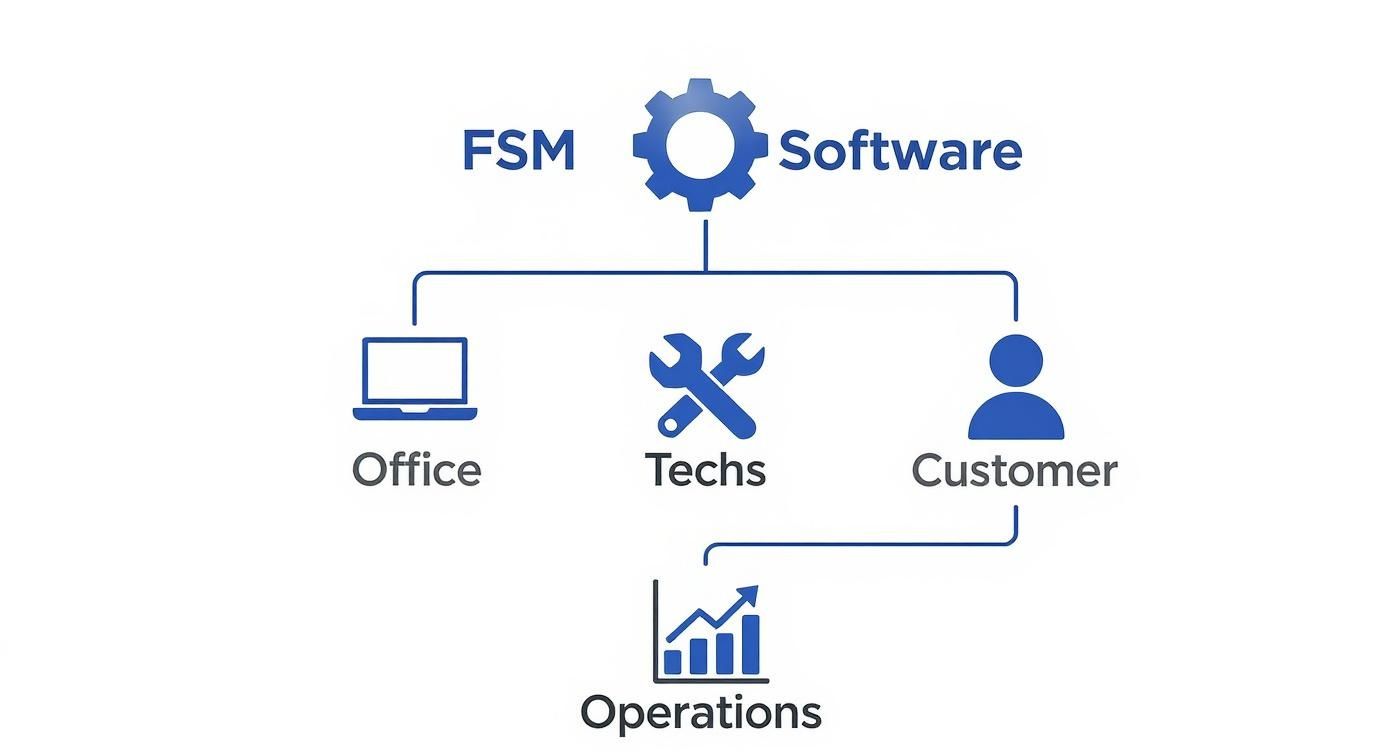
As you can see, a robust FSM platform becomes the central hub, ensuring information flows smoothly between every part of the business. This integration is what drives success on the ground. Let's dig into the core features that make it all happen.
The table below gives a quick snapshot of the essential features and the real-world value they bring to Australian organisations.
Essential FSM Software Features and Their Business Impact
| Core Feature | Description | Primary Business Benefit |
|---|---|---|
| Intelligent Scheduling & Dispatch | Automatically assigns the best technician to a job based on skills, location, and availability. | Slashes travel time and fuel costs while maximising the number of jobs completed each day. |
| Mobile Workforce Enablement | Provides technicians with a powerful mobile app to access job details, update work orders, and capture data. | Boosts first-time fix rates by giving techs the information they need on-site, even when offline. |
| Work Order Management | Digitises the entire job lifecycle, from creation and dispatch to completion and invoicing. | Speeds up the cash flow cycle by automating invoicing as soon as a job is signed off. |
| Asset Management | Maintains a detailed service history and technical data for every piece of equipment your team services. | Enables proactive maintenance, improves diagnostic accuracy, and ensures compliance with service agreements. |
| Remote Assistance | Allows technicians to share a live video feed with remote experts for real-time guidance on complex jobs. | Cuts down on costly second visits and leverages senior expertise across the entire team. |
Each of these features plays a crucial role in building a more efficient, profitable, and customer-focused field service operation.
Intelligent Scheduling and Dispatch
Think of intelligent scheduling as the air traffic control for your entire field team. Manual dispatching often leads to inefficient routes and sending the wrong person for the job. Modern FSM platforms like Salesforce Field Service eliminate that guesswork.
The system analyses multiple factors in real-time to find the perfect match for every job, including:
- Technician Skills: Ensuring a certified electrician is assigned to a complex wiring job, not a general maintenance tech.
- Location and Route Optimisation: Finding the smartest route across sprawling suburbs or regional areas to cut fuel costs and fit more jobs into each day.
- Availability: Automatically checking shifts, leave, and current job status to prevent double-bookings.
- Urgency: Prioritising emergency call-outs based on service-level agreements (SLAs) to ensure you always meet your targets.
This level of automation frees your dispatchers from a complex manual puzzle, allowing them to focus on managing exceptions and delivering a better customer experience.
Mobile Workforce Enablement
A powerful mobile app effectively puts the office in every technician's pocket. This is essential in Australia, where technicians often work in areas with patchy or non-existent mobile reception. A quality FSM mobile app, like the one from Salesforce, works offline, allowing staff to access job details, update work orders, and capture customer signatures without a connection.
Once they're back online, the app automatically syncs all data back to the central Salesforce platform, ensuring everyone is working with the latest information. Technicians gain on-site access to everything they need: customer history, asset details, technical manuals, and safety checklists.
When you equip your team with the right information at the right time, you’re empowering them to solve problems faster, achieve a first-time fix, and act as true experts representing your brand.
Salesforce takes this further by integrating advanced tools like Visual Remote Assistant. For a particularly tricky issue, a technician can use their device's camera to share a live video feed with a senior expert back at base. This real-time guidance can prevent a costly second visit.
Work Order and Asset Management
Going digital with the entire job lifecycle is what FSM software is all about. Work order management transforms the clunky, paper-based process into a smooth, digital workflow within Salesforce.
Every step is tracked, from creation to completion:
- A work order is created, either automatically from a customer case in Service Cloud or manually.
- The job is scheduled and dispatched to the best-suited technician.
- The tech completes the work, logs parts used, takes photos, and gets a digital signature.
- The completed work order automatically triggers an invoice, dramatically speeding up the billing cycle.
Tied closely to this is asset management. For businesses servicing specific equipment—like HVAC units, industrial machinery, or medical devices—the software maintains a detailed history of every single asset within your CRM. Your technicians can instantly pull up an asset's service history, warranty info, and past issues, leading to more accurate diagnostics and proactive maintenance.
How Salesforce FSM Drives Growth in Australian Industries
Across Australia, field service management software has evolved from an operational tool into a core driver of growth, helping businesses tackle unique industry challenges. For many, it's the key to turning logistical headaches into a competitive advantage while adhering to our demanding local safety standards.
The momentum is undeniable. Australia’s field service management (FSM) software market is expanding rapidly, driven by huge demand from sectors like renewable energy, telco, and construction. In these industries, a platform like Salesforce Field Service is no longer a nice-to-have; it's essential for managing mobile teams, eliminating paperwork, and excelling in strict audits.

Case Study Snapshot: Renewable Energy and Utilities
Australia's renewables sector often operates across vast, remote landscapes. Managing wind farms in rural NSW or solar installations in the WA outback presents immense logistical and safety challenges.
- The Challenge: Scheduling proactive maintenance and ensuring safety compliance for remote assets was a manual, time-consuming process prone to error.
- The Salesforce Solution: Salesforce FSM automates maintenance schedules based on asset data. Technicians arrive on-site with a complete asset history on their mobile device. Digital safety checklists must be completed before starting work, creating a clear, auditable trail for compliance.
- The Result: Reduced equipment downtime, improved safety compliance, and significant cost savings from optimised travel routes between isolated sites.
Case Study Snapshot: Telecommunications and IT Services
In the fast-paced telco industry, meeting service-level agreements (SLAs) is paramount. Whether it's a new NBN installation or an urgent network outage, speed and efficiency are non-negotiable.
- The Challenge: A slow, manual dispatch process was causing SLA breaches and damaging customer satisfaction. The wrong technicians were often sent to complex jobs.
- The Salesforce Solution: FSM automates dispatch based on technician skills (e.g., fibre optic splicing) and real-time location. This ensures the right expert gets on-site quickly.
- The Result: A dramatic improvement in first-time fix rates, consistent achievement of SLAs, and a stronger brand reputation for reliability.
For a telco provider, a missed appointment isn’t just an inconvenience. It can be a breach of contract with financial penalties. FSM provides the backbone needed to deliver on service promises.
Case Study Snapshot: Construction and Engineering
Construction sites are a whirlwind of activity with subcontractors, heavy machinery, and countless moving parts. A single delay can cause a domino effect, pushing back timelines and budgets.
- The Challenge: Coordinating subcontractors and scheduling equipment maintenance was done on spreadsheets, leading to breakdowns and project delays.
- The Salesforce Solution: FSM provides project managers with real-time visibility into subcontractor progress and resource allocation. Proactive maintenance for heavy machinery is scheduled automatically, preventing costly on-site failures.
- The Result: Projects are kept on schedule and on budget through precise coordination and maximised asset uptime.
By integrating Salesforce FSM into their operations, these industries aren't just becoming more efficient; they are fundamentally transforming how they do business. This strategic approach is what separates market leaders from the rest.
Connecting Service and Sales with Salesforce
Many field service management tools operate in a silo, disconnected from the rest of the business. This creates a massive gap: your field team—the people who are the face of your company—arrive at a customer's door with only half the story.
This is the exact problem Salesforce Field Service was built to solve. It doesn't just manage your field operations; it weaves them directly into your CRM. This creates a single, powerful view of the entire customer journey, connecting every touchpoint from the first sales call to the final service sign-off.

A 360-Degree Customer View in the Field
Imagine a technician arrives on-site for a repair. With a standard FSM tool, they know the address and the issue. With Salesforce Field Service, they pull out their tablet and see the customer's entire history.
This 360-degree view gives them instant access to crucial context from your CRM:
- Purchase History: What equipment do they own? Are there any related products?
- Previous Service Calls: What problems have they had in the past? How were they resolved?
- Active Support Cases: Is there an open complaint or issue the technician should be aware of before walking in?
- Sales Communications: What has the sales team been discussing with them? Upgrades? New services?
This level of insight is a game-changer. It allows your technicians to go beyond just fixing what’s broken. They can deliver a personal experience, anticipate questions, and represent your brand with a deep understanding of the customer relationship.
From Repair Tech to Trusted Advisor
When your technicians are armed with this complete customer context, their role transforms. They are no longer just a "fix-it" person; they become a trusted advisor. This shift opens up new avenues for boosting customer satisfaction and driving revenue.
A technician might see that the customer's equipment is nearly out of warranty or that they enquired about an upgraded model six months ago. Instead of just leaving, they can have an intelligent conversation about a new service contract or a better product, generating qualified leads for the sales team directly from the field.
By bridging the gap between service and sales, you turn every service call into an opportunity to strengthen the customer relationship and identify organic growth. This is how modern field service management software in Australia delivers a significant return on investment.
Case Study: An Australian HVAC Company's Success
We recently partnered with a growing HVAC company in Sydney stuck in a common rut. Their first-time fix rate was hovering around 65%, and service contract renewals were declining. Their field service and sales data lived in two different worlds, creating a disconnected customer experience.
The Challenge:
Technicians were walking into jobs blind. They had no idea if a customer was a high-value client or had an unresolved complaint with the sales team. This led to frustrating repeat visits and missed opportunities to discuss contract renewals when the value of their service was top of mind.
The Salesforce Solution:
We implemented Salesforce Field Service and integrated it tightly with their existing Sales Cloud CRM. Suddenly, their technicians had a complete, real-time view of every customer on their mobile devices.
The Results and Benefits:
- First-Time Fix Rate Jumped to 85%: With full asset service histories from the CRM at their fingertips, techs could diagnose issues more accurately and ensure they had the right parts before arriving.
- Service Contract Renewals Grew by 20%: Technicians could see when contracts were due and proactively start renewal conversations on-site, backed by the customer's full service history.
- Upsell Revenue Increased by 15%: By identifying ageing equipment in the asset history, technicians started generating qualified leads for the sales team, turning service calls into genuine sales opportunities.
This project perfectly illustrates the immense value a unified CRM platform brings. For expert guidance on achieving similar results, explore our Salesforce consulting services to see how a connected digital transformation can reshape your operations.
Finding the Right Salesforce FSM Implementation Partner
Choosing the right field service management software is a huge step, but even the world's best platform won't deliver results without the right implementation partner. For the Australian market, selecting a partner with deep local knowledge is essential. They are more than just an installer—they become a strategic advisor, ensuring the technology genuinely fits your business operations.
A great Salesforce partner understands that a successful rollout of field service management software in Australia is never a standard setup. They invest time to deeply understand your unique operational workflows, compliance needs, and business goals. This ensures the final solution is configured to solve your challenges, not just a generic, one-size-fits-all installation.
Why Local Salesforce Expertise Matters
An Australian-based Salesforce partner brings an invaluable local perspective. They are familiar with our specific regulatory landscapes and the logistical realities of running a team across vast distances. This local insight is critical when integrating your FSM platform with other essential local systems.
A partner with proven local experience will know the ins and outs of connecting Salesforce with Australian accounting software like MYOB or Xero. This creates a seamless flow of information—a work order completed in the field can automatically trigger an invoice in your finance system, accelerating your cash flow cycle. This localised integration turns good software into a great business solution.
Your implementation partner is the bridge between the powerful capabilities of Salesforce Field Service and the day-to-day realities of your Australian business. Their mission is to deliver a solution that drives real, measurable value from day one.
Key Questions to Ask a Potential Partner
When vetting potential Salesforce partners, dig deeper than their technical certifications. Their project management approach, industry experience, and long-term support model will ultimately determine the success of your investment.
Here are a few essential questions to ask:
- Can you share case studies of similar Salesforce projects you've completed for businesses in our industry here in Australia? This verifies their hands-on experience and understanding of your operational needs.
- How do you approach customisation and integration with local systems like Xero or MYOB? Their answer reveals their technical depth and familiarity with the Australian business ecosystem.
- What is your process for change management and user training? Successful user adoption is critical. A good partner will have a clear strategy to ensure your team embraces the new system.
- What kind of ongoing support and managed services do you offer after go-live? Your business will evolve, and you need a partner who will be there to help your system adapt alongside you.
Choosing the right partner is foundational to your digital transformation. For a more detailed walkthrough, our Salesforce implementation guide for Australian businesses offers practical advice to help you make an informed decision. Finding a partner invested in your success is as important as the software itself.
Your Salesforce FSM Questions, Answered
Considering a move to modern field service management software in Australia? It's a significant project, and it's natural to have questions. Here are answers to some of the most common queries we hear from Australian organisations.
What's the Typical ROI for Salesforce Field Service in Australia?
Australian businesses typically see a significant return on investment from several key areas: a major boost in technician productivity, fuel savings from optimised routing, and reduced administrative overhead. A huge gain also comes from improving the first-time fix rate, which directly increases customer satisfaction and retention.
While every business is unique, many organisations see measurable cost savings and revenue growth within the first 12-18 months. This happens even faster with a connected platform like Salesforce Field Service, as it links service data to the entire customer journey, unlocking new insights and sales opportunities.
How Does Salesforce Handle Offline Work in Remote Areas?
This is non-negotiable for any Australian field team. The Salesforce Field Service mobile app was designed to work seamlessly offline. Before heading into an area with no reception, technicians can download all necessary information: work orders, customer histories, and technical manuals.
In the field, they can update jobs, capture signatures, and log parts used entirely offline. The moment they regain connectivity, the app automatically syncs all data. This ensures your operations continue without interruption and your CRM data remains accurate, no matter how remote the job site.
Can Salesforce FSM Integrate with Our Existing Systems?
Yes, and this is a core strength of the Salesforce platform. It is designed to integrate with a vast range of business systems, from ERPs like SAP to Australian accounting software staples such as Xero and MYOB. An experienced Salesforce partner is key to mapping these connections for a truly streamlined business.
This means a completed work order can instantly generate an invoice in Xero, or a part used on a job can automatically update inventory levels in your ERP, creating a powerful, automated workflow across your entire business.
Is Salesforce Field Service Suitable for Small to Medium Businesses?
Absolutely. In fact, it can be a game-changer. Modern, cloud-based FSM software like Salesforce Field Service is highly scalable and accessible for SMEs. The subscription model eliminates the need for a massive upfront investment in servers and IT infrastructure.
It provides smaller businesses with enterprise-grade tools, allowing you to optimise your team, deliver exceptional service, and compete effectively with larger players. It levels the playing field by empowering you with the same efficiency and customer insight as industry leaders.
Ready to see what a field service solution built on the world's #1 CRM could do for your Australian business? Adaptal is the expert Salesforce partner you need to implement a powerful, integrated FSM system.