

Finding the right CRM consultants in Sydney is more than a procurement decision; it’s a strategic move for any business serious about scaling in a competitive market. A true Salesforce partner doesn’t just install software. They analyse your business processes, providing the strategic guidance needed to align your sales, service, and marketing operations with your growth goals using the power of the Salesforce platform.
Why Sydney Businesses Need Expert Salesforce Partners

In Sydney's fast-paced business scene, simply having a powerful platform like Salesforce isn't a guaranteed win. The real value is unlocked when you customise it to fit your unique operational workflows, customer journey, and long-term vision. Too often, we see businesses hitting growth walls that an out-of-the-box CRM simply can't break through on its own.
This is where a skilled Salesforce partner proves their worth. Think of them as strategic advisors who get deep into your processes, pinpoint the real bottlenecks, and help re-engineer your operations for peak efficiency using Salesforce tools.
Business Challenges Solved by Salesforce Consultants
A quick look at common business challenges and how an expert Salesforce consultant in Sydney provides a direct, strategic solution.
| Common Business Challenge | How Salesforce Experts Solve It with CRM |
|---|---|
| Fragmented Customer Data | They unify data from scattered spreadsheets and apps into a single customer 360-degree view within Salesforce. |
| Inefficient Sales Cycles | By automating admin tasks in Sales Cloud, they provide clear pipeline visibility, freeing up your team to focus on selling. |
| Poor Customer Service | They implement Service Cloud to track inquiries and resolve issues promptly, enabling personalised, top-tier support. |
| Lack of Actionable Insights | A properly configured Salesforce instance allows them to build dashboards that generate accurate reports for data-driven decisions. |
An experienced consultant turns these everyday frustrations into genuine opportunities for growth. They aren’t just implementing software; they're building the very foundation you need to scale effectively. To get a better handle on the core ideas that make these partnerships work, brushing up on Customer Relationship Management (CRM) basics is a great starting point.
The Strategic Value of Local Salesforce Expertise
It's no surprise that the demand for CRM consultants in Sydney has exploded as local businesses accelerate their digital transformation. The Australian CRM market was valued at a huge USD 1.73 billion in 2024 and is projected to hit USD 4.70 billion by 2034, highlighting the intense focus on customer-centric operations. As the country's main commercial hub, Sydney is at the heart of this movement. You can learn more about the crucial role of Salesforce development consultants in this shift.
By engaging a local Salesforce partner, you gain more than technical skills. You get a team that understands the nuances of the Sydney market, compliance requirements, and the specific pressures facing Australian businesses.
Defining Your Salesforce Project Goals and Scope
Before searching for CRM consultants in Sydney, the most critical work happens in-house. Jumping into calls without a clear vision is like asking a builder to construct a house without blueprints. You’ll get something, but it won’t be what you pictured. Defining your project goals and scope is the single most important step to ensure every conversation is productive.
This early stage isn't about picking software features. It's about identifying the real-world operational headaches holding your business back. Are your sales and marketing teams using different data sources? Is your customer service team buried in manual data entry? These are the exact problems a well-implemented Salesforce solution is designed to solve.
Translate Pain Points into Measurable Salesforce Goals
Once you’ve pinpointed the core issues, you need to translate them into specific, measurable outcomes. Vague goals like "improve sales" won't cut it. A good Salesforce partner needs concrete targets to architect a solution around.
Let's look at a couple of real-world examples:
- Business Challenge: "Our lead follow-up is inconsistent, and we know opportunities are falling through the cracks."
- Salesforce Goal: "Reduce lead response time by 50% using Sales Cloud automation and increase our lead-to-opportunity conversion rate by 20% within six months of go-live."
- Business Challenge: "Client onboarding is a chaotic mess of spreadsheets and manual emails."
- Salesforce Goal: "Automate the client onboarding workflow in Salesforce, cutting the time it takes by 40% and eliminating manual errors."
Getting this level of clarity is non-negotiable. It doesn’t just guide the consultant; it gives you a solid benchmark to measure the project's success and calculate your ROI.
Outlining a Realistic Project Scope
With clear goals in hand, you can start outlining the project's scope. This doesn’t have to be a massive technical document. Think of it as a brief that gives any potential consultant a clear picture of the project's boundaries.
Try to cover these key areas:
- Involved Departments: Which teams will use the system? Sales and service are common, but what about marketing, finance, or operations?
- Salesforce Cloud Focus: Do you have specific Salesforce products in mind? Perhaps you need Sales Cloud for pipeline management and Service Cloud for customer support. A good consultant can guide you here.
- Essential Integrations: What other critical software does your CRM need to connect with? For Sydney businesses, this often means accounting systems like Xero or MYOB, or even ERPs like NetSuite.
- Ideal Timeline: What’s driving your go-live date? Is there a key business event, like the start of a new financial year or a product launch?
Taking the time to document these goals and scope details will fundamentally change the quality of your search. It means that when you start talking to CRM consultants in Sydney, you're having a strategic conversation from day one, not just sitting through another sales pitch.
For a deeper look at what a successful project rollout looks like, our detailed Salesforce implementation guide for Australia is packed with valuable insights.
How to Vet and Shortlist Sydney CRM Consultants
Once your project goals are mapped out, it's time to find the right partner to bring them to life. The Sydney market has many talented consultants, but the key is finding a Salesforce partner with the right mix of technical skill, industry knowledge, and a culture that aligns with yours.
Your first stop should be the official Salesforce AppExchange. It’s a curated directory where you can filter partners by location, Salesforce product expertise, and customer ratings. This is a safer bet than a generic web search because every consultant listed has met Salesforce's own partnership standards.
At the same time, don't overlook your local network. Attend industry events in Sydney or ask for referrals within your professional circle. A recommendation from a trusted peer who has completed a similar project provides invaluable, firsthand insight into a consultant’s real-world performance.
Create Your Salesforce Partner Evaluation Checklist
A methodical approach is key to comparing potential partners fairly. Your checklist should be a blend of technical qualifications and real-world performance indicators.
Make sure you focus on these non-negotiables:
- Salesforce Certifications: Look for a team with certified professionals. Key credentials to watch for are Administrator, Sales Cloud Consultant, Service Cloud Consultant, and Platform Developer. This proves they have a deep, validated understanding of the platform.
- Proven Industry Experience: A consultant who understands the nuances of your sector—whether it's finance, construction, or professional services—will get up to speed much faster. They’ll speak your language and bring relevant solutions to the table.
- Genuine Client Testimonials: Don’t just settle for polished quotes. Ask to speak to references or look for detailed reviews on the AppExchange. This is where you'll get the real story on their project management style and communication.
This infographic breaks down how to turn those broad business problems into the clear, actionable goals you'll share with potential partners.
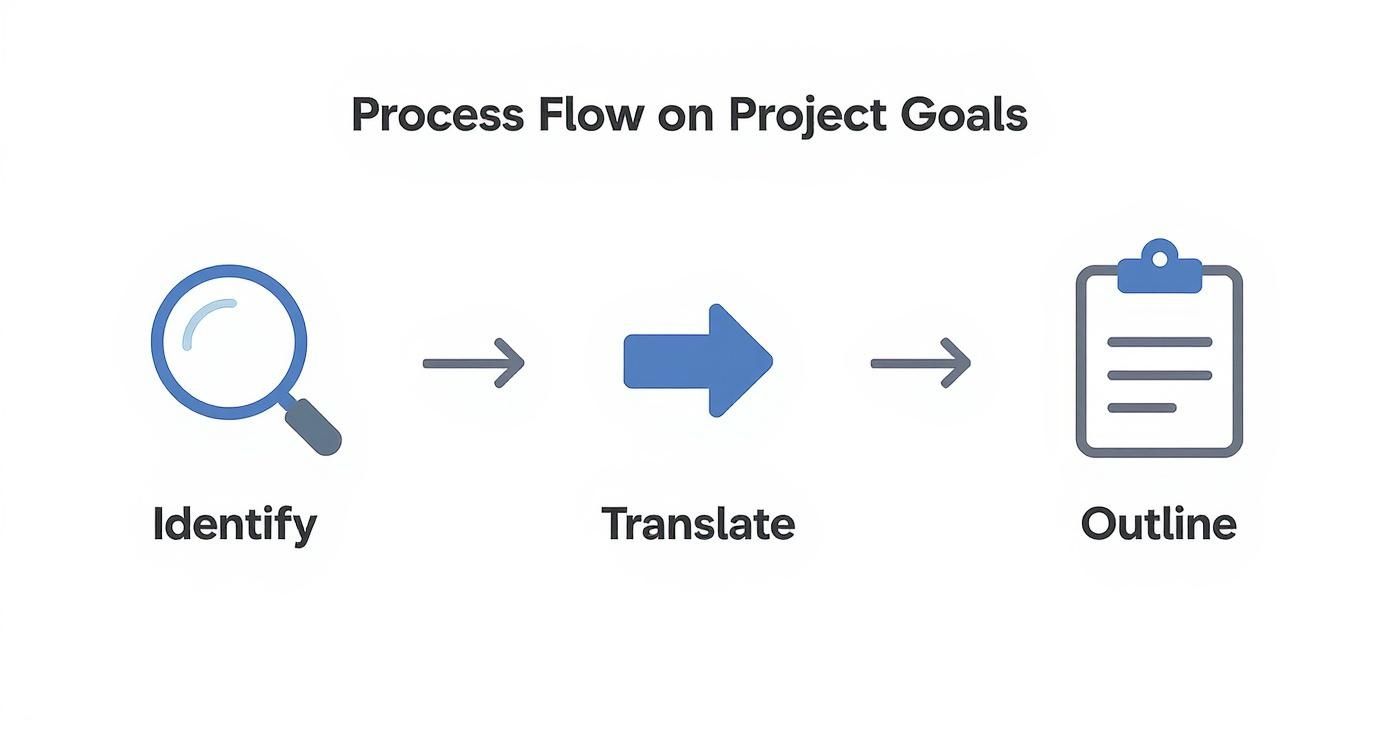
A structured approach ensures you can communicate your needs effectively, making it easier to gauge whether a consultant’s expertise aligns with your objectives.
Look Beyond the Polished Case Study
Case studies are great, but you need to read between the lines. The real insight is in understanding how the consultant achieved the results.
When reviewing their past work, ask yourself:
- What was the specific business challenge they were hired to solve?
- Did they just install software, or did they re-engineer a broken business process using Salesforce?
- Do the results feel tangible and tied to real business metrics like revenue or efficiency gains?
The best CRM consultants in Sydney are strategic problem-solvers first and technologists second. Their case studies should demonstrate a deep understanding of business operations, not just technical configurations. Feel free to explore some of our proven Salesforce case studies to see how we tackle real-world challenges for Australian businesses.
Taking this analytical approach to their portfolio helps you understand a firm’s problem-solving DNA. Are they about quick fixes, or do they build scalable Salesforce solutions designed for long-term growth?
The goal of this vetting stage is to narrow your options to a shortlist of two to three top contenders. These are the partners you'll invite for a deeper conversation, armed with the knowledge that they already meet your core requirements.
This diligence pays off, especially as more Sydney businesses invest in CRM. The Australian CRM market hit USD 1.97 billion in 2024 and is expected to climb to USD 5.01 billion by 2033. As you can see from the Australian CRM market insights on imarcgroup.com, this growth highlights the massive competitive edge businesses gain from an expert partner guiding their digital transformation.
Critical Questions to Ask Potential Salesforce Partners
Once you have a shortlist, it's time to dig deeper. The interview is your chance to get past the proposals and see how a partner really operates. This isn't just about ticking boxes on technical skills. It's about determining if their strategic thinking and project discipline align with your business.
Generic questions are a waste of time. To find a true expert, you need to ask questions that make them draw from real-world Salesforce project experience.
Probing Their Strategic Approach to Salesforce
Your CRM project is a business initiative, not just a tech rollout. The best consultants connect every technical decision back to your business goals.
Frame your questions around a genuine challenge your business is facing.
- "Walk us through helping a business like ours with fragmented customer data. What was your strategic approach, what Salesforce tools did you use, and what was the business outcome?" This forces them to talk about their problem-solving method and focus on tangible results.
- "How do you define project success beyond 'going live'? What KPIs do you track to ensure the Salesforce solution delivers long-term value?" Their answer reveals if they are focused on your ROI and a genuine partnership, or just completing the job.
A top-tier consultant will talk about user adoption rates, a shorter sales cycle, or improved customer satisfaction scores. Their definition of success should align with your business objectives.
Understanding Their Project Management Discipline
A smooth implementation hinges on solid project management. What matters is how a consultant plans for and handles challenges. You need to feel confident they can manage scope, budget, and timelines.
Get right to the point with scenario-based questions:
- "Describe your process for managing scope creep. If our team requests a new feature midway through the project, how do you handle that?" This reveals their change management process and communication style, which is crucial for keeping the project on track and on budget.
- "Tell us about a Salesforce project that hit a major snag. What went wrong, and what steps did you take to get it back on course?" This tests their transparency and problem-solving skills. The best partners are honest about past challenges and can explain what they learned.
Assessing Technical Depth and Post-Launch Philosophy
Finally, you need to be certain they have the technical depth to build a robust, scalable Salesforce solution and that they won't disappear after go-live.
- "Tell us about the most complex data migration you've managed. What were the source systems, what data quality issues did you face, and how did you ensure a clean import into Salesforce?" This separates consultants who can handle real-world complexity from those only comfortable with simple setups.
- "What does your support look like after we go live? Do you offer ongoing managed services, and what's your philosophy on empowering our own team to become self-sufficient on the Salesforce platform?" The ideal partner offers great support but also actively trains your team, making you powerful, not dependent.
Asking these in-depth questions will give you a much clearer picture of how each of the CRM consultants in Sydney on your list truly works. It shifts the dynamic from a sales pitch to a strategic conversation.
Interview Questions Checklist for Vetting Salesforce Consultants
| Focus Area | Question to Ask | What Their Answer Reveals |
|---|---|---|
| Strategic Fit | "Based on what you know about our business, what's the biggest opportunity you see for us with Salesforce?" | Their ability to connect the project to real business value beyond the technical tasks. |
| Project Management | "How do you structure your project teams, and who would be our primary day-to-day contact?" | Clarity on communication, accountability, and the experience level assigned to your project. |
| Technical Expertise | "Describe a custom solution you built when a standard Salesforce feature wasn't enough. Why was it necessary?" | Their problem-solving skills and understanding of when to customise versus using standard functionality. |
| Industry Experience | "What's the most common mistake you see companies in our industry make with their Salesforce implementation?" | Their depth of industry-specific knowledge and ability to offer proactive, strategic advice. |
| Data & Integration | "How do you approach user acceptance testing (UAT), especially when integrating with systems like NetSuite or SAP?" | Their rigour, attention to detail, and experience with complex, multi-system environments. |
| Change Management | "What's your strategy for winning over reluctant users and driving Salesforce adoption across the team?" | Whether they have a plan for the human side of the project, which is often the biggest hurdle. |
| Post-Launch Support | "What does your onboarding and training process for our team look like?" | Their commitment to empowering your team versus creating a long-term dependency. |
Using a structured approach ensures you're comparing apples with apples. By the end of these conversations, you'll have a genuine feel for which consultant is the right cultural and strategic fit.
Right then, you've got a shortlist of potential CRM consultants in Sydney, and the proposals are rolling in. Now comes the tricky part: figuring out the real cost. A Salesforce project's price is a mix of consulting fees, software licenses, and other costs. A professional proposal will break this down for you.
You'll encounter a few different pricing structures. Each has its place, and the best fit depends on your project's clarity and complexity. The common models are fixed-price, time and materials (T&M), and retainers.
Comparing Common Pricing Models
Let's unpack the engagement models you're likely to see. Understanding these is key to picking a structure that matches your budget and risk tolerance.
- Fixed-Price Model: This is ideal when the scope is crystal clear. You agree on a single price for the entire project. It provides budget certainty but can be rigid if changes are needed.
- Time and Materials (T&M) Model: Here, you pay an hourly or daily rate for the consultant's time. It offers the most flexibility, making it perfect for complex projects where requirements might evolve. The catch? You need to monitor it closely to manage the budget.
- Retainer Model: This is for long-term engagement—ongoing support, optimisation, and managed services after the initial project. You pay a flat monthly fee to have a Salesforce expert on call.
A detailed proposal and a well-drafted Statement of Work (SOW) are your best friends. A good SOW spells out the deliverables, timelines, responsibilities, and payment schedule, leaving no room for surprises.
Budgeting for the Full Salesforce Investment
A realistic budget covers more than just the consultant's invoice. Forgetting other components is a classic pitfall. Your complete financial picture needs to include consulting fees, actual Salesforce licensing costs (which vary by edition and user count), and any third-party apps or integration tools.
The complexity is why the consulting CRM software market in Australia, especially in a hub like Sydney, has grown. Globally, this market is tipped to hit USD 37.00 billion by 2033, showing how much businesses rely on expert help. You can read more in the global consulting CRM software market report on cognitivemarketresearch.com. This growth underscores why a clear, all-inclusive budget is so important from the start.
For instance, a typical project budget might break down like this:
| Cost Component | Description | Estimated % of Total Budget |
|---|---|---|
| Consulting Fees | Covers discovery, implementation, customisation, and training. | 50-60% |
| Salesforce Licensing | Annual subscription fees per user for products like Sales Cloud or Service Cloud. | 25-35% |
| Third-Party Apps | Costs for AppExchange apps or integration middleware. | 5-10% |
| Contingency Fund | A smart buffer for unexpected scope changes. | 5-10% |
Approaching it this way means you're not just comparing quotes; you're making an informed investment decision. That clarity prevents financial shocks and sets you up for a project that finishes on time and on budget.
Planning for Your Key Salesforce Integrations
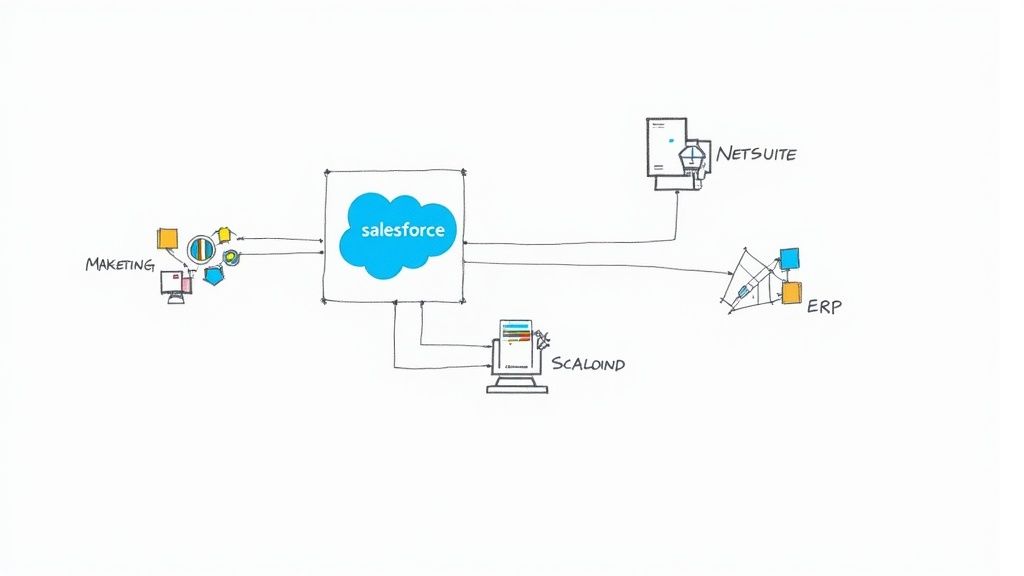
A Salesforce implementation doesn't exist in a bubble. Its real power is unleashed when it integrates with the rest of your business ecosystem, becoming the central hub for customer data.
Ignoring integrations until the end is one of the most common and costly mistakes.
Treating integration as an afterthought creates data silos, manual double-entry, and a clunky user experience that kills adoption. The right approach is to map out your tech stack and discuss it with potential CRM consultants in Sydney from the first conversation. The goal is to create a unified ecosystem where information flows freely, automating tasks and giving your teams a single source of truth.
Common Integrations for Sydney Businesses
For most Australian businesses, a few core integrations are non-negotiable. Ensure your consultant has proven experience connecting Salesforce to these systems, as each brings unique challenges and opportunities.
Here are the systems we frequently connect to Salesforce:
- Accounting Software: Linking Salesforce with local favourites like Xero or MYOB allows for automatic invoice generation when a deal is won. It also gives your sales team visibility into a client's payment status without leaving the CRM.
- Enterprise Resource Planning (ERP): For larger companies, integrating with systems like NetSuite or SAP is crucial. This syncs everything from customer master files to product catalogues and order information, ensuring consistency across the business.
- Marketing Automation Platforms: Connecting Salesforce to marketing tools is essential for aligning sales and marketing. A tight integration with platforms like Account Engagement (formerly Pardot) ensures leads are passed seamlessly, giving sales deep insights into a prospect's engagement history.
For those on Account Engagement, the nuances of that connection are vital. You can get a deeper understanding by reading our guide on Account Engagement best practice to see how a proper integration drives marketing ROI.
It's More Than Just a Connection
A top-tier consultant does more than just plug two systems together. The strategic questions to ask are about how they build these connections to be robust, scalable, and secure. A shallow integration might work on day one but will break under business growth.
A consultant's approach to data mapping, API management, and error handling reflects their technical depth. A well-architected integration anticipates future needs, ensuring your tech stack can evolve with your business.
When scoping your CRM project, understand how all the pieces will fit together. It’s worth exploring some of the leading API integration platforms to get a feel for the available tools and strategies. This will arm you with the right knowledge for a more informed discussion with potential partners.
Ultimately, the right consultant sees integration as a core pillar of your business strategy, ensuring your technology works together to drive growth and efficiency.
Got Questions About Hiring Salesforce Consultants?
If you’re a Sydney-based organisation looking to hire a Salesforce consultant, you likely have questions about budgets, timelines, and your team's involvement.
Let's address some of the most common queries to help you move forward with confidence.
We'll cover the essentials:
- Realistic budget planning for Salesforce
- Typical project timelines
- Choosing the right partner
- What's needed from your team
- Handling integrations
- The importance of a contingency fund
- Support after you go live
How Much Should We Realistically Budget for a Salesforce Project?
This depends on the project's complexity. A straightforward, out-of-the-box Sales Cloud implementation can start around $20,000.
For most mid-market businesses needing custom workflows, data migration, and key integrations, the budget typically lands between $60,000 and $150,000.
Your budget should account for:
- Consultancy Costs: Discovery, design, configuration, and testing.
- Salesforce Licences: Per-user fees for Sales Cloud, Service Cloud, etc.
- Integration Tools: Middleware needed to connect systems like Xero or NetSuite.
- Contingency: A buffer (10-15%) for unexpected scope changes.
For example, we recently helped a retail company integrate marketing automation and their ERP system. Their total investment was $85,000, covering custom objects, two integrations, and six weeks of post-launch support. A thorough discovery phase is non-negotiable to ensure your quote matches reality.
What’s a Typical Implementation Timeline?
Like budget, the timeline depends on complexity. A basic CRM rollout with no custom code or complex data migration can be done in as little as 6 weeks.
A more involved project—with custom development, significant data migration, and multiple integrations—should be planned for 4 to 6 months.
A standard project flow might look like this:
- Weeks 1–2: Discovery workshops and goal setting.
- Weeks 3–6: Core platform configuration and build.
- Weeks 7–12: Customisation, integration work, and testing.
- Weeks 13+: User training, final User Acceptance Testing (UAT), and go-live.
A quick tip: always factor in public holidays or the end-of-financial-year rush, as these can impact resource availability. Ask potential partners how they plan to manage key milestones.
Should We Choose a Large Firm or a Boutique Agency?
The right choice depends on your project's needs. Large consultancies have deep benches with specialist teams for nearly every Salesforce cloud. This can mean faster project velocity, but you may have less direct contact with senior experts.
Boutique agencies often provide a more personalised, hands-on service. You’ll likely work directly with senior consultants who are implementing the solution, and they often bring deep niche or industry expertise.
To help you decide, consider:
- Do you need broad, generalist knowledge or deep, specialist expertise?
- What is the average team size they assign to a project like yours?
- Is their communication style and company culture a good fit for your team?
What Level of Commitment is Needed From Our Team?
A successful Salesforce project is a true partnership. It requires active engagement from your side. As a rule of thumb, designate one internal project lead who can dedicate roughly 10–15% of their week to the project.
Beyond that, you’ll need to involve other stakeholders:
- Sales and marketing teams for process mapping workshops.
- IT staff for integration planning and data security.
- End-users for User Acceptance Testing (UAT).
When your team is actively involved in workshops and provides early feedback, the project stays grounded in how your business actually works.
In our experience, getting your team invested from the start can increase final user adoption by up to 30%. Those early feedback loops are also brilliant for nipping potential issues in the bud, saving time and money.
Ready to get the most out of your Salesforce investment? Contact Adaptal for expert, hands-on guidance for your next CRM project.