
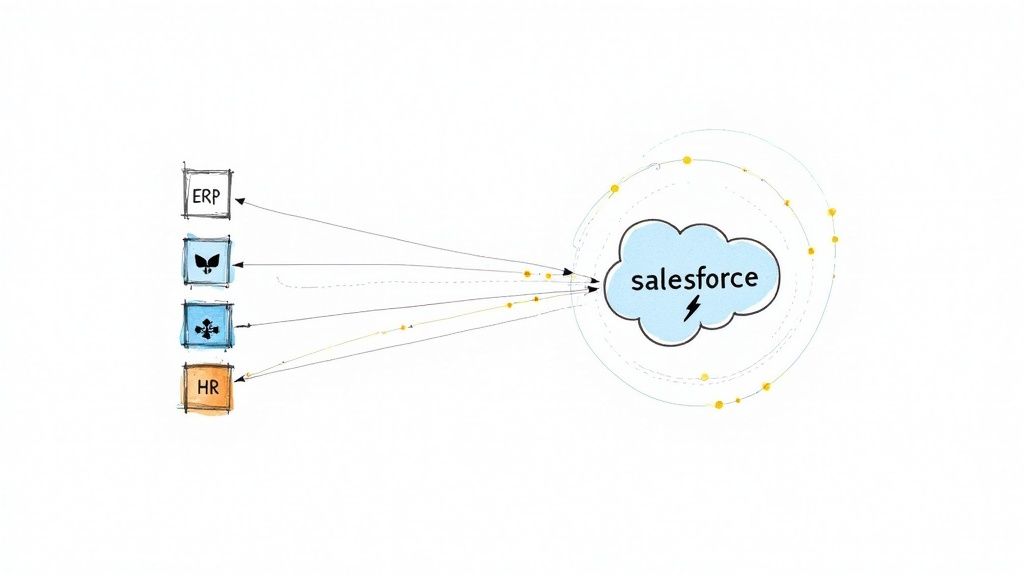
Selecting the best enterprise resource planning software is a critical decision that impacts every facet of an organisation, from finance and operations to supply chain and customer relationships. The right ERP system centralises data and automates core business processes. However, a modern ERP's true power is unlocked when it works in concert with a world-class CRM. For businesses aiming for a complete 360-degree view of their customers and operations, seamless Salesforce integration is no longer a "nice-to-have"—it's an essential component of a successful digital transformation.
This guide provides a detailed analysis of the top ERP platforms available to Australian businesses, viewed through the lens of a Salesforce implementation partner. We move beyond generic marketing copy to offer practical insights based on real-world projects. For each system, we examine its core strengths, potential limitations, and how it can be integrated with Salesforce to solve common business challenges. The business challenge is often the same: sales and customer service operate in one system (Salesforce), while finance and operations use another (the ERP). The solution is a robust integration that creates a single source of truth, and the results are streamlined processes, enhanced visibility, and a superior customer experience.
Throughout this resource, you will find direct links and screenshots to help you visualise each platform. Our goal is to equip you with the detailed information needed to compare solutions and make a confident decision that aligns with your organisation's strategic objectives and technology ecosystem. We'll explore how these platforms solve complex operational challenges and what to consider when planning your Salesforce integration.
1. Microsoft Dynamics 365 Finance (Australia)
Microsoft Dynamics 365 Finance stands as a leading choice among the best enterprise resource planning software, specifically tailored for mid-market to large Australian organisations. It provides a robust, cloud-based financial management platform designed to unify financial operations and drive strategic decision-making. The software moves beyond traditional accounting, offering predictive insights and AI-driven guidance through its embedded Copilot assistant, helping teams automate routine tasks and focus on higher-value analysis.
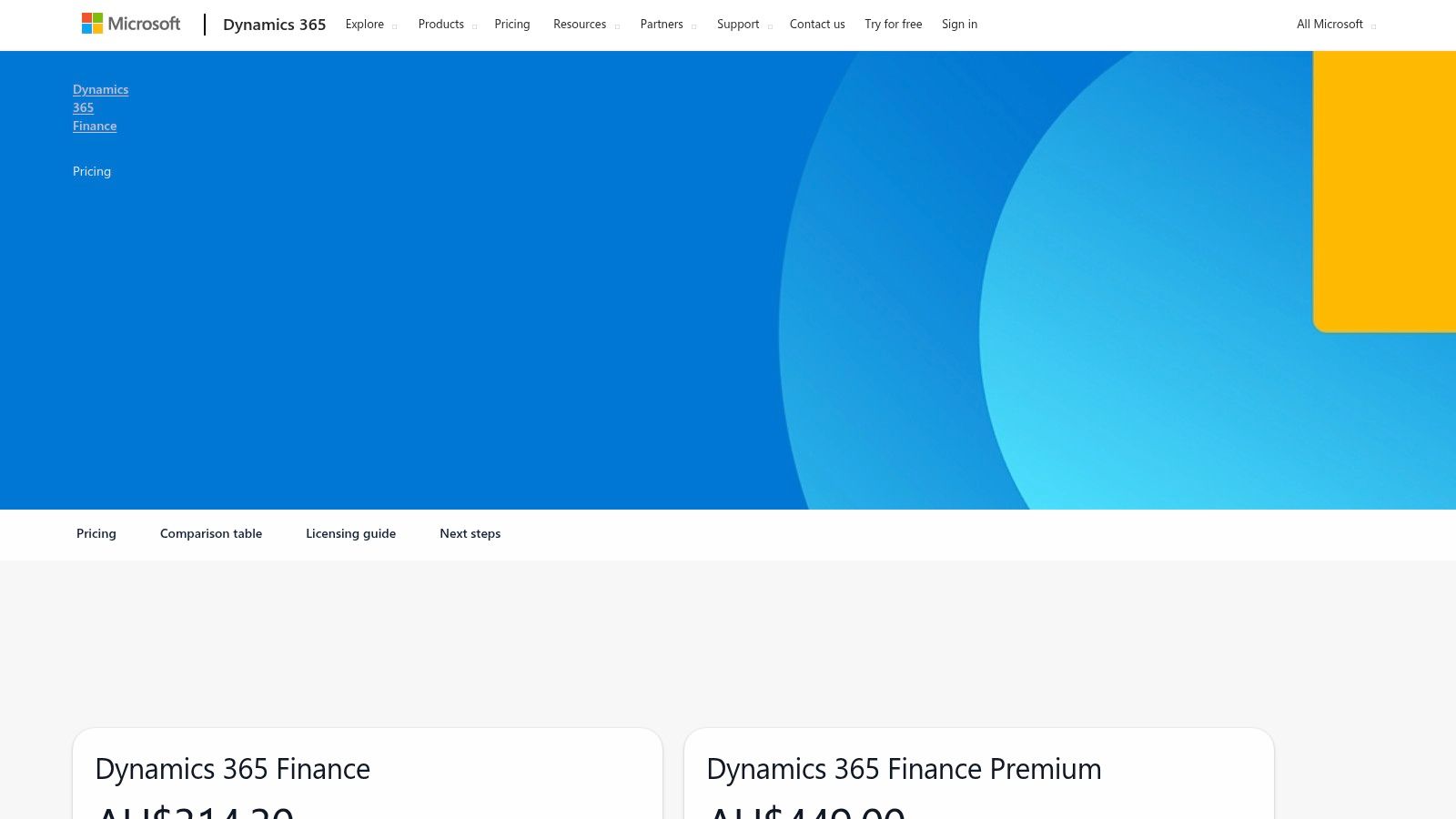
Its core strength lies in its deep integration with the broader Microsoft ecosystem. However, many organisations standardise on Salesforce for their CRM needs, creating a common integration challenge: how to sync customer and sales data from Salesforce with financial data in Dynamics 365. The solution involves using a middleware platform or custom connectors to create a seamless quote-to-cash process, ensuring that when a deal is closed in Sales Cloud, an invoice is automatically generated in Dynamics 365. This automation eliminates manual data entry and provides real-time visibility into revenue. For businesses looking to implement or optimise their Microsoft Dynamics 365 solution, specialised expertise can be invaluable. Consider leveraging dedicated Microsoft Dynamics 365 consulting services to navigate the complexities and maximise ROI.
Key Features & Considerations
- Financial Management: Comprehensive modules for general ledger, accounts payable/receivable, budgeting, and financial reporting.
- Automation & AI: Utilises AI through Copilot for tasks like invoice automation and financial close process optimisation.
- Localisation: Built-in tools ensure compliance with Australian tax laws and reporting standards.
- Salesforce Integration: Requires a well-planned integration strategy to connect customer data from Sales Cloud with back-office financials.
Our Take: Dynamics 365 Finance is an excellent fit for organisations already invested in the Microsoft stack. Its transparent Australian pricing (starting from AUD $279.10 per user/month) and strong local partner network simplify adoption. However, for businesses using Salesforce as their CRM, a successful implementation hinges on a robust integration strategy to bridge the two ecosystems. Discover more about achieving this with our Salesforce consulting insights.
2. Oracle NetSuite (Australia)
Oracle NetSuite is a formidable player in the cloud ERP space, delivering one of the best enterprise resource planning software solutions for growing and mid-market Australian businesses. It provides a truly unified platform that combines financials, CRM, e-commerce, and inventory management into a single, cohesive system. This integrated approach eliminates data silos and offers a real-time, comprehensive view of business operations.
While its native CRM is robust, many businesses choose Salesforce for its superior ecosystem and specialised tools like Sales Cloud and Service Cloud. The challenge then becomes synchronising data between the two platforms. A common project involves integrating Salesforce CPQ (Configure, Price, Quote) with NetSuite's inventory and order management. The solution is to create a bidirectional sync where approved quotes in Salesforce automatically create sales orders in NetSuite, which then updates inventory levels that are visible back in Salesforce. This gives sales reps real-time product availability, leading to more accurate quotes and improved customer satisfaction. Explore our Salesforce integration case studies to see how we connect disparate systems for optimal performance.
Key Features & Considerations
- Unified Business Management: A single platform for ERP, CRM, e-commerce, and professional services automation.
- Global Business Ready: Strong support for multi-subsidiary, multi-currency, and multi-tax compliance.
- Salesforce Integration: Commonly integrated with Sales Cloud and CPQ to create a seamless quote-to-cash workflow and provide sales teams with real-time inventory data.
- Scalability & Customisation: The SuiteCloud platform enables extensive customisation and third-party app integration.
Our Take: NetSuite is an outstanding all-in-one solution for organisations that have outgrown their initial accounting software. Its extensive Australian partner network ensures strong local implementation. However, pricing is not public, and for businesses committed to Salesforce, the success of the project will depend heavily on the quality of the integration between the two platforms.
3. SAP S/4HANA Cloud (Public Edition) – Australia
SAP S/4HANA Cloud stands as a cornerstone in the world of the best enterprise resource planning software, built for complex, large-scale organisations in Australia. As SAP's flagship cloud ERP, it delivers deep industry-specific content and preconfigured best-practice processes. The platform is engineered to handle extensive operational demands, providing a unified, intelligent suite that embeds real-time analytics and automation directly into core business functions.
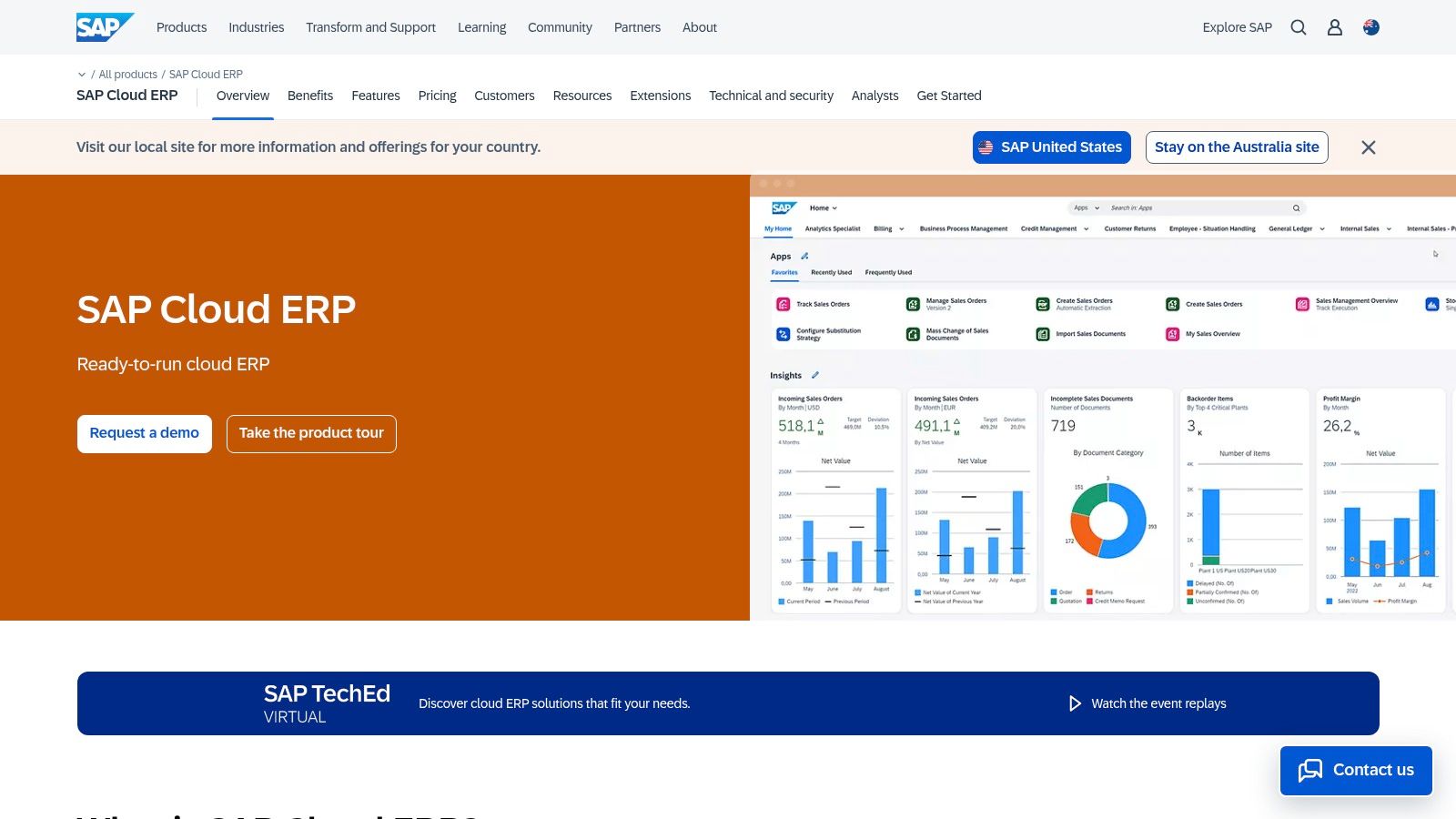
For global enterprises, a common business challenge is aligning their powerful SAP back-end with their customer-facing Salesforce front-end. The solution often involves a sophisticated integration to connect Salesforce Service Cloud with SAP's service and asset management modules. When a customer raises a case in Service Cloud, the integration can automatically check warranty information or product history in SAP, providing the support agent with a complete customer view. This results in faster case resolution and a more proactive service experience. Managing the data lifecycle across these integrated systems is critical, a topic further explored in our guide on effective data storage and deletion strategies.
Key Features & Considerations
- Preconfigured Processes: Utilises industry best practices for faster implementation and time-to-value.
- Industry-Specific Content: Deep functionality tailored for sectors like public sector, manufacturing, and professional services.
- Salesforce Integration: Crucial for connecting front-office customer data in Sales or Service Cloud with back-office operational data in SAP.
- Security & Compliance: Offers strong security controls and Australian data sovereignty options for regulated workloads.
Our Take: SAP S/4HANA Cloud is the go-to for large, complex organisations needing deep industry functionality. While pricing is not public, its value is most apparent at a large scale. A successful implementation requires a clear strategy for integrating with other best-of-breed platforms like Salesforce to achieve a true 360-degree view of the business.
4. Oracle Fusion Cloud ERP (Australia)
Oracle Fusion Cloud ERP is a powerhouse in the enterprise resource planning software landscape, engineered for large-scale enterprises operating in Australia. It offers a comprehensive, AI-driven suite that unifies financials, project management, procurement, and supply chain into a single cloud platform. Oracle’s key differentiator is its continuous innovation model, delivering quarterly updates with advanced technologies like machine learning.
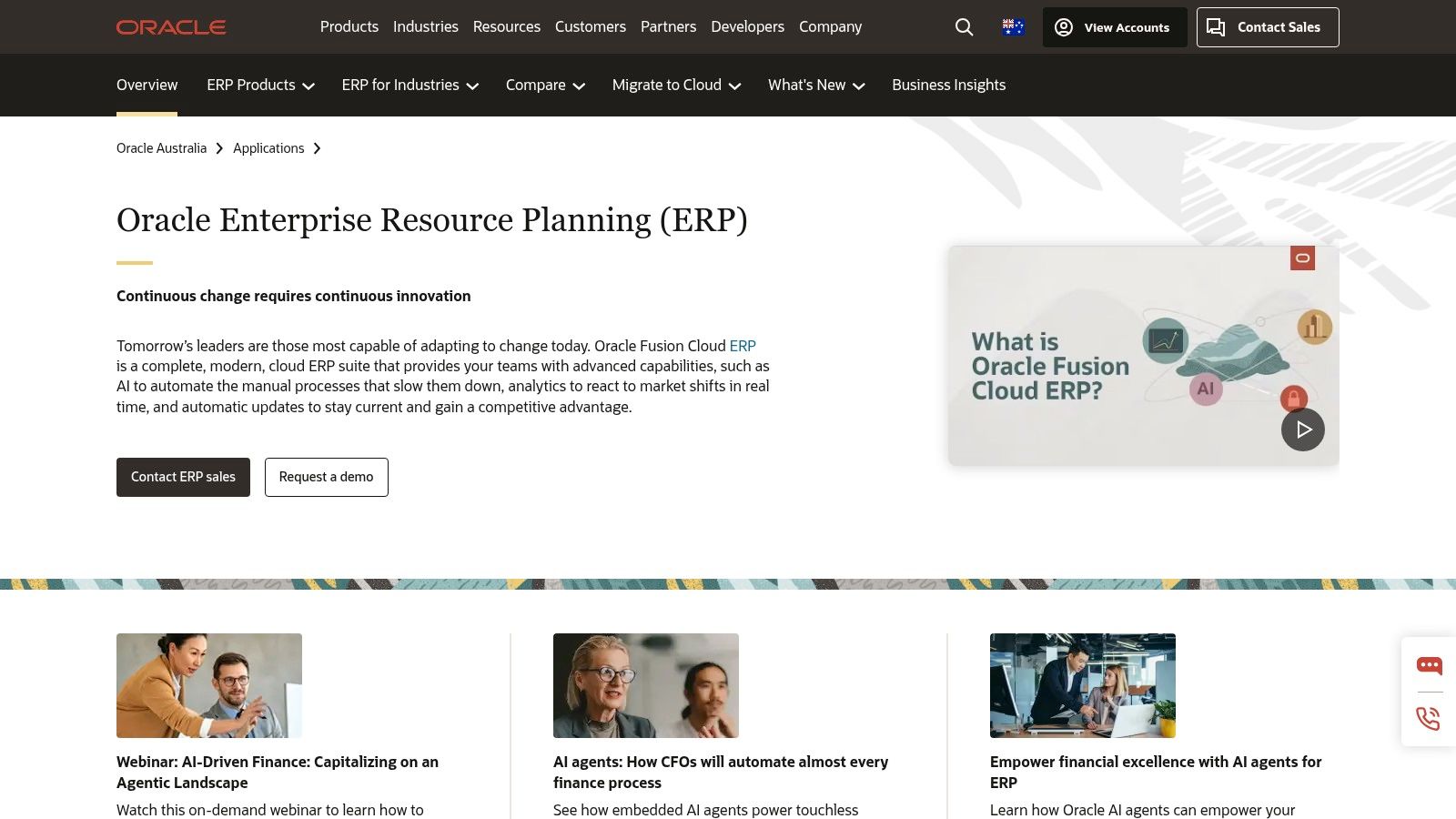
A frequent challenge for businesses using Oracle ERP is the disconnect between sales pipeline data in Salesforce and financial forecasting in Oracle. The solution is to build an integration that syncs opportunity stages and amounts from Sales Cloud with Oracle's financial planning modules. This allows finance teams to generate more accurate revenue forecasts based on real-time sales activity. The result is better strategic planning and resource allocation. This integration is critical to connect front-office sales activities with back-office financial and operational data, creating a seamless quote-to-cash process and a unified view of business performance.
Key Features & Considerations
- Comprehensive Suite: Modules cover financials, procurement, project management, risk management, and supply chain management.
- Embedded AI & Analytics: Prebuilt KPIs and machine learning models help automate processes and predict outcomes.
- Salesforce Integration: Essential for syncing sales pipeline data from Sales Cloud to enable accurate financial forecasting in Oracle.
- Enterprise Scalability: Designed to support the complex requirements of large, global organisations with multi-entity structures.
Our Take: Oracle Fusion Cloud ERP is an excellent choice for large Australian enterprises needing a powerful, all-in-one solution that can scale globally. However, its quote-based pricing and the potential complexity of multi-module implementations require significant planning. For businesses running on Salesforce, a well-architected integration is the key to unlocking the full value of both platforms.
5. Infor CloudSuite (Australia)
Infor CloudSuite distinguishes itself as one of the best enterprise resource planning software options by focusing on deep, pre-configured industry-specific functionality. Rather than offering a one-size-fits-all solution, Infor provides specialised ERP editions for sectors like manufacturing and fashion, all hosted on AWS infrastructure with dedicated Australian support. This approach is designed to deliver industry best practices out-of-the-box, reducing the need for extensive customisation.
The platform's power is unified through the Infor OS (Operating Service), which provides a modern user experience and robust integration tools. A common business challenge for manufacturers using Infor is giving their sales team, who work in Salesforce, visibility into complex production schedules and inventory. The solution is an integration that surfaces key manufacturing data within the Salesforce Account or Opportunity record. This allows salespeople to provide accurate lead times and manage customer expectations, leading to higher satisfaction and repeat business. Learn more from these Salesforce consulting insights on creating a cohesive technology stack.
Key Features & Considerations
- Industry-Specific Editions: Pre-built CloudSuites for manufacturing, distribution, fashion, and public sector with tailored workflows.
- Infor OS Platform: Provides a foundation for extensibility, analytics, and integration across applications.
- Salesforce Integration: Enables sales teams in Sales Cloud to access real-time production and inventory data from Infor, improving quoting accuracy.
- Multi-Tenant Cloud: Hosted on AWS, ensuring continuous updates, scalability, and security without manual patching.
Our Take: Infor CloudSuite is an exceptional choice for product-centric organisations in Australia that require deep vertical functionality. Its industry-template model offers a faster path to value. However, pricing is not publicly available, and its focus is on the upper mid-market and enterprise segments. A successful digital transformation project will prioritise connecting its rich operational data with your Salesforce CRM.
6. Epicor Kinetic (ANZ)
Epicor Kinetic is a formidable contender in the best enterprise resource planning software space, specifically engineered for the nuanced demands of manufacturers across Australia and New Zealand. This cloud-first ERP solution excels in providing deep, industry-specific functionality for discrete and make-to-order manufacturing environments. Its modern, browser-based user experience is designed to simplify complex processes and enhance collaboration.
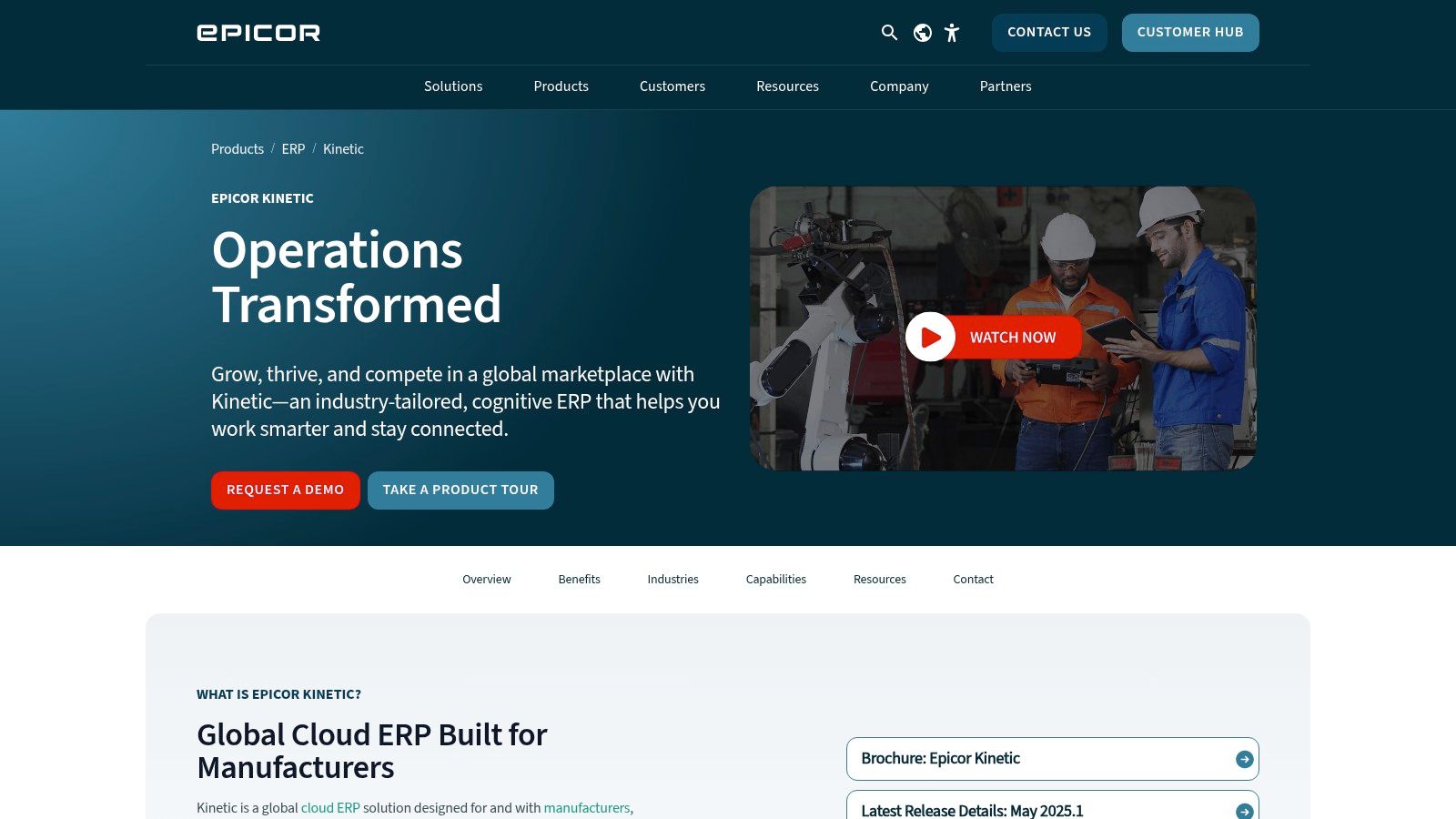
The platform's core advantage is its sharp focus on manufacturing workflows. A typical business challenge is the manual process of converting a complex, configured quote from Salesforce CPQ into a detailed bill of materials (BOM) in Epicor. The solution involves an integration that automatically translates the approved quote into a production order in Epicor, complete with the correct BOM and routing. This automation drastically reduces errors, shortens the lead time from sales to production, and improves overall operational efficiency, creating a seamless quote-to-cash cycle.
Key Features & Considerations
- Manufacturing Functionality: Advanced modules for production management, material requirements planning (MRP), and quality assurance.
- Global Business Management: Supports multi-company, multi-currency, and multi-site operations with built-in compliance packs for ANZ regulations.
- Salesforce Integration: Integrating with Salesforce CPQ can automate the creation of production orders and bills of materials, streamlining the quote-to-production process.
- Industry-Specific Focus: Tailored capabilities for industries such as industrial machinery, medical devices, and fabricated metals.
Our Take: Epicor Kinetic is a top-tier choice for ANZ manufacturers seeking an ERP that speaks their language. However, its pricing is quote-based and typically partner-led. For manufacturers, integrating Kinetic with Salesforce is key to achieving a holistic business view from sales engagement through to final product delivery. See how our Salesforce consulting insights can bridge that gap.
7. Sage Intacct (Australia)
Sage Intacct has carved out a strong reputation as a leading choice among the best enterprise resource planning software, specifically for Australian midsize organisations that prioritise powerful, cloud-native financial management. It is designed to automate complex financial processes and provide deep, real-time visibility. The platform excels at handling sophisticated accounting needs, such as multi-entity consolidation, making it a favourite for professional services firms.
Its core differentiator is its best-in-class financial engine. For professional services firms using Salesforce to manage projects and client relationships, a key challenge is tracking project profitability. The solution is an integration that syncs project data from Salesforce with Sage Intacct's financial modules. This allows businesses to automatically track billable hours, expenses, and revenue against specific projects, providing real-time visibility into project margins and overall profitability. The result is better decision-making and improved financial performance.
Key Features & Considerations
- Financial Management: Advanced capabilities for general ledger, accounts payable/receivable, and cash management.
- Multi-Entity Consolidation: Streamlines the process of consolidating financials across multiple business units or locations.
- Salesforce Integration: Ideal for professional services firms to sync project data from Salesforce, enabling real-time profitability tracking in Sage Intacct.
- Integration Framework: A strong API and marketplace facilitate connections to a wide range of third-party applications.
Our Take: Sage Intacct is an excellent solution for finance-led organisations that need deep accounting functionality. Its strong local Australian presence ensures relevant support. However, its pricing is quote-based. Proper configuration and a robust Salesforce integration are key to creating a unified view of financial and customer data. Insights from certified professionals, such as those discussed by the Institute of Certified Bookkeepers, can be invaluable.
8. MYOB Acumatica (formerly MYOB Advanced) – Australia
MYOB Acumatica serves as a powerful, localised version of the globally recognised Acumatica Cloud ERP, specifically configured for Australian and New Zealand businesses. This platform is a strong contender for the best enterprise resource planning software for mid-sized organisations looking for a comprehensive, cloud-native solution with strong local support. Rebranded from MYOB Advanced in July 2024, it delivers specialised editions for industries like construction and manufacturing.
The key differentiator is its partner-led implementation model combined with robust Australian localisation. For a distribution company, a common business challenge is providing field sales reps using the Salesforce mobile app with up-to-date customer credit limits and order history from MYOB. The solution is a real-time integration that surfaces this financial data directly within the Salesforce Account record. This empowers reps to make informed decisions on the go, upsell effectively, and manage accounts proactively, leading to improved cash flow and stronger customer relationships.
Key Features & Considerations
- Industry-Specific Editions: Tailored modules for finance, distribution, project accounting, construction, and manufacturing.
- Australian Localisation: Built-in compliance for Australian tax and business regulations, backed by local support.
- Salesforce Integration: Can provide field sales teams with real-time customer financial data (e.g., credit limits, payment history) from MYOB directly within the Salesforce mobile app.
- Partner-Led Implementation: Relies on a network of local partners for implementation, customisation, and support.
Our Take: MYOB Acumatica is an excellent choice for Australian businesses that need an industry-specific, cloud-first ERP backed by local expertise. However, pricing is only available via partners. Navigating the data synchronisation between this ERP and your Salesforce CRM is critical to maximising the value of both platforms and achieving operational excellence.
9. Odoo (Australia/global)
Odoo presents a unique, app-based approach to enterprise resource planning software, offering remarkable flexibility for small, medium, and growing businesses globally. Instead of a monolithic system, Odoo provides a suite of integrated business management apps covering everything from CRM and sales to accounting, inventory, and manufacturing. This modularity allows organisations to start with what they need and add new applications as their operational complexity increases.
The platform's core strength is its open-source model. While Odoo has its own CRM app, many scaling businesses prefer the power and ecosystem of Salesforce. The challenge is connecting customer interactions logged in Salesforce with operational data in Odoo's other apps. The solution is an integration that syncs Account and Contact data, ensuring that when a new customer is added in Sales Cloud, a corresponding record is created in Odoo's accounting and inventory apps. This eliminates duplicate data entry and ensures consistency across the business. For a detailed look at Odoo's capabilities, explore this guide on Odoo ERP Software for Australian Business Growth.
Key Features & Considerations
- App-Based Modularity: Select from dozens of integrated apps (Accounting, Inventory, MRP, HR) to build a custom ERP.
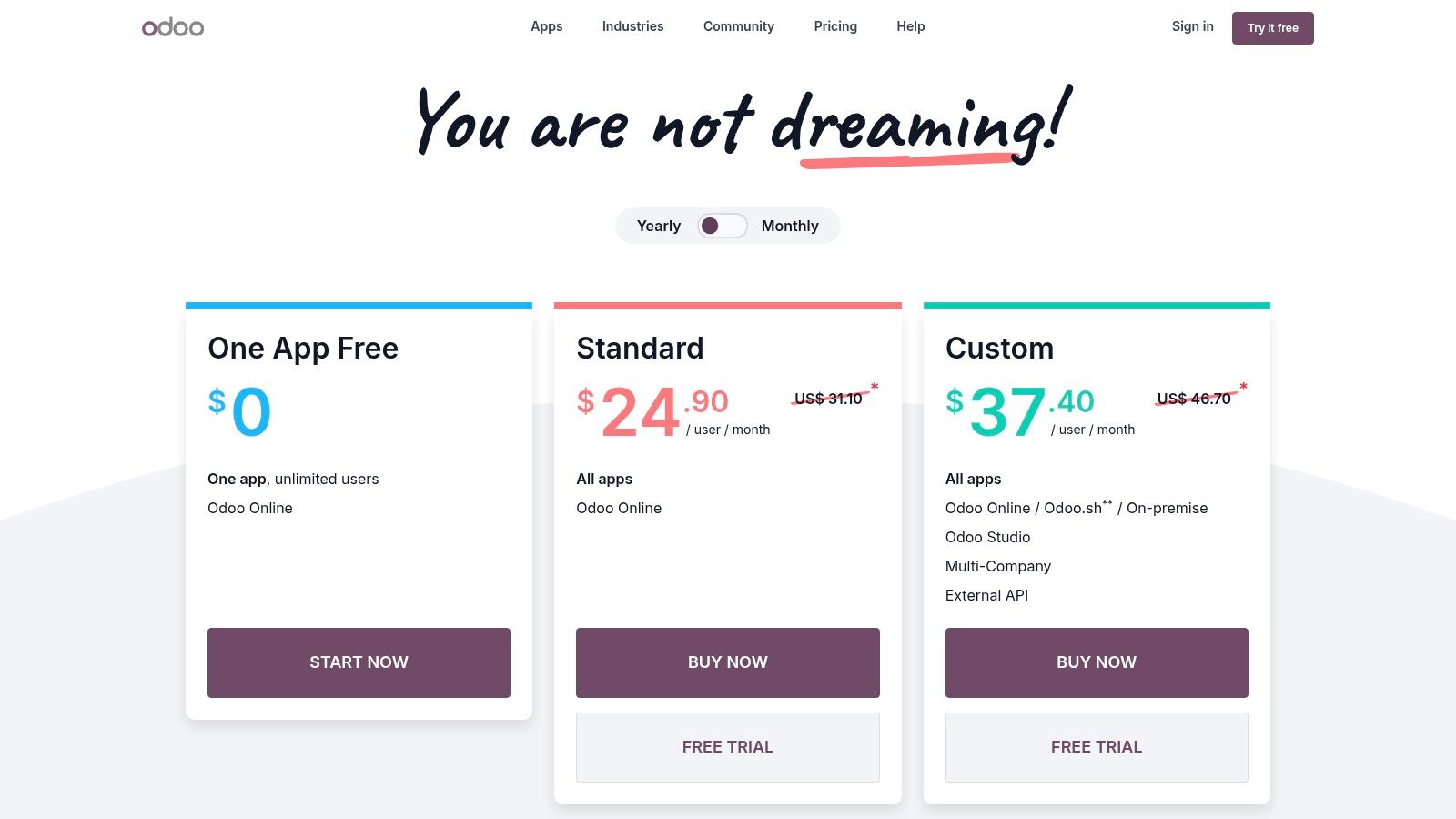
- Transparent Pricing: Publicly available pricing for its "all-in-one" app bundles, simplifying budget forecasting.
- Salesforce Integration: While it has a native CRM, integration with Salesforce is common for businesses needing a best-of-breed front-office and back-office solution.
- Open-Source Foundation: Benefits from a large community and an extensive marketplace of third-party apps.
Our Take: Odoo is an excellent choice for businesses seeking an affordable, all-in-one solution that can scale from startup to mid-market. However, large enterprises may require significant customisation, and its native CRM module is less specialised than a dedicated platform like Salesforce. A well-planned integration can provide the best of both worlds.
10. SYSPRO (Australia)
SYSPRO has carved out a niche as a top-tier enterprise resource planning software, specifically for Australian manufacturers and distributors. It provides a highly specialised, industry-built platform designed to manage the complexities of the supply chain, from raw materials to finished goods. The system is engineered to provide deep visibility into manufacturing operations, helping businesses optimise production schedules and manage inventory.
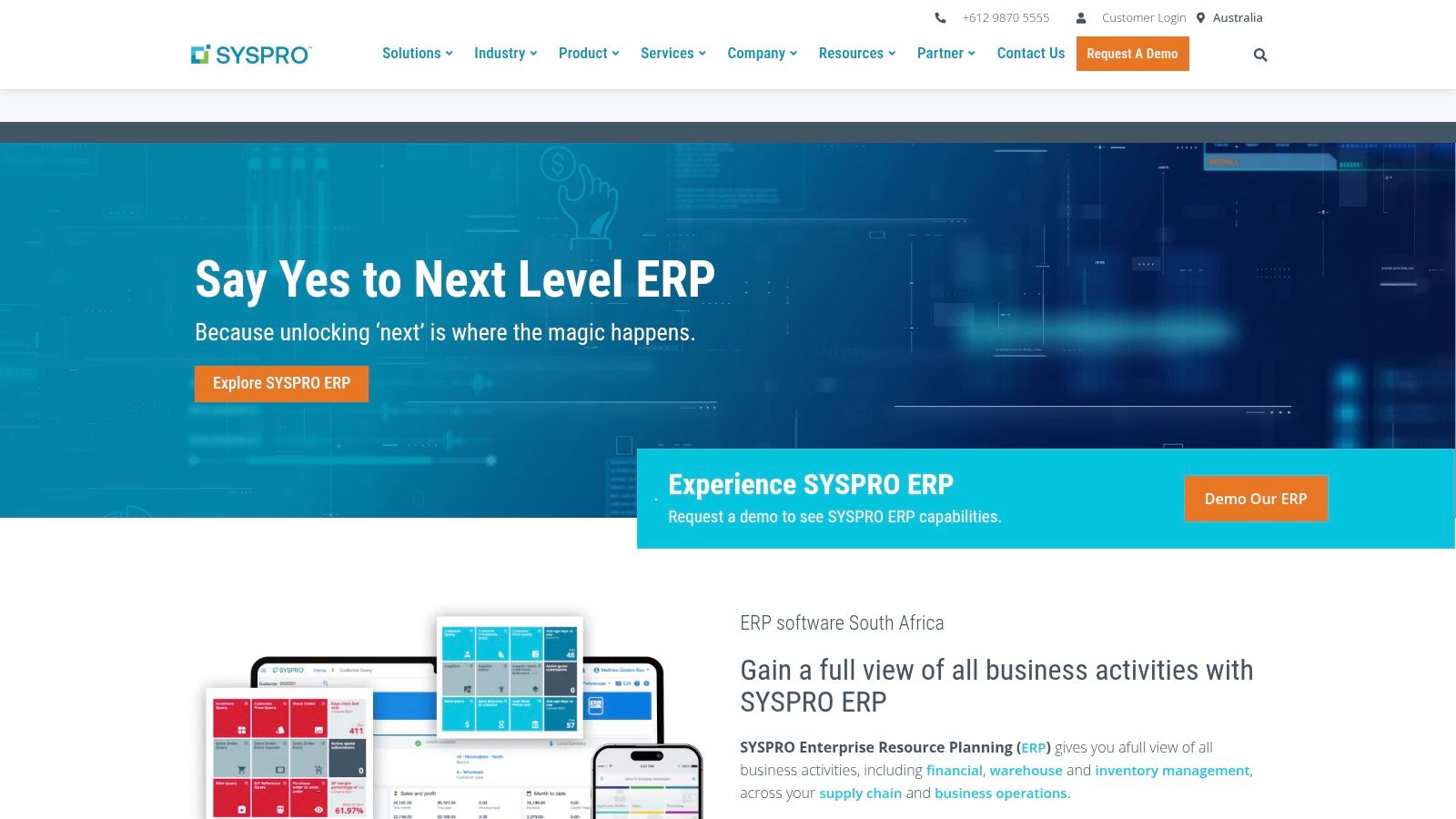
A key differentiator for SYSPRO is its flexible deployment model. A frequent business challenge is the disconnect between customer service cases logged in Salesforce Service Cloud and the quality control processes managed in SYSPRO. The solution is an integration that automatically creates a quality assurance ticket in SYSPRO when a product defect case is escalated in Service Cloud. This ensures that customer feedback directly informs the manufacturing process, leading to improved product quality and a closed-loop customer service experience.
Key Features & Considerations
- Manufacturing Operations Management: Core functionality includes robust tools for shop floor control, production scheduling, and quality management.
- Industry-Specific Solutions: Pre-configured solutions tailored for industries like food and beverage, fabricated metals, and electronics.
- Salesforce Integration: Connects Service Cloud cases with SYSPRO's quality management module to create a closed-loop feedback process from customer to factory floor.
- Flexible Deployment: Offers a choice of cloud, on-premise, or hybrid deployment models, providing long-term flexibility.
Our Take: SYSPRO is an excellent choice for mid-market Australian manufacturers who need deep, industry-specific functionality. However, pricing is not public. To gain a complete business overview, connecting its rich operational data with your Salesforce CRM is essential. Learn how to bridge this gap by exploring Salesforce consulting services.
11. Pronto Xi (Pronto Software) – Australia
Pronto Xi distinguishes itself as a premier choice among the best enterprise resource planning software, especially for Australian businesses seeking a locally developed and supported solution. Developed by Pronto Software, this fully integrated ERP offers comprehensive, end-to-end functionality designed to manage every aspect of a business from financials to supply chain. Its strong local presence ensures deep understanding and compliance with Australian business regulations.
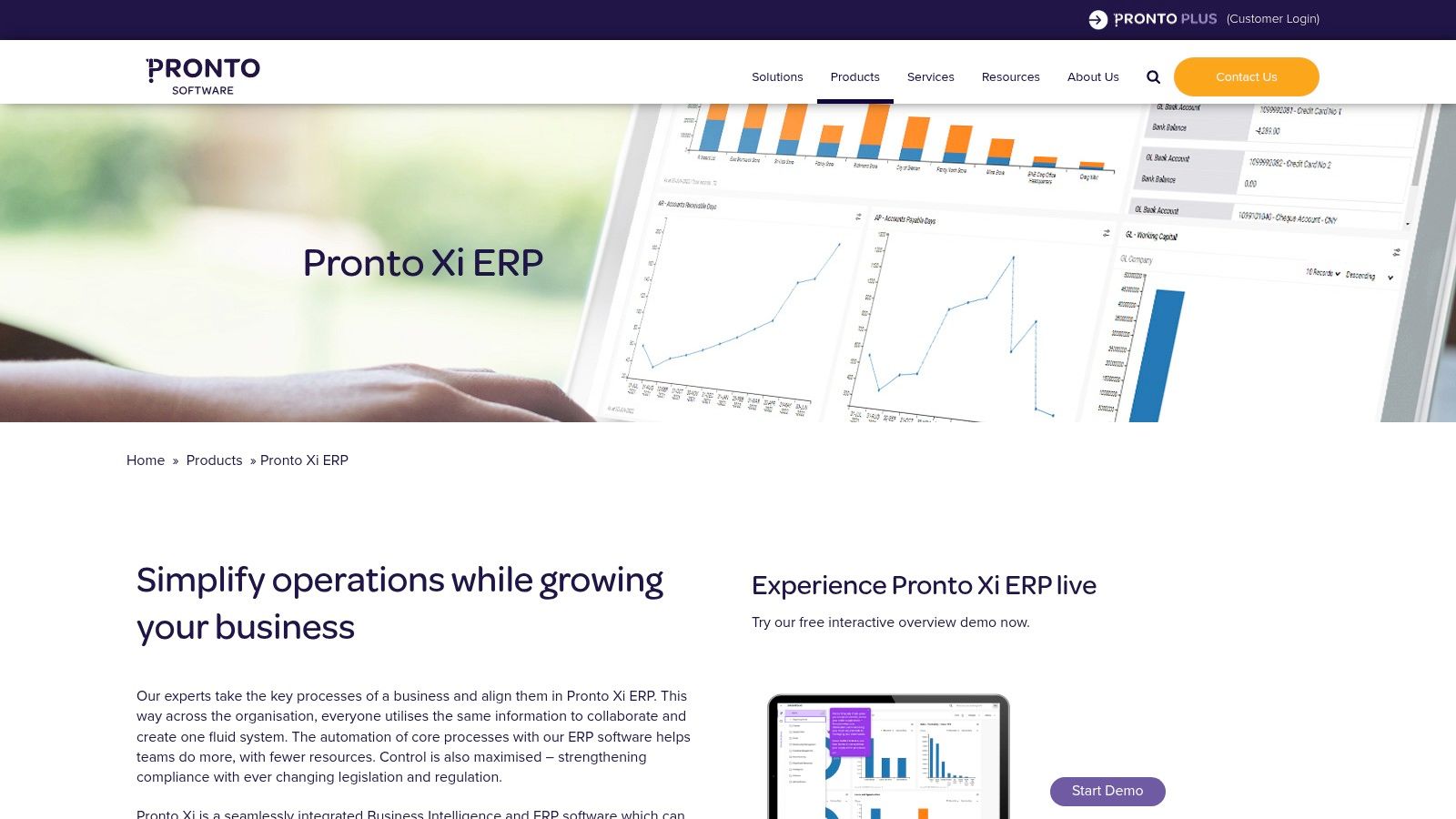
A key differentiator for Pronto Xi is its embedded IBM Cognos analytics engine, which delivers powerful business intelligence capabilities. A common challenge for businesses using Pronto Xi for field service is scheduling and dispatching technicians efficiently. The solution is to integrate it with Salesforce Field Service. This allows dispatchers to manage service appointments and technician schedules within Salesforce, while the integration ensures that work orders, parts usage, and billing information are synced back to Pronto Xi's financial and inventory modules. The result is a more efficient field service operation and faster invoicing.
Key Features & Considerations
- Integrated Business Intelligence: Native IBM Cognos analytics for sophisticated reporting and data analysis.
- Flexible Deployment: Available as a cloud-hosted or on-premise solution to match business requirements.
- Salesforce Integration: Integrating with Salesforce Field Service can streamline dispatching, work order management, and billing for service-based businesses.
- Local Australian Focus: Developed and supported locally, ensuring deep alignment with Australian compliance and market needs.
Our Take: Pronto Xi is an excellent option for Australian businesses that value local support and an all-in-one ERP. However, pricing is quote-based. For businesses looking to pair its robust back-office power with a world-class front-office solution like Salesforce, a well-planned integration is key to unlocking a 360-degree view of operations and customer engagement.
12. Capterra Australia – ERP Category
While not a software itself, Capterra Australia’s ERP category is an indispensable resource for organisations starting their search for the best enterprise resource planning software. It functions as a comprehensive, localised marketplace where businesses can discover, compare, and shortlist potential ERP solutions. The platform provides a structured way to navigate the often-overwhelming landscape of ERP vendors, offering filters for industry, business size, and specific features.
This directory is particularly useful for gathering initial intelligence. Its core value lies in the aggregated user reviews, which offer authentic, peer-driven feedback on implementation experiences and customer support quality. For businesses aiming to integrate their chosen ERP with a central CRM like Salesforce, Capterra helps identify which solutions are commonly used by similar Australian companies, providing a practical starting point for building a connected technology stack. It's a great place to begin your research before engaging a Salesforce partner to discuss the specifics of your integration project.
Key Features & Considerations
- Australia-Focused Directory: Filters and vendor profiles are geared towards solutions available and supported in Australia.
- User Reviews & Ratings: Provides real-world insights from other businesses, helping to validate vendor claims.
- Comparative Tools: Allows for side-by-side comparisons of features, pricing models, and user satisfaction scores.
- Vendor Shortlisting: Streamlines the initial research phase by consolidating vendor information in one place.
Our Take: Capterra is a crucial first step in the ERP evaluation process. However, be mindful that some listings are sponsored. Always verify pricing and feature details directly with vendors. This platform excels at helping you build a well-informed shortlist before engaging in deeper analysis or seeking expert guidance from a Salesforce partner on complex integrations.
Top 12 ERP Solutions (Australia) — Side-by-Side Comparison
| Solution | Core focus / Key features | Best for | Salesforce Integration Use Case | Pricing & value | Unique selling point |
|---|---|---|---|---|---|
| Microsoft Dynamics 365 Finance (Australia) | Core financials, budgeting, close automation; embedded analytics & Copilot | Midsize → large organisations | Sync closed deals from Sales Cloud to auto-generate invoices. | Transparent local pricing; premium analytics can raise TCO | Strong Microsoft ecosystem and frequent AI updates |
| Oracle NetSuite (Australia) | Unified cloud ERP: finance, inventory, order mgmt, commerce; SuiteAnalytics | Multi-entity businesses & commerce-led firms | Sync Salesforce CPQ quotes to NetSuite sales orders for real-time inventory visibility. | No public list price; module & user based | Broad module marketplace and multi-entity support |
| SAP S/4HANA Cloud (Public) – Australia | Enterprise cloud ERP with preconfigured best-practice processes & deep industry content | Large, complex organisations and public sector | Connect Service Cloud cases to SAP for warranty checks and asset history. | Quote-based; enterprise implementations can be lengthy | Rich industry content and strong localisation/compliance |
| Oracle Fusion Cloud ERP (Australia) | Full-suite ERP: financials, procurement, projects, supply chain; embedded analytics | Enterprise-scale organisations | Sync Sales Cloud pipeline data for accurate revenue forecasting in Oracle. | Quote-based; often multi-year terms | Enterprise breadth with strong analytics & automation |
| Infor CloudSuite (Australia) | Industry-specific CloudSuite editions, Infor OS with AI/analytics | Product-centric industries & public sector | Provide sales teams in Salesforce with real-time manufacturing and inventory data. | Pricing not public; enterprise/upper mid-market focus | Fast time-to-value via industry templates |
| Epicor Kinetic (ANZ) | Cloud-first ERP for discrete & MTO manufacturing; browser UX | Manufacturers in ANZ | Automate creation of production orders in Epicor from approved Salesforce CPQ quotes. | Quote-based; partner-led implementations | Deep manufacturing functionality and ROI tools |
| Sage Intacct (Australia) | Cloud financial management, multi-entity consolidation, real-time dashboards | Midsize organisations focused on finance | Sync project data from Salesforce for real-time profitability tracking. | Tailored pricing (not public) | Well-regarded core financials and reporting for mid-market |
| MYOB Acumatica (Australia) | Cloud ERP for finance, distribution, projects, construction & manufacturing | AU/NZ businesses needing local compliance | Give field sales reps in Salesforce access to customer credit limits from MYOB. | Partner-based pricing; implementation costs vary | Local brand with Acumatica global platform |
| Odoo (Australia/global) | Modular app-based ERP (Accounting, MRP, HR, Inventory); multiple hosting options | SMBs and fast-scaling businesses | Sync new Salesforce Accounts to Odoo's accounting app to eliminate data entry. | Transparent subscription pricing; competitive | Fast to start, flexible apps and transparent pricing |
| SYSPRO (Australia) | Manufacturing & distribution ERP, operations management, embedded analytics | Manufacturers & distributors | Create quality assurance tickets in SYSPRO from Service Cloud cases. | Pricing not public; partner-led | Deep manufacturing features with flexible deployment |
| Pronto Xi (Pronto Software) – Australia | End-to-end ERP with embedded IBM Cognos BI; cloud or on‑prem | Australian businesses valuing local vendor support | Integrate with Salesforce Field Service to sync work orders and parts usage. | Quote-only, scope-driven | Integrated analytics (Cognos) and strong local references |
| Capterra Australia – ERP Category | Marketplace: vendor profiles, filters, user reviews and ratings | Buyers shortlisting ERP options | Identify ERPs with pre-built connectors or strong integration reviews. | Free to use; vendor pricing varies | Fast comparison, peer reviews and shortlist tools |
Final Thoughts: The Power of an Integrated Salesforce and ERP Ecosystem
Selecting the right enterprise resource planning software is one of the most significant technology decisions a business can make. As we've explored, the landscape of the best enterprise resource planning software is diverse, but the true measure of a solution's value lies in its ability to connect seamlessly with your CRM. An ERP manages your resources, but Salesforce manages your customers—and in today's economy, the customer is at the center of everything.
The journey doesn't end with choosing an ERP. That's where the real work of digital transformation begins. Successful implementation hinges on a clear strategy for integrating your systems to create a single source of truth.
Key Takeaways for Your ERP and Salesforce Integration Journey
Reflecting on the detailed analysis of each platform, several core themes emerge that should guide your decision-making process:
- Industry Specialisation is Crucial: A generic ERP rarely fits perfectly. Platforms like Epicor Kinetic for manufacturing demonstrate the value of industry-specific functionality that can be enhanced by a tailored Salesforce integration.
- Scalability Defines Future Success: Your business will evolve. Cloud-native solutions like NetSuite and SAP S/4HANA Cloud are built for scalability, but your integration strategy must be equally scalable to support future growth.
- Integration is Non-Negotiable: Your ERP cannot exist in a silo. Its ability to connect with Salesforce is paramount. A well-integrated ERP and CRM create a powerful, unified view of your customers and operations. This is a critical factor we see in all successful digital transformation projects.
- Total Cost of Ownership (TCO) Includes Integration: Look beyond the licence fees. Factor in the cost of developing and maintaining the integration between your ERP and Salesforce. A cheaper ERP with a complex, custom-built integration can become significantly more expensive over its lifecycle.
Actionable Next Steps: From Research to a Connected Reality
- Form a Cross-Functional Team: Involve stakeholders from finance, operations, sales, and IT. Their diverse perspectives are invaluable for defining the data flows between your ERP and Salesforce.
- Document Your Core Processes: Map out your essential workflows, specifically focusing on the handoffs between sales, service, and finance. Where are the current data bottlenecks? This will define your integration requirements.
- Prioritise Your Integration Needs: Use a "must-have" and "nice-to-have" framework. Is a real-time inventory check in Sales Cloud a must-have? Is syncing marketing campaign data a nice-to-have?
- Engage with a Salesforce Integration Partner: Shortlist ERP vendors, but also engage with a Salesforce partner early in the process. We can help you evaluate the integration capabilities of each ERP and design a solution that aligns with your business goals.
Choosing the best enterprise resource planning software is a strategic initiative. It’s an opportunity to break down data silos and build a unified technological foundation for growth. By approaching this decision with a clear focus on Salesforce integration, you can select a solution that not only meets today's needs but also empowers your business to thrive.
Frequently Asked Questions (FAQ) about Salesforce and ERP Integration
1. Why is integrating our ERP with Salesforce so important?
Integrating your ERP with Salesforce creates a single source of truth across your business. It connects your customer-facing teams (sales, service) with your back-office teams (finance, operations), automating processes like quote-to-cash, improving data accuracy, and providing everyone with a complete 360-degree view of the customer.
2. What are the most common challenges in a Salesforce-ERP integration project?
The biggest challenges often involve data mapping (ensuring fields in both systems align), managing complex business logic, and ensuring the integration can scale with your business. Choosing the right integration tool (middleware vs. custom code) and having a clear project plan are crucial for overcoming these hurdles.
3. Can we build the integration ourselves or should we hire a Salesforce partner?
While some businesses have in-house IT teams capable of building integrations, hiring a specialised Salesforce partner brings significant advantages. We have proven methodologies, experience with various ERP systems, and knowledge of best practices to ensure your integration is robust, secure, and future-proof. This allows your team to focus on their core responsibilities.
Navigating the complexities of integrating your chosen ERP with Salesforce is a critical step in unlocking its full potential. As a dedicated Salesforce implementation partner, Adaptal specialises in creating seamless connections between your operational and customer data. We ensure your ERP and CRM work in perfect harmony, providing a single source of truth to drive smarter business decisions.
Explore how Adaptal can help you build a powerful, integrated technology stack.