

The term “sales in the cloud” is everywhere, but what does it actually mean for your business and your sales team’s daily performance? It’s about shifting your entire sales process—from lead generation to deal closure and customer retention—onto a powerful, web-based platform. With a solution like Salesforce Sales Cloud, your team gains secure, real-time access to the customer data they need, no matter where they are or what device they’re using.
As a Salesforce partner, we’ve seen firsthand how this transition moves businesses from disconnected data silos to a unified, growth-oriented engine.
What Does Sales in the Cloud Really Mean for Your Business?
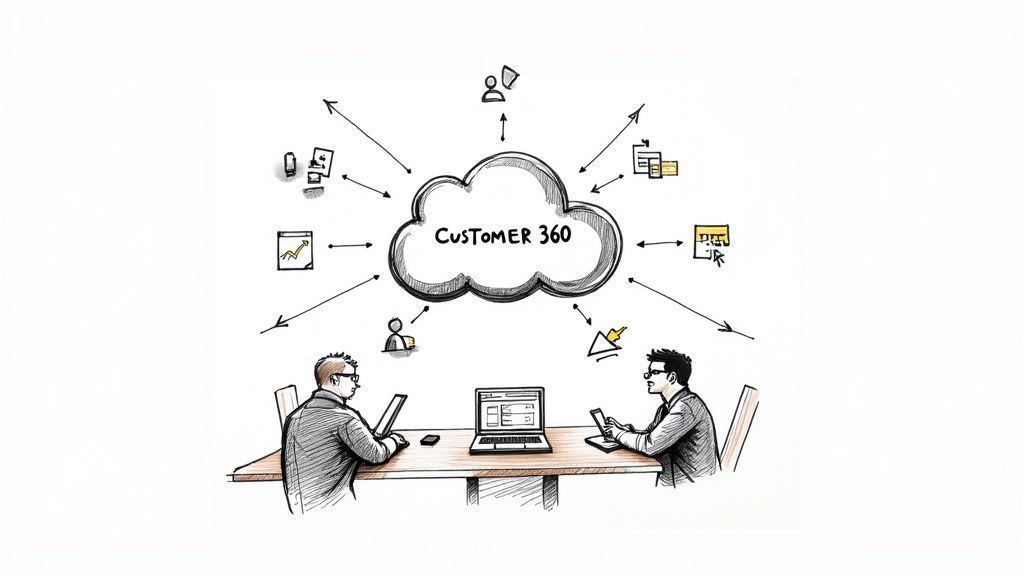
Forget the technical jargon. Imagine the difference between a static spreadsheet saved on one person’s desktop and a live, collaborative Salesforce dashboard. The spreadsheet is isolated, quickly outdated, and invisible to the rest of the team. The Salesforce dashboard, however, is a living source of truth—always current, accessible to everyone, and designed for collaboration.
This is the core concept behind sales in the cloud. It represents a strategic move away from disconnected spreadsheets, siloed information, and clunky manual processes. Instead, you centralise every sales activity and piece of customer data into a single, secure online hub like Salesforce.
From Disconnected Data to a Single Source of Truth in Salesforce
In a traditional sales environment, critical customer information is often scattered across email inboxes, personal spreadsheets, and separate departmental systems. This data chaos isn’t just inefficient; it’s a direct obstacle to growth, leading to missed opportunities and a disjointed customer experience.
Cloud-based CRM platforms, with Salesforce Sales Cloud at the forefront, eliminate this fragmentation. They establish a single source of truth where every customer interaction, sales activity, and deal progression is captured in one unified profile. This ensures your entire organisation—from sales and marketing to service and leadership—is operating from the same accurate, real-time information.
For a sales team, having a single source of truth isn’t just a convenience; it’s a competitive advantage. It ensures that when a customer calls, any team member can pick up the conversation with full context, delivering a seamless and professional experience that builds trust.
Let’s break down the practical differences.
Comparing Traditional vs. Salesforce Cloud-Based Sales
The table below highlights the fundamental shift from relying on on-premise tools to leveraging a dynamic cloud platform like Salesforce.
| Aspect | Traditional On-Premise Sales | Modern Sales in the Cloud (Salesforce) |
|---|---|---|
| Data Access | Limited to office computers; remote access is difficult and often insecure. | Accessible anywhere, anytime, on any device with an internet connection. |
| Collaboration | Siloed. Reps work from separate files, making team selling and management oversight difficult. | Real-time and seamless. Multiple team members can collaborate on the same customer record simultaneously. |
| Information | Fragmented across emails, spreadsheets, and different departments. A recipe for confusion. | A unified single source of truth for all customer data, sales activities, and service interactions. |
| Updates & Maint. | Requires manual software installations, patches, and server maintenance by an internal IT team. | Automatic, seamless updates are rolled out by Salesforce three times a year, with no downtime. |
| Scalability | Expensive and slow. Requires purchasing and configuring new hardware to accommodate growth. | Effortlessly scalable. Add new users, features, or integrations with just a few clicks. |
This comparison makes it clear: moving your sales to the cloud with Salesforce isn’t just a minor upgrade—it’s a complete operational transformation that prepares your business for modern challenges and sustainable growth.
How Salesforce Sales Cloud Empowers Sales Teams
This centralisation delivers immediate, practical benefits that directly impact your bottom line. It’s not just about online storage; it’s about building a smarter, more efficient sales engine. With a cloud CRM like Salesforce, you empower your team to:
- Access Data Anywhere: Your reps can update opportunities on a laptop in the office, check deal statuses on a tablet while travelling, or pull up a report on their phone between meetings. The work follows them, not the other way around.
- Automate Repetitive Tasks: Free your team from manual data entry, follow-up reminders, and report generation. Salesforce automation lets them focus on what they do best: building relationships and closing deals.
- Improve Cross-Functional Collaboration: Sales managers get a live view of the team’s pipeline. Marketing can see which leads are converting into revenue. Service teams can flag upsell opportunities. This alignment creates a truly customer-centric organisation.
As a trusted Salesforce partner, we’ve guided numerous businesses through this transition. It lays the groundwork for a more organised, data-driven, and agile sales operation ready for any market condition.
The Business Case for Salesforce Sales Cloud
Moving your sales operation to the cloud with Salesforce is more than a technology decision; it’s a strategic investment in your company’s future. To build a compelling business case, you must focus on the measurable operational improvements that fuel growth, enhance efficiency, and create a competitive advantage.
The argument for Salesforce rests on three powerful pillars: superior cost-efficiency, effortless scalability, and enhanced team collaboration. By shifting from owning infrastructure to subscribing to a world-class service, you revolutionise your financial model and operational agility.
Shifting from Capital Expense (CapEx) to Operational Expense (OpEx)
Traditionally, acquiring new sales software meant a huge upfront investment in servers, software licenses, and the IT staff required to maintain it. This Capital Expense (CapEx) model ties up significant cash in depreciating assets and makes it difficult to adapt to market changes.
Cloud platforms like Salesforce completely transform this financial equation. Instead of a large upfront purchase, you pay a predictable subscription fee, moving your CRM costs into the Operational Expense (OpEx) category.
This shift from CapEx to OpEx is a game-changer for financial planning. It frees up capital that can be reinvested into other growth areas—like marketing, product development, or hiring top talent—while making your technology costs predictable and manageable.
This transition delivers several key financial benefits:
- Reduced IT Overhead: You no longer need to budget for server maintenance, hardware replacements, or disruptive software updates. Salesforce handles all of it.
- Predictable Budgeting: Monthly or annual subscription fees make forecasting costs straightforward, eliminating surprise expenses.
- Lower Total Cost of Ownership (TCO): When you factor in hardware, maintenance, and staff time, the TCO for on-premise solutions is often significantly higher than a Salesforce subscription.
Enabling True Business Scalability with Salesforce
For any growing business, scalability is non-negotiable. In the on-premise world, expansion was slow and expensive. Onboarding a new sales team might require purchasing and configuring a new server—a project that could take weeks or months, causing you to miss market opportunities.
Salesforce removes these barriers. Scaling your team up or down is as simple as adjusting your subscription. This agility ensures your CRM grows with your business, not against it. This is especially relevant in Australia’s thriving digital economy. According to Grand View Research, the Australian cloud computing market reached USD 14,981.1 million in 2024 and is projected to soar to USD 60,745.5 million by 2030, demonstrating the rapid adoption of scalable cloud solutions.
Case Study: How Salesforce Powered a Retailer’s National Expansion
We partnered with a mid-sized Australian retailer with ambitious plans for national growth. Their existing sales system was tied to their head office, making it impossible to support a remote or geographically dispersed team. They faced a classic growth dilemma: make a massive investment in new IT infrastructure or find a smarter, cloud-based path to scale.
We implemented Salesforce Sales Cloud, creating a central hub for their entire sales operation.
- The Business Challenge: Support a growing, national sales team without a significant increase in IT infrastructure costs.
- The Salesforce Solution: A single Sales Cloud platform providing every team member with real-time data access on any device, regardless of their location.
- The Results and Benefits: The retailer successfully expanded into three new states within the first year. New sales reps were onboarded and productive in days, not weeks. Management gained a live, national view of sales performance, and the company achieved its expansion goals without purchasing a single server.
This project, and others in our portfolio of client success stories, perfectly illustrates the power of sales in the cloud with Salesforce. The retailer didn’t just get new software; they gained the operational backbone for sustainable, cost-effective growth.
A Look Inside the Salesforce Sales Cloud Engine
While the high-level benefits are compelling, the true value of Salesforce Sales Cloud is revealed in its day-to-day functionality. It’s not just a digital contact list; it’s a purpose-built engine designed to manage every stage of your sales cycle with intelligence and clarity.
Let’s explore the core components that directly drive revenue and improve team performance.
Lead and Opportunity Management: Your Blueprint for Revenue
This is the command centre for your sales pipeline. Lead Management in Salesforce captures every potential customer, whether they came from a web form, a trade show, or a referral. The platform ensures no lead is ever lost. You can automatically score leads based on their engagement and route them to the right sales rep for immediate follow-up.
Once a lead is qualified, it’s converted into an Opportunity. This is where Salesforce provides a clear, detailed view of every potential deal. You can track the deal stage, expected close date, and potential value, giving sales managers a real-time, accurate forecast of the entire pipeline. This visibility is crucial for making informed business decisions.
Contact Management: The 360-Degree Customer View
In Salesforce, a contact record is far more than just a name and phone number. It is the central repository for every piece of information about a person and their company. This 360-degree view is the foundation of modern, relationship-based selling, providing your team with complete context in an instant.
From a single screen, a sales rep can see:
- Interaction History: Every email, phone call, and meeting is logged.
- Service Cases: Any past support tickets are visible, preventing awkward conversations.
- Purchase History: A complete record of past purchases provides perfect context for upselling.
- Marketing Engagement: See which campaigns they’ve engaged with to understand their interests.
This complete picture empowers your team to have smarter, more personalised conversations. They can anticipate customer needs and build consultative relationships—a significant advantage in any competitive market.
Sales Forecasting and Analytics: Driving Data-Informed Decisions
Gut feelings are no longer sufficient for managing a high-performing sales team. Salesforce replaces guesswork with hard data through its powerful forecasting and analytics tools. Sales leaders can view forecasts in real time, segmented by team, territory, or individual rep, enabling proactive adjustments to meet targets.
Customisable dashboards and reports provide an at-a-glance view of your key performance indicators (KPIs). You can track lead conversion rates, average deal size, and sales cycle length to identify what’s working and what needs improvement. This data-driven feedback loop is essential for continuous process refinement and growth. Plus, with every new update, like the highlights of the Salesforce Winter ’25 release, these analytics capabilities become even more powerful.
Project Insight: We worked with a professional services firm drowning in disconnected spreadsheets. Their team was wasting hours each week on manual reporting instead of engaging with clients. By implementing Salesforce Sales Cloud and automating their lead-to-opportunity workflow, we helped them reduce manual data entry by 30%.
This automation didn’t just save time—it directly increased revenue. With the administrative burden lifted, the team refocused that energy on building client relationships and closing larger deals. It’s a perfect example of how sales in the cloud with Salesforce is about empowering your people to do their best work.
Your Strategic Guide to a Successful Salesforce Implementation
A successful Salesforce launch is less about the technology itself and more about aligning your people, processes, and strategy. As a dedicated Salesforce partner, we’ve learned from over 110 projects that a structured, strategic approach is the key to unlocking the platform’s full potential from day one.
Think of your implementation as a critical business project that demands a clear vision and an experienced partner to guide you through it. The journey begins by defining what success looks like for your business.
Defining Clear Business Goals Before You Begin
Before any technical work starts, the most important step is to answer one question: “What specific business problems are we trying to solve?” A Salesforce implementation should be a business transformation project, enabled by technology.
To get this right, bring stakeholders from across the organisation into the conversation. Talk to your sales reps, marketing team, and customer service staff to understand their daily challenges and opportunities for improvement.
- For Sales Leaders: Is the goal to improve forecast accuracy by 15%?
- For Sales Reps: Is it about reducing administrative tasks by five hours per week?
- For Marketing: Is the objective to gain clear visibility into which campaigns generate high-quality leads?
Setting these specific, measurable goals provides a clear direction for the project and establishes the benchmarks you’ll use to measure your return on investment.
Mapping Sales Processes and Managing Your Data
With your goals defined, the next step is to map your existing sales processes. This involves detailing the journey from a new lead to a closed deal, which often uncovers hidden inefficiencies that Salesforce can solve through intelligent automation and streamlined workflows.
Next comes data migration—a critical milestone. Your existing customer data is a valuable asset, but it must be cleaned, organised, and correctly formatted before being moved into Salesforce. This step is often underestimated, but getting it right ensures your team trusts the system from the moment they log in. For more detail, explore our complete Salesforce implementation guide for Australian businesses.
This infographic shows how Salesforce features manage the customer journey, turning leads into actionable business insights.
This visual flow highlights how a well-implemented CRM creates a structured, repeatable path to revenue.
Driving User Adoption Through a Collaborative Partnership
Here’s a lesson learned from over a decade of successful Salesforce projects: user adoption is everything. You can build the most technically perfect system, but if your sales team doesn’t use it, the project is a failure.
The key to achieving high adoption is not a secret formula; it’s involvement.
On one project, the initial system design was led entirely by management. When we facilitated workshops that included frontline sales reps, everything changed. They identified practical, real-world challenges the initial plan had missed. Their input was instrumental in building a system they were genuinely excited to use, which drove adoption rates through the roof.
This collaborative approach proves that the best implementations are built on a solid foundation of change management and partnership. Success isn’t just delivered by a technology partner; it’s co-created with the people who will use the platform every day.
Integrating Salesforce into Your Technology Ecosystem
Salesforce delivers maximum value when it serves as the central hub of your business, not as an isolated data silo. To truly capitalise on your investment, integrating Salesforce with your other critical business systems is essential. This creates a seamless flow of information across your entire organisation, breaking down the barriers that hinder growth.
Think of it as building digital bridges between Salesforce and the other software you rely on. When your systems can communicate, your sales in the cloud strategy becomes exponentially more powerful.
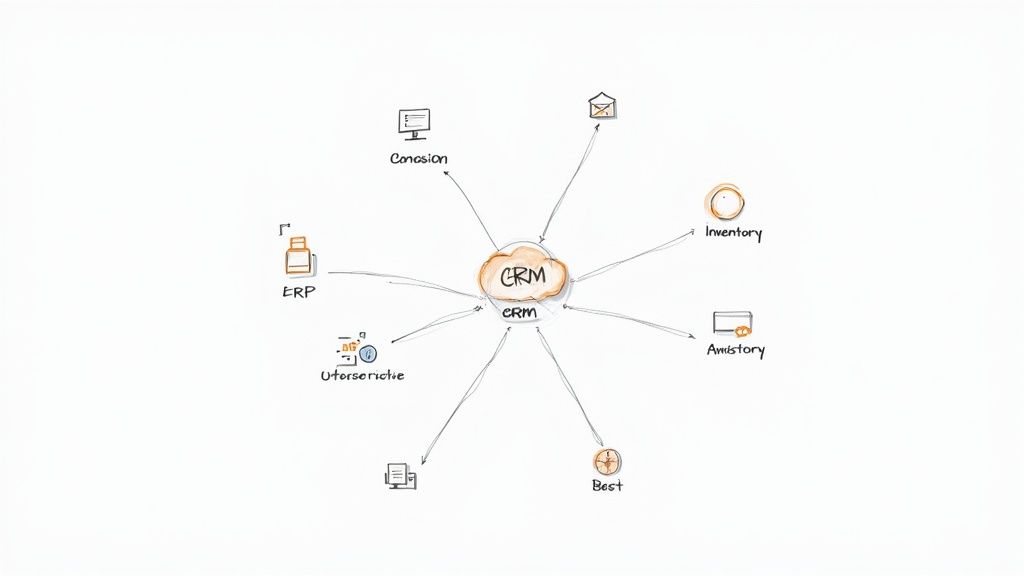
Common and Critical Salesforce Integration Points
While every business has a unique tech stack, several key integrations consistently deliver immediate and significant value by ensuring every department is working from a single source of truth.
Consider integrating Salesforce with these critical systems:
- Enterprise Resource Planning (ERP): Connecting Salesforce to your ERP (e.g., NetSuite, SAP) gives your sales team real-time visibility into financials, order history, and inventory levels directly within the CRM.
- Marketing Automation Platforms: A tight integration with platforms like Salesforce Account Engagement (formerly Pardot) creates a seamless lead-to-revenue journey, allowing marketing to pass qualified leads to sales and track campaign ROI accurately. Learn more in our guide on Account Engagement best practice.
- Customer Service Tools: Integrating Sales Cloud and Service Cloud allows sales reps to see a customer’s complete support history. This context is invaluable for nurturing relationships and identifying upsell opportunities.
As a Salesforce partner, we’ve learned that the most successful integrations are driven by a clear business need. The goal isn’t just to connect systems; it’s to solve a specific operational problem, like eliminating duplicate data entry or providing sales with real-time stock information.
Mini Case Study: A Manufacturing Client’s Integration Success
We recently partnered with a manufacturing client whose sales and operations teams were completely disconnected. The sales team lacked visibility into real-time stock levels, leading to inaccurate delivery estimates and frustrated customers.
- The Business Challenge: The sales team was selling products without knowing if they were in stock, causing a poor customer experience and operational challenges.
- The Salesforce Solution: We integrated their Salesforce Sales Cloud instance directly with their inventory management system. This integration displayed real-time stock data on the product and opportunity records within Salesforce.
- The Results and Benefits: The impact was immediate. The sales team could now provide customers with accurate delivery timelines during the sales process. This single integration dramatically improved customer satisfaction, reduced internal friction, and helped them close deals faster and with greater confidence.
This project demonstrates how strategic integrations amplify the power of sales in the cloud. It’s not just about centralising sales data; it’s about enriching that data with critical information from across your entire business ecosystem. Exploring how interactive video platforms integrate with Salesforce can also provide innovative ideas for your own technology strategy.
The Future of Sales: AI and Cloud Innovation with Salesforce
The world of cloud sales is accelerating, driven by innovations in artificial intelligence (AI) and machine learning embedded directly into platforms like Salesforce. This is where sales in the cloud evolves from a system of record into an intelligent co-pilot for your sales team.
This shift is about more than just automation; it’s about embedding predictive insights into your team’s daily workflow to drive smarter decisions and better outcomes.
AI-Driven Insights with Salesforce Einstein
Salesforce Einstein acts as a dedicated data scientist for every sales rep. Instead of manually sifting through leads, Einstein uses AI to analyse historical data and provide predictive lead scoring, guiding your team to focus on the opportunities most likely to convert.
This intelligence extends to sales forecasting. Einstein analyses your pipeline, identifies deals at risk, and offers more accurate revenue predictions, giving leadership the clarity needed for strategic planning.
The real power of AI in sales isn’t about replacing sales professionals. It’s about augmenting their skills, removing guesswork, and freeing them to spend more time on high-value activities like building relationships and solving complex customer problems.
Data Security and Sovereignty in Australia’s Cloud Market
As Australian businesses embrace cloud solutions, data security and sovereignty have become paramount. The demand for secure, locally hosted data solutions is fuelling massive growth in the local cloud market.
Leading cloud providers like Salesforce are responding by investing heavily in Australian data centres and robust security measures. This commitment ensures that sensitive customer information is handled in full compliance with Australian privacy laws, which is fundamental to building and maintaining client trust.
Staying ahead of these trends—from AI-powered efficiency to best-in-class data security—is essential for a competitive edge. Understanding the future of AI sales agents provides a glimpse into the next wave of cloud innovation. These advancements offer a clear path to smarter selling and sustainable growth for businesses ready to embrace the future.
Answering Your Key Questions About Salesforce Sales Cloud
Moving your sales operations to a cloud platform like Salesforce is a significant strategic decision. As a Salesforce partner who has guided hundreds of businesses through this transition, we find that the same critical questions often arise. Let’s address them directly.
How secure is our customer data in the Salesforce cloud?
This is the top concern for most businesses, and rightly so. The answer is: your data is extremely secure. Salesforce was built with a multi-layered security architecture at its core. This includes physical security at global data centres, robust network defences, and application-level security that gives you granular control over user permissions. This ensures your team members only see the data relevant to their role. Furthermore, Salesforce adheres to stringent global compliance standards and Australian data sovereignty laws, providing peace of mind that your most valuable asset—your customer data—is protected.
What is the typical ROI on a Salesforce Sales Cloud investment?
While the exact return on investment (ROI) varies based on your business goals and implementation scope, a well-executed project consistently delivers a strong positive return. The value is driven by measurable improvements across your sales operations. We typically see ROI generated from three key areas:
- Increased Sales Productivity: By automating manual tasks, your sales team can spend more time on revenue-generating activities.
- Shorter Sales Cycles: Enhanced pipeline visibility and streamlined processes enable reps to close deals faster.
- Improved Forecast Accuracy: Real-time data and powerful analytics provide leadership with a reliable view of future revenue, enabling better strategic decisions.
Ultimately, a Salesforce implementation is an investment in efficiency and growth, not just a software expense.
How long does a Salesforce implementation take?
The project timeline depends on the complexity of your requirements. A straightforward, out-of-the-box implementation for a small team can often be completed within 6-12 weeks. More complex projects involving significant customisation, complex data migration from legacy systems, or multiple integrations will naturally require a longer timeline.
As an experienced implementation partner, we often recommend a phased rollout. This approach gets your team using and benefiting from core Salesforce features quickly, while we build out more advanced functionality in subsequent phases. It’s the smartest way to achieve a faster return on your sales in the cloud investment.
This strategy ensures a smoother transition, fosters early user adoption, and demonstrates value from the very beginning.
Ready to explore how a tailored Salesforce solution can accelerate your business growth? The team at Adaptal has successfully delivered over 110 Salesforce projects for businesses across Australia. Let’s discuss how we can help you achieve your sales objectives. Contact us for a consultation today.
Pingback: A Guide To CPQ For Salesforce For Smarter Selling