
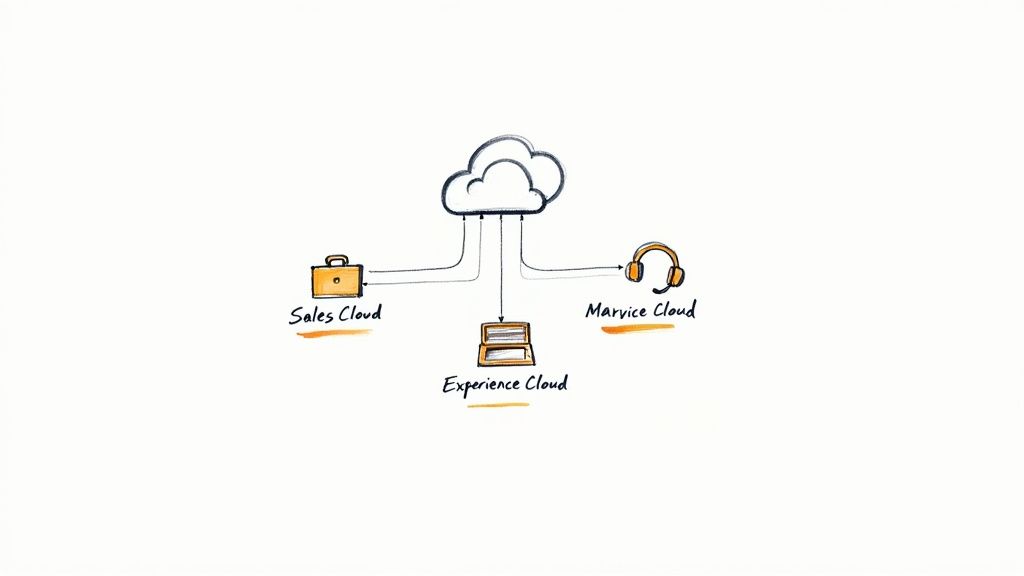
Salesforce cloud services are a suite of powerful, interconnected applications built to manage every touchpoint of your customer relationships. At their heart, they provide a single, shared view of every customer, tearing down the walls that traditionally separate sales, service, and marketing teams to fuel cohesive, sustainable growth. As a trusted Salesforce partner, we've seen firsthand how this integrated approach transforms businesses, turning data silos into a powerful engine for digital transformation.
What Are Salesforce Cloud Services
Many businesses still operate in silos. Sales has its own data, customer service works from a different set of records, and marketing uses another platform entirely. This disconnection doesn't just create inefficient internal processes; it creates a fractured and frustrating experience for customers. This is the exact business challenge Salesforce was built to solve.
Instead of a single piece of software, picture Salesforce as the central hub for your entire organisation. Each "cloud"—such as Sales Cloud, Service Cloud, or Marketing Cloud—is a specialised tool designed for a specific business function. The magic happens because they all connect to the same core platform, sharing data and insights in real time.
This integrated approach means every person on your team, regardless of their role, works from the same playbook. When a sales rep views a contact, they can see recent support tickets. When a service agent takes a call, they already know that customer's entire purchase history. It's this unified view that forms the foundation of a modern, customer-centric business.
Connecting Your Business Functions for a 360-Degree Customer View
The true power of Salesforce cloud services ignites when these specialised clouds work together. A lead generated by a marketing campaign can be automatically routed to the right salesperson, complete with a history of every interaction that prospect has had with your brand. Once a sale is made, that customer’s information flows seamlessly into Service Cloud, arming your support team for any future needs.
This operational harmony is what drives tangible business results. Your teams can stop wasting time manually passing information between departments and instead focus on what they do best. The key benefits delivered by this unified model are clear:
- A Complete Customer View: Every department gains access to a rich, 360-degree profile of each customer, enabling more personalised and effective interactions.
- Improved Team Collaboration: Breaking down data silos fosters a culture of collaboration where sales, service, and marketing are aligned and pulling in the same direction.
- Data-Driven Decisions: With all your customer data in one place, you can generate accurate reports and forecasts that lead to smarter, more confident strategic decisions.
At its core, Salesforce provides a single source of truth. It ensures that no matter where a customer interacts with your business, the experience is consistent, informed, and built on a complete understanding of their history with you.
The platform is also constantly evolving. For business owners and admins, staying on top of updates is crucial to maximising your investment. You can find valuable information on the highlights of the Salesforce Winter '25 release to see how the latest advancements can support your business objectives. As an experienced Salesforce partner, we see how this connected ecosystem helps businesses not just manage customer relationships, but truly transform them.
Driving Growth and Revenue with Sales Cloud
A common business challenge for growing companies is hitting a sales plateau. Leads are coming in from multiple sources, customer data is buried in scattered spreadsheets, and the sales team is operating more on intuition than on hard data. This disconnected approach creates a massive blind spot, making it nearly impossible to forecast revenue or identify why certain deals are stalling.
This lack of visibility is a growth killer. Opportunities slip through the cracks, follow-ups are missed, and leadership has no real-time view of the pipeline. This is precisely the chaos that Salesforce Sales Cloud is the solution for.
Sales Cloud becomes the single source of truth for your entire sales process. It takes every lead, contact, and opportunity and organises it into a structured, transparent system. This isn't just about tidying up records; it's about building a predictable and scalable engine for generating revenue.
The Solution: From Manual Chaos to Automated Precision
Imagine a new lead comes in through your website. Instead of someone manually logging it, Sales Cloud can instantly capture it, assign it to the right rep, and schedule the first follow-up task. This level of automation frees your team from administrative work so they can focus on what they do best—building relationships and closing deals.
The platform gives reps a complete history for every customer, providing full context before every call or meeting. The results and benefits of this organised approach are massive:
- Centralised Customer Data: All contact info, communication history, and past deals live in one place, creating a complete customer profile.
- Automated Lead Management: Efficiently track leads from their first point of interest through to conversion, ensuring no opportunity is left behind.
- Clear Pipeline Visibility: Get an instant, real-time snapshot of your entire sales pipeline, from prospecting to a closed-won deal.
Sales Cloud shifts your sales process from a reactive, manual slog into a proactive, data-driven strategy. It provides the clarity needed to not just meet targets, but consistently exceed them.
By standardising how your team manages opportunities, you create the foundation for predictable growth. This clarity helps you spot bottlenecks, coach your team more effectively, and make strategic decisions based on what's happening right now.
Advanced Salesforce Tools for Complex Sales Cycles
For businesses with complex offerings, Sales Cloud offers powerful tools to simplify even the most tangled deals. Salesforce CPQ (Configure, Price, Quote), for instance, automates the quoting process. It ensures every quote is accurate, includes the right product mix, and has the necessary approvals, which drastically reduces errors and shortens the time it takes to get a proposal out.
Furthermore, AI-powered insights can analyse past data to predict which deals are most likely to close, flag at-risk opportunities, and even suggest the next best action for a sales rep. This helps the team focus on high-value activities that will have the biggest impact. As a dedicated Salesforce partner, we help businesses implement these salesforce cloud services to achieve tangible results, turning pipeline uncertainty into measurable success.
Building Customer Loyalty with Service Cloud
While Sales Cloud is about winning new customers, Salesforce Service Cloud is engineered to keep them for life. Today's customers expect fast, consistent, and personalised help across every channel—email, phone, live chat, or social media. The business challenge is that without the right tools, this is a difficult promise to keep.
Many businesses stumble here, delivering a disjointed experience where customers must repeat their story because one agent has no idea what another has done. Service Cloud is the solution, transforming your support function from a reactive cost centre into a proactive, loyalty-building machine.
The key is giving every support agent a complete, 360-degree view of the customer. By pulling data from across the Salesforce ecosystem, agents instantly see a customer’s entire history—past purchases, previous support tickets, and even recent chats with sales. This immediate context is the foundation of exceptional service.
Equipping Agents with a Unified Workspace for Better Service
At its core, Service Cloud centralises and organises every customer request, no matter the channel. Here are the key features that solve real-world support challenges:
- Case Management: This is the command centre for all support issues. It automatically creates a "case" for every inquiry and tracks it from open to resolution, ensuring nothing falls through the cracks.
- Knowledge Base: Your team can build a library of helpful articles and FAQs. This empowers agents to find answers fast and lets customers solve common problems themselves, reducing ticket volumes.
- Omni-Channel Routing: This feature intelligently assigns incoming cases to the best-suited agent based on their skills and workload, leading to faster, more accurate resolutions.
Service Cloud stops your support team from flying blind. It provides the tools and context needed to resolve issues on the first contact, turning potentially negative experiences into opportunities to build trust and strengthen relationships.
This commitment to customer service is on full display in Australia. Salesforce has been a major player locally since 2004, and its AI-powered technologies are used by leading companies like Telstra, Flight Centre, and Canva. It’s part of a larger plan to invest in local AI innovation, which you can read more about in this eWeek article on Salesforce's Australian strategy.
Extending Service into the Field with Salesforce Field Service
For businesses with teams out in the field, support doesn't stop at the office. Salesforce Field Service extends the power of Service Cloud to your mobile workforce, connecting dispatchers, technicians, and customers on a single platform.
This powerful addition lets you intelligently schedule and dispatch mobile workers, give them access to customer history on their devices, and provide real-time updates to customers. It ensures the person arriving on-site is as informed as the agent in the call centre. By connecting every touchpoint, these salesforce cloud services create a seamless experience that builds lasting loyalty.
Engaging Customers with Salesforce Marketing Cloud and Account Engagement
While your sales and service teams handle one-on-one interactions, your marketing team faces the challenge of nurturing conversations with thousands of people at once. The goal isn't just sending emails; it's delivering personal, relevant messages that cut through the noise.
This is where Salesforce’s marketing automation platforms shine. They provide the tools to reach the right people at the right moment with a message that resonates. However, Salesforce offers two distinct solutions for different marketing worlds. As a Salesforce partner, one of our first lessons learned is the importance of helping clients choose the right tool for the job.
Marketing Cloud for B2C Customer Journeys
Salesforce Marketing Cloud is engineered for the high-volume, fast-paced world of business-to-consumer (B2C) marketing. It's built to manage massive audiences and create seamless experiences across every channel—email, social media, SMS, and mobile apps.
The core of Marketing Cloud is Journey Builder, a visual tool for mapping out automated customer pathways. For example, an e-commerce brand could design a journey to tackle abandoned carts:
- A customer adds an item to their cart but leaves the site.
- An hour later, an automated reminder email is sent.
- If they still don't purchase, a follow-up SMS with a small discount is sent the next day.
- Once they buy, they are automatically moved into a post-purchase welcome journey.
This level of automation ensures no one slips through the cracks and allows you to build relationships at scale.
Account Engagement (Pardot) for B2B Lead Nurturing
On the other hand, Salesforce Account Engagement (formerly Pardot) is purpose-built for the longer, more considered sales cycles typical in business-to-business (B2B) deals. The challenge here is nurturing high-value leads over weeks or months, ensuring they are sales-ready before the handoff.
Account Engagement is the bridge between marketing and sales. It turns cold leads into warm, qualified opportunities, ensuring that when a salesperson makes contact, they’re talking to someone who is already educated and engaged.
This platform is a powerhouse for key B2B marketing tasks:
- Lead Nurturing: Create automated email campaigns that drip-feed relevant content to prospects over time, building trust.
- Lead Scoring and Grading: The system assigns points to leads based on their actions (like visiting your pricing page) and a grade based on their profile (like job title), automatically surfacing the hottest leads.
- Seamless Sales Handoff: It provides sales reps with a complete history of every marketing touchpoint a lead has had, offering invaluable context for their first conversation.
Implementing these marketing automation tools correctly is a specialised skill. To help businesses maximise their investment, we've compiled key strategies in our guide on Account Engagement best practices. Choosing the right tool—Marketing Cloud for B2C scale or Account Engagement for B2B nurturing—delivers marketing that drives a clear, measurable return.
Creating Digital Experiences and Salesforce Integrations
While the core Salesforce clouds manage your internal world, the real magic happens when you extend that power outwards to connect with customers and link Salesforce with other critical business systems.
This is where two vital parts of the salesforce cloud services ecosystem come into play: Experience Cloud and integration. Getting these right turns Salesforce from an internal tool into the true central hub of your business.
Building Branded Digital Spaces with Salesforce Experience Cloud
Imagine giving your customers their own secure, branded online portal where they can find answers, track orders, and manage their account 24/7. That’s the essence of Salesforce Experience Cloud. It allows you to build stunning websites, portals, and communities that are directly connected to your CRM data.
This is a strategic move to empower everyone you work with.
Case Study Example: We once worked with a manufacturing client whose support team was drowning in repetitive questions about product specs and order status.
- The Business Challenge: Hundreds of hours were being spent each month answering the same basic inquiries.
- The Salesforce Solution: We launched a customer self-service portal using Experience Cloud, giving customers direct access to a knowledge base and their order history.
- The Results and Benefits: Support ticket volume for routine questions dropped by over 40% in just three months. This freed up their agents to tackle complex, high-value problems that required a human touch.
This infographic gives a great overview of how Salesforce's marketing tools work hand-in-hand to create these engaging customer journeys.
As the diagram shows, whether you're B2B (Account Engagement) or B2C (Marketing Cloud), everything is powered by the central Salesforce platform, creating a single, unified way of interacting with your customers.
Unifying Your Tech Stack Through Salesforce Integration
Salesforce is powerful on its own, but it becomes unstoppable when connected to other software that runs your business—like accounting systems such as Xero or MYOB, or your ERP like NetSuite or SAP.
Integration ensures that Salesforce isn't just another data silo. It becomes the single source of truth for your entire organisation, creating a unified view of the business from the first marketing touchpoint to the final invoice.
Without it, you’re stuck with manual data entry, which is slow and error-prone. Salesforce offers two main ways to integrate:
- The AppExchange: Salesforce's marketplace, packed with thousands of pre-built apps to connect Salesforce to other popular tools.
- MuleSoft: For more complex, custom integrations, Salesforce's MuleSoft platform can connect almost any application, data source, or device.
To get the most value from your Salesforce cloud services, it’s worth exploring how real-time data integration can lift business efficiency. For those interested in the technical side, our guide on how to expose a file via Salesforce Flow is a great resource. As an experienced Salesforce partner, we specialise in these complex projects, ensuring your entire tech stack works in harmony.
Choosing the Right Salesforce Partner for Your Digital Transformation
Understanding what the various Salesforce cloud services can do is the first step. The next, and arguably more important, step is turning that potential into real-world business results. The best technology is ineffective without a solid plan for implementation, user adoption, and ongoing optimisation. Success with Salesforce is never just about the software; it's about the strategy, people, and processes you build around it.
This is where finding the right Salesforce partner is crucial. A good partner does more than just technical setup. They act as a strategic guide, helping you navigate the complexities of digital transformation and ensuring your Salesforce investment aligns with your business goals from day one.
Best Practices: Beyond Technical Implementation
A successful Salesforce project is built on three pillars that go beyond the initial configuration. A skilled partner will prioritise each one to deliver genuine, long-term value.
- Strategic Planning: Before implementation begins, your partner should collaborate with you to map everything out. This means defining success metrics, identifying potential roadblocks, and ensuring the project supports your company vision.
- Change Management: A new CRM is a significant cultural shift. A great partner helps manage this by communicating the benefits to your team, providing proper training, and securing buy-in from the start.
- User Adoption: The true test of success is whether your team actually uses the platform. A focus on user adoption means designing intuitive workflows, providing continuous support, and proving how Salesforce makes their jobs easier.
Choosing a Salesforce partner isn’t just about finding someone with technical skills; it’s about finding a guide who understands that technology is only a tool. Real success comes from aligning that tool with your people, processes, and vision to drive meaningful growth.
Finding a Partner with Proven Project Experience
The right partner has a proven track record of helping businesses like yours achieve tangible outcomes. They bring lessons learned from dozens of projects, allowing them to anticipate challenges and steer you toward solutions that work. They understand that a go-live is just the beginning of the journey.
As you consider your next move, think about what you need in a guide. Our team specialises in turning Salesforce’s powerful features into practical, results-driven solutions. If you’re ready to start your journey or get more from your existing setup, explore our dedicated Salesforce consulting services and let’s discuss how we can help you achieve your goals.
Frequently Asked Questions about Salesforce Cloud Services
Jumping into the world of Salesforce cloud services often sparks questions. Here are practical answers to common queries we hear from business leaders and IT managers.
Which Salesforce Cloud is Right for My Small Business?
For most small to medium-sized businesses, Salesforce Sales Cloud is the best starting point. It provides the essential tools to organise leads, manage customer relationships, and gain a clear view of your sales pipeline—the foundation needed for growth. As your business expands, you can easily add other clouds like Service Cloud to manage customer support.
What is the Main Difference Between Sales Cloud and Service Cloud?
The easiest way to think about it is in terms of the customer journey. Sales Cloud focuses on the pre-sale experience—finding prospects, nurturing leads, and closing deals to generate revenue. Service Cloud kicks in post-sale, focusing on retaining customers through exceptional support, issue resolution, and building long-term loyalty. While they have different functions, they work together on the same platform to provide a complete customer view.
The simplest distinction is that Sales Cloud helps you win customers, while Service Cloud helps you keep customers. Both are critical for sustainable business growth and rely on the same shared CRM data.
Can Salesforce Integrate with Our Existing Accounting Software?
Absolutely. This is one of the platform’s greatest strengths. Salesforce is designed to be the central hub of your business, so connecting it to critical systems like Xero, MYOB, NetSuite, or SAP is not just possible—it's a best practice. This is typically done through pre-built connectors on the AppExchange or through custom integrations built by a Salesforce partner.
Why Do We Need a Salesforce Partner for Implementation?
While you can set up Salesforce on your own, a partner brings invaluable experience from hundreds of projects. Their value goes beyond technical setup; they act as strategic advisors. A good partner ensures your implementation is directly tied to business goals, helps manage the change within your team to drive user adoption, and configures the platform to match your unique processes. This expertise helps you avoid common pitfalls and achieve a higher return on your investment, faster.
Ready to see how Adaptal can tailor Salesforce cloud services to your unique business needs? We are a leading Salesforce Consulting Partner in Australia, dedicated to helping organisations like yours achieve transformative growth. Explore our services and book a consultation to start your journey.