
A digital transformation consultant is an expert co-pilot, guiding your business through the often-turbulent journey of integrating new digital technology. They don't just hand you a map; they help you build a strategic roadmap using platforms like Salesforce, and provide the change management know-how to ensure your investment delivers real results and enthusiastic user adoption.
Why a Salesforce Consultant Is Your Digital Transformation Co-Pilot

Kicking off a digital transformation can feel like trying to build a plane while it's already in the air. You know you want more efficiency, incredible customer experiences, and sustainable growth, but the path is rarely smooth. This is why a specialist Salesforce consultant isn't just an advisor; they're your co-pilot, helping you navigate the complexities of the Salesforce ecosystem.
Think of it like an expedition. A seasoned guide knows the terrain, anticipates pitfalls, and ensures you’re properly equipped. In the same way, a consultant digital transformation expert helps you sidestep common project disasters like blown budgets, stalled progress, and disappointingly low user adoption of your Salesforce platform.
Identifying the Need for Expert Salesforce Guidance
The first step in any transformation is admitting you need to change. Often, this realisation hits when you start to understand the real financial drain of sticking with outdated processes. For instance, many businesses only see the urgency after calculating the true cost of AR inefficiency in professional services. These pain points are clear signals that it’s time for an expert-led Salesforce strategy.
Some of the most common challenges that call for a consultant's help include:
- Siloed Customer Data: Your sales, service, and marketing teams work from different spreadsheets and systems, creating a fractured customer experience and leaving revenue on the table.
- Inefficient Manual Workflows: Repetitive tasks are eating up your team's time and energy, preventing them from focusing on high-value, strategic work.
- Lack of Actionable Insights: You're swimming in data but have no clear way to turn it into smart decisions that grow the business.
Translating Problems into a Salesforce Roadmap
This is where a skilled Salesforce consultant shines. They take these messy business challenges and translate them into a clear, actionable roadmap using powerful Salesforce tools, architecting solutions that solve your specific pain points.
For example, they might design a Salesforce Sales Cloud implementation to unify all your sales data, creating a single source of truth for your entire pipeline. Or, for service teams drowning in disorganised emails, they might configure Service Cloud to create a streamlined case management system.
The goal is to ensure your technology investment delivers tangible results from day one. By partnering with an experienced Salesforce consulting team, you’re not just hiring a tech expert; you’re gaining a strategic ally dedicated to making your Salesforce-driven transformation a genuine success.
The Strategic Role of a Salesforce Consultant
A great Salesforce consultant does more than just install software; they're the architects of your business's growth. Their role isn't merely technical—it's deeply strategic, designed to rethink your processes and unlock your Salesforce investment's true potential. A genuine consultant digital transformation expert steps into several critical roles to ensure the project delivers lasting value.
This strategic partnership is becoming non-negotiable as Australian businesses double down on their digital plans. The Australian digital transformation market, currently sitting at around USD 18.5 billion, is tipped to grow at a staggering rate of 18.4% each year, potentially hitting USD 84.7 billion by 2033. This explosion is fuelled by the rush to adopt advanced cloud solutions like Salesforce, underscoring the need for expert guidance.
The Consultant as an Architect
First, a top-tier Salesforce consultant is the Architect of your transformation. Their job is to draw up a detailed, scalable blueprint that aligns with your big-picture business goals, not just immediate tech headaches. They look beyond current pain points to design a Salesforce setup that can grow and change with your organisation.
This involves:
- Deep Discovery: Running workshops to understand your unique workflows, long-term ambitions, and hidden inefficiencies.
- Solution Design: Mapping your business processes to the right Salesforce products—like Sales Cloud, Service Cloud, or Marketing Cloud—to ensure a perfect fit.
- Future-Proofing: Building a solid foundation that can handle future integrations, new business units, and shifting market demands without a complete rebuild.
For a manufacturing firm, the architect doesn’t just switch on Sales Cloud. They might design a fully integrated system with Salesforce CPQ to automate complex quoting, ensuring the solution can scale as the product line expands.
The Consultant as a Translator
Next, the consultant plays the crucial role of Translator. They are the essential bridge between your team's day-to-day needs and the powerful technical capabilities of the Salesforce platform. Getting this right is what makes a solution both powerful and easy to use.
A consultant’s value lies in their ability to turn a business problem into a technical solution and then explain that solution back in clear, business-focused terms. They ensure what is built is not just what was asked for, but what is truly needed.
This means they listen to the frustrations of your sales reps and service agents. Instead of talking in code, they explain how a workflow automation in Service Cloud will slash manual data entry or how an Account Engagement (Pardot) journey will nurture leads more effectively. This ensures the final product feels intuitive and solves tangible problems—a massive part of any successful Salesforce project.
The Consultant as a Change Champion
Finally, and perhaps most importantly, a consultant must be a Change Champion. Technology is only useful if people use it, and driving company-wide adoption is often the biggest hurdle. A great consultant anticipates resistance and works proactively to build enthusiasm for the new system.
Their role as a champion involves:
- Building Buy-In: Involving key stakeholders from the start so they feel a sense of ownership over the project.
- Demonstrating Value: Clearly showing teams how new Salesforce tools will make their jobs easier and more impactful.
- Providing Training and Support: Developing role-specific training that turns sceptical users into confident platform advocates.
For a non-profit, this could mean guiding them to bring scattered donor data into one Salesforce instance. By championing this change, the consultant helps the fundraising team see how Salesforce provides a 360-degree view of donors, helping them build stronger relationships and boost contributions. Discover more about how Salesforce development consultants drive these impactful transformations in our detailed guide.
Mapping Your Consultant-Led Salesforce Journey
A successful Salesforce transformation isn’t a chaotic sprint; it’s a well-mapped expedition. A core part of what an expert digital transformation consultant does is break down a complex project into a clear, four-phase journey. This structured approach demystifies the process, turning an overwhelming vision into manageable, strategic steps.
This infographic shows how a consultant’s value evolves through the key roles of Architect, Translator, and Champion during the project.
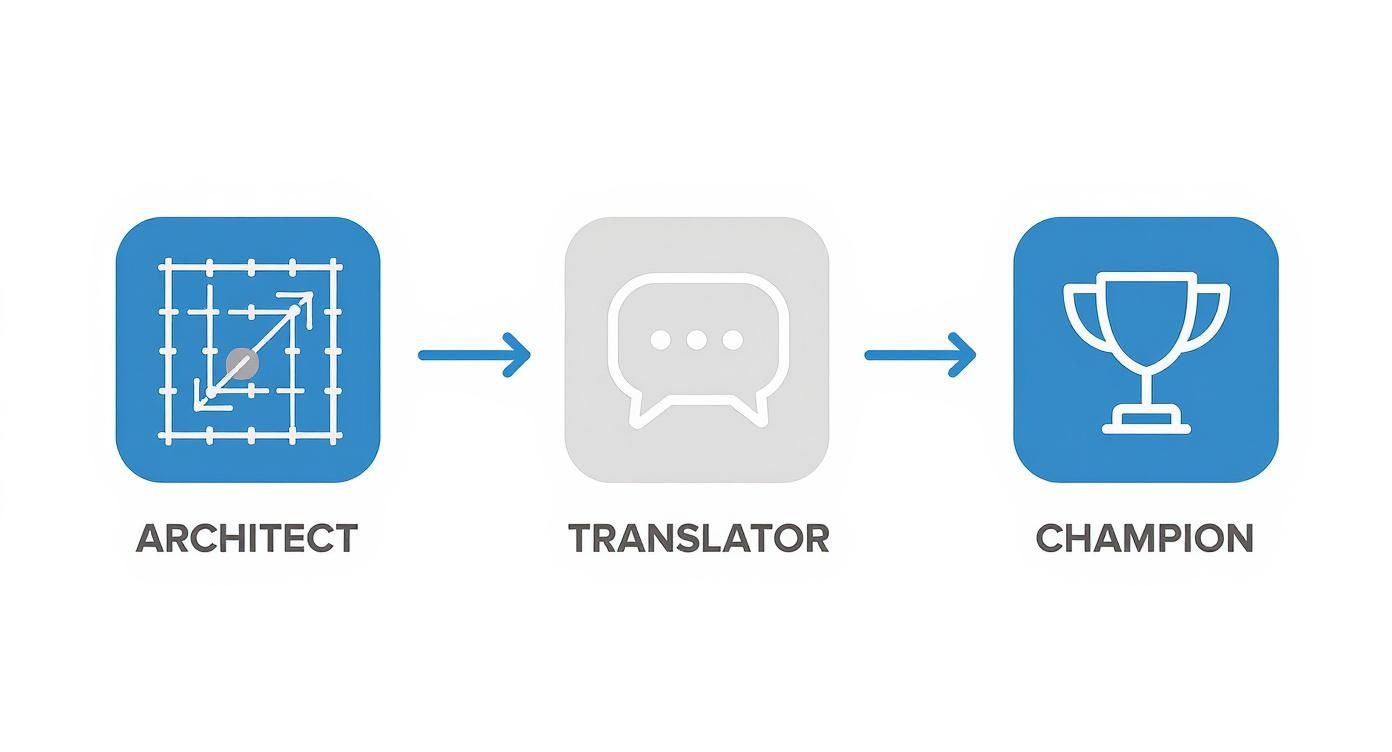
A consultant's contribution isn't a one-off task but a continuous cycle of designing, communicating, and driving adoption to ensure the changes stick. Let’s explore how this value is delivered at each stage of a typical Salesforce implementation.
Phase 1: Discovery and Strategy
This initial phase is arguably the most critical. It’s where your consultant digs deep to uncover your core business challenges and operational pain points. This isn't just about tech; it’s about understanding the "why" behind your need for change.
A key activity here is talking to everyone, from C-suite executives to frontline sales and service staff. After more than 110 Salesforce implementations, we've learned that you uncover the gold by listening to the people who will use the system every day.
The primary goals of this stage are:
- Defining Success Metrics: What does a "win" look like? Is it a 20% increase in lead conversion, a 30% drop in case resolution time, or a clear view of your sales pipeline? We establish measurable KPIs from the start.
- Identifying Quick Wins: We pinpoint high-impact, low-effort changes that can deliver immediate value and build project momentum.
- Creating a Strategic Roadmap: We map out a plan outlining project phases, key milestones, and the resources needed.
Phase 2: Solution Design and Architecture
With a clear strategy, the focus shifts to designing the technical solution. This is where your consultant puts on their architect hat, translating your business needs into a robust and scalable Salesforce setup. They map your real-world processes to Salesforce features, ensuring the final system feels natural for your team.
This stage involves creating detailed solution design documents, which become the blueprint for the entire project. This covers everything from data models and security profiles to workflow automations and integrations with other systems like Xero or NetSuite.
The goal of solution design isn't to bend your business to fit Salesforce, but to configure Salesforce to support and enhance your unique way of working.
For example, for a professional services firm, we might design a custom object in Sales Cloud to track project milestones, linking them directly to client accounts and opportunities. The design must be practical and solve a real-world business need.
Phase 3: Implementation and Configuration
This is the build phase, where the vision from the design documents comes to life. A consultant-led team gets hands-on, configuring the Salesforce environment, building custom automations, and tackling one of the most delicate parts of any project: data migration.
A proven data migration strategy is essential. We've seen projects stumble because of poor data quality. Our approach involves a multi-step process of cleaning data, mapping old fields to new Salesforce fields, and running test migrations before the final switch. This minimises risk and ensures your team starts day one with clean, reliable data.
During this phase, we also focus on integrating Salesforce with your other critical business systems to create a unified tech stack where data flows seamlessly.
Phase 4: Adoption and Optimisation
The project isn't over at go-live. The final, ongoing phase is about ensuring your team uses the new platform and that the solution keeps delivering value. A true digital transformation consultant prioritises change management from day one.
This final stage includes:
- Role-Based Training: We provide hands-on training tailored to how each team—sales, service, marketing—will use Salesforce in their day-to-day jobs.
- Post-Launch Support: A dedicated "hypercare" period after go-live ensures any immediate questions are resolved quickly.
- Continuous Improvement: We set up a framework for gathering user feedback and planning future enhancements, turning your Salesforce platform into a dynamic tool that adapts with your business.
Real-World Salesforce Transformation Success Stories
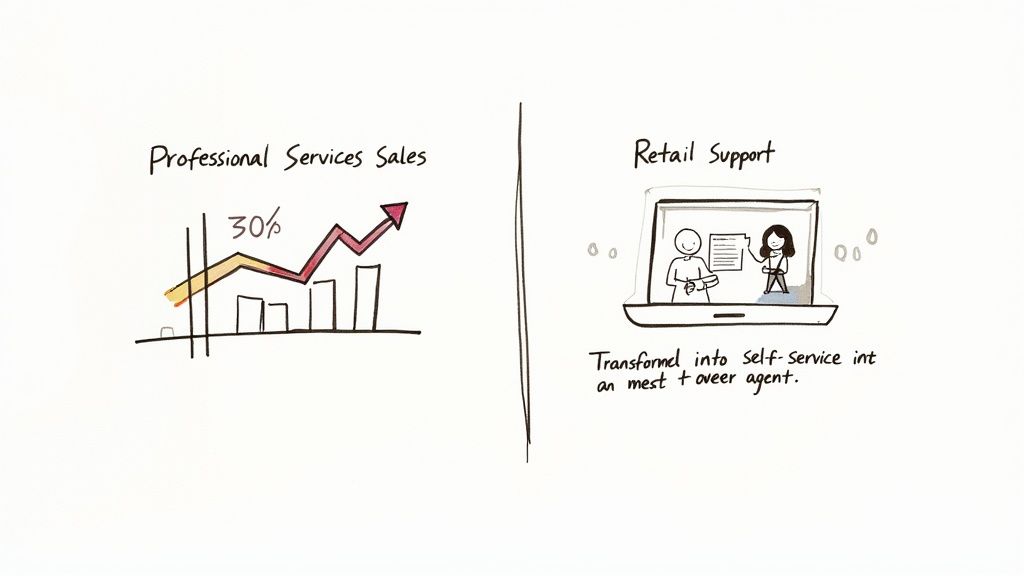
While strategy is the foundation, the real proof of a digital transformation is in the results. A great Salesforce consulting partner turns ambitious plans into tangible business outcomes. The case studies below show how expert guidance, paired with the Salesforce platform, solves genuine business challenges and delivers a clear return on investment.
These aren't hypotheticals; they're impactful projects driving growth for businesses across Australia, fuelling demand for this expertise. The Asia-Pacific digital transformation consulting market is projected to hit USD 11.88 billion by 2025, with Australia comprising about 5.16% of that total, showing how much local businesses value getting their transformation right.
Case Study: From Lead Leakage to a Unified Sales Pipeline
A fast-growing professional services firm was dealing with a common problem: rapid growth was causing process chaos. Leads were scattered in spreadsheets, follow-ups were inconsistent, and management had no visibility into the sales pipeline. This resulted in frustrating lead leakage and lost revenue.
Our team stepped in to implement Salesforce Sales Cloud as the new central nervous system for their entire sales operation.
- The Business Challenge: Disconnected data, no single source of truth for leads or deals, and an inability to forecast revenue accurately.
- The Salesforce Solution: We configured Sales Cloud to automate lead assignment, rolled out standardised sales processes, and built custom dashboards to give leadership a real-time view of pipeline health and team performance.
- The Results and Benefits: Within six months of going live, the firm saw a 30% increase in lead conversion rates. Their sales team finally had a single, unified platform, and leadership could make strategic decisions based on data, not guesswork.
Case Study: Transforming Customer Support with Service Cloud and a Self-Service Portal
A mid-sized retail company was drowning in customer support tickets managed from a chaotic shared email inbox. This meant slow responses, unhappy customers, and burnt-out support agents. They needed a system to bring order to the chaos and empower customers to solve simple problems themselves.
The goal wasn't just to answer tickets faster, but to fundamentally change the customer service dynamic from reactive problem-solving to proactive support.
We rolled out a two-pronged solution to completely overhaul their support function:
- Salesforce Service Cloud: We replaced the shared inbox with Service Cloud, creating an organised case management system. This enabled automated ticket routing, prioritisation, and a 360-degree view of every customer's history.
- Salesforce Experience Cloud: We then built a customer-facing, self-service portal where customers could track orders, search a knowledge base, and connect with other users.
This dual approach had a massive impact. The self-service portal deflected over 40% of routine enquiries, freeing up agents to focus on more complex issues. As a result, their customer satisfaction (CSAT) scores improved significantly.
You can explore more stories like these in our portfolio of Salesforce case studies.
How to Choose the Right Salesforce Partner
Picking a consultant is the single biggest decision you’ll make on your digital transformation journey. You’re not just hiring a contractor; you’re bringing on a partner who will be deeply embedded in your business, helping steer strategic decisions.
A great Salesforce partner becomes an extension of your team. They should have a transparent, proven methodology and, just as importantly, a collaborative culture that makes the process feel like a shared mission.
Look Beyond Technical Skills
While Salesforce expertise is the baseline, the true value of a digital transformation consultant is their ability to drive change and ensure your team actually wants to use the new system. A partner with a relentless focus on change management is your best bet for getting a real return on your investment.
This is more important than ever, as the Australian consulting services market continues to boom. Valued at AUD 14.45 billion, the sector is projected to grow at a CAGR of 7.5% from 2025 to 2034, with IT consulting leading the charge as businesses seek help with digital adoption.
Critical Questions to Ask Potential Salesforce Partners
To help you make a confident choice, here is a checklist of questions you should be asking. The answers will reveal a partner's approach, experience, and long-term suitability.
- Industry Experience: "Can you show us examples of Salesforce projects you’ve delivered for businesses like ours in our industry?"
- Change Management Focus: "What is your plan for ensuring our team embraces the new platform, not just learns it?"
- Methodology and Transparency: "Walk me through your project methodology. How will you keep us informed on progress and potential hurdles?"
- Problem-Solving Skills: "Tell me about a time a project went off track. What did you do to resolve it, and what was the outcome?"
- Post-Launch Strategy: "What does your support look like after we go live? How do you help clients optimise their investment over time?"
A partner’s response to the 'off-track project' question is particularly telling. Honesty and a clear, proactive problem-solving process are hallmarks of a mature and reliable consultant.
Asking these sharp questions moves the conversation from a sales pitch to a strategic discussion. It shows you’re looking for a genuine partner, not just a vendor. This is the bedrock of a successful transformation and a core part of our philosophy in our Salesforce consulting services.
Frequently Asked Questions about Salesforce Transformation
Stepping into a digital transformation project naturally brings up questions. It's a significant partnership, and business leaders want confidence before they commit. Here are direct answers to the queries we hear most often.
What does a consultant-led digital transformation cost?
The cost of a Salesforce digital transformation is tied directly to the project's scope and complexity. A simple Sales Cloud setup for one team will be a smaller investment than a full-scale transformation involving complex data migrations and integrations with systems like NetSuite or Xero. A credible consultant will first conduct a thorough discovery process to understand your needs before providing a detailed statement of work. The focus should be on the return on investment (ROI), as a well-executed project delivers value through new efficiencies, increased sales, and better customer retention that far outweighs the initial cost.
How do you ensure our team will adopt the new Salesforce system?
User adoption is the heart of a successful transformation, and our strategy is built in from day one. Our approach includes involving end-users in design workshops, developing role-specific training, identifying internal 'Salesforce Champions' to build momentum, and providing robust post-launch support. The secret is to create a solution that your team genuinely wants to use because it makes their jobs easier and more effective.
How much time will our internal team need to commit to the project?
A digital transformation is a partnership, and your team’s input is essential. The time commitment varies by project phase. The initial discovery and strategy phase requires more time from key stakeholders. During implementation, a dedicated project manager from your side will need to be regularly available, and other users will be involved in user acceptance testing (UAT). We work with you from the start to create a realistic project plan that taps into your team's knowledge without causing burnout.
What happens after the project is over?
The launch of your new Salesforce platform is the beginning of a new chapter of growth. We provide a period of dedicated 'hypercare' support immediately after launch to resolve any issues and ensure your team feels confident. From there, most of our clients move into an ongoing support or managed services partnership. This allows us to help you continuously fine-tune the platform, roll out new features, and adapt your Salesforce investment as your business grows. Our goal is to become your long-term strategic advisor.
Ready to start a conversation about your own digital transformation? The team at Adaptal has helped over 110 Australian businesses achieve their growth goals with Salesforce. Contact us today for a consultation and let's build your roadmap to success.