
For any organisation looking to scale its operations and maximise revenue, accurate sales forecasting is not a luxury; it's a fundamental necessity. Relying on gut feelings or overly simplistic estimations can lead to significant business challenges, including mismanaged inventory, poor resource allocation, and missed growth opportunities. Inaccurate forecasts ripple through every department, affecting everything from marketing budgets and hiring plans to cash flow management. This is where a structured approach to sales forecasting techniques, powered by a robust CRM like Salesforce, becomes a powerful competitive advantage, turning raw sales data into a strategic roadmap for predictable growth.
This comprehensive guide moves beyond guesswork to provide a detailed roundup of the most effective sales forecasting methods used by high-performing teams today. We will explore ten distinct techniques, each with its unique strengths, weaknesses, and ideal use cases. More importantly, we'll connect each method back to practical implementation within the Salesforce ecosystem. You will discover how tools like Sales Cloud, Collaborative Forecasts, and Salesforce Einstein can be leveraged to automate, refine, and supercharge your forecasting accuracy.
Whether you're a business owner aiming for sustainable growth, a sales manager standardising processes, or an executive planning for project capacity, this article will equip you with the knowledge to choose and implement the right forecasting models for your specific business needs. You will learn not just the what but the how: from harnessing historical data for trend analysis to leveraging AI for predictive insights, all within the powerful framework of Salesforce.
1. Historical Forecasting (Trend Analysis)
Historical forecasting is one of the most foundational sales forecasting techniques, relying on past performance data to predict future sales. This quantitative method operates on the assumption that what happened in the past will likely happen again. It involves analysing historical sales data from previous months, quarters, or years to identify consistent trends, seasonal fluctuations, and growth patterns.
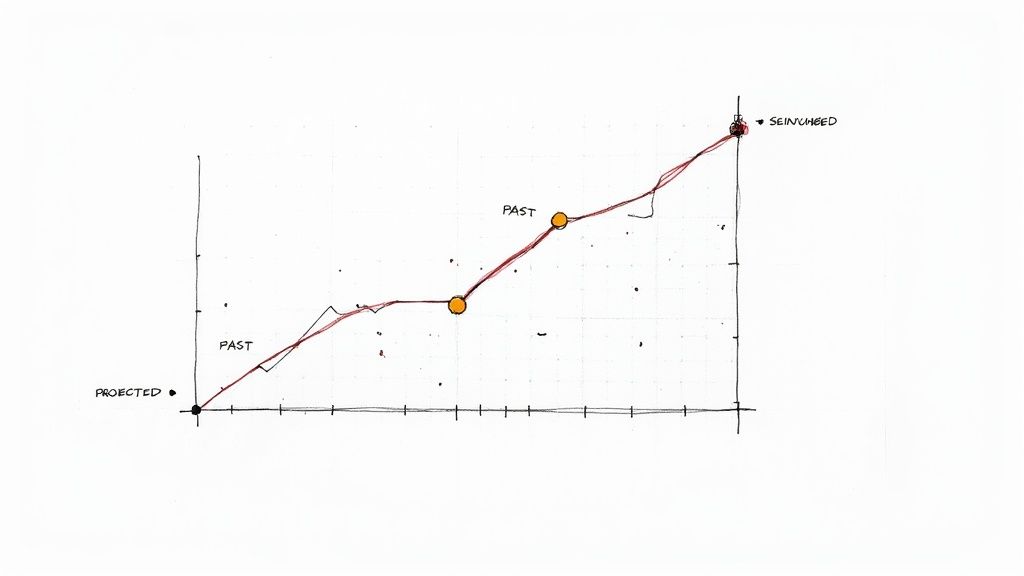
For an established business with a stable market presence, this technique provides a reliable baseline. For instance, a retail chain can analyse sales data from the last three holiday seasons to accurately estimate inventory needs for the upcoming year, preventing both stockouts and overstocking. Similarly, a subscription-based software (SaaS) company can project its annual recurring revenue by calculating its average year-over-year growth rate. This is a common challenge we solve for clients—turning years of unstructured sales history into a predictable model for the future.
Leveraging Salesforce for Historical Forecasting
Salesforce Sales Cloud is the ideal platform for implementing this method, as it houses a rich repository of historical sales data.
- Reports and Dashboards: Use Salesforce's native reporting to visualise sales trends over time. Create reports that group opportunities by
Close Date(by month, quarter, or year) and sum theAmountto see historical performance. You can then use this data to calculate a simple growth rate. We often build custom dashboards for our clients that automatically surface these trends, providing leadership with an instant view of performance against historical benchmarks. - Collaborative Forecasts: Salesforce’s built-in Collaborative Forecasts tool allows you to view historical forecast data alongside current projections, making it easier to spot deviations and adjust expectations based on past results.
Best Practices for Implementation
To maximise accuracy when using this sales forecasting technique, follow these guidelines:
- Use Sufficient Data: A longer time frame provides more reliable patterns. Aim for at least 2-3 years of sales data.
- Account for Anomalies: Did a one-time viral marketing campaign cause a sales spike last year? Was there an unexpected market downturn? Manually adjust your forecast to exclude these outliers so they don't skew future predictions.
- Smooth Out Fluctuations: Use a moving average (e.g., a three-month rolling average) to smooth out short-term volatility and reveal the underlying trend more clearly.
2. Opportunity Stage Forecasting (Pipeline Forecasting)
Opportunity stage forecasting, also known as pipeline forecasting, is a quantitative method that calculates future sales by assigning a probability of closing to each deal based on its current stage in the sales process. Each stage, from initial qualification to final negotiation, has a predetermined percentage reflecting the likelihood of success. The forecast is generated by multiplying each opportunity's potential value by its corresponding stage probability.
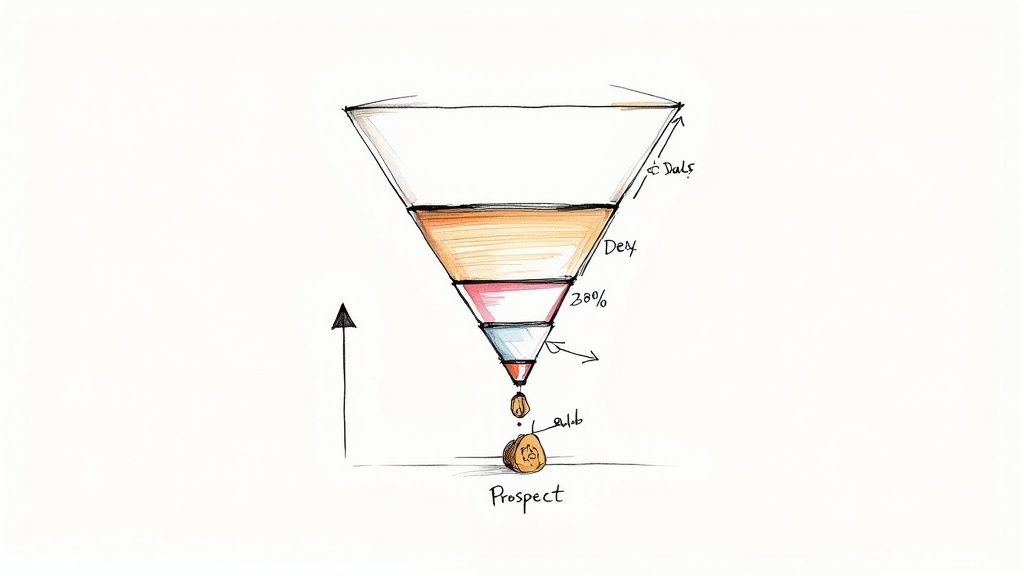
This technique offers a dynamic and real-time view of expected revenue, making it invaluable for B2B organisations with a well-defined sales cycle. For example, an enterprise software company can calculate its weighted pipeline value to project quarterly bookings, allowing leadership to make informed decisions about resource allocation. Similarly, a professional services firm can use this method to anticipate monthly revenue and manage consultant workloads effectively—a common Salesforce project we deliver for clients in the consulting space.
Leveraging Salesforce for Opportunity Stage Forecasting
Salesforce is purpose-built for this forecasting technique, with opportunity stages and probabilities at its core.
- Opportunity Stages & Probability: In Salesforce, each
Opportunity Stageis tied to aProbabilitypercentage in your sales process. As a sales rep moves an opportunity from "Qualification" (e.g., 25%) to "Proposal" (e.g., 50%), the weighted forecast value automatically updates. - Collaborative Forecasts: This native Salesforce tool directly uses this weighted pipeline data. It rolls up each rep's open opportunities, calculates the forecast based on stage probabilities, and provides managers with an aggregate view of the team's expected performance against their quota. This is the central hub for forecasting in Sales Cloud.
Best Practices for Implementation
To ensure this sales forecasting technique is reliable, consistency and data integrity are essential:
- Define Clear Stage Criteria: Document objective, non-negotiable exit criteria for each stage. Every team member must know exactly what conditions must be met to advance a deal.
- Validate Probabilities: Don't rely on default percentages. Analyse your historical win rates from each stage in Salesforce to set realistic and data-backed probabilities.
- Establish a Strong Pipeline: To effectively implement opportunity stage forecasting, having a well-structured pipeline is crucial. You can explore various useful sales pipeline templates to build a solid foundation.
- Monitor Pipeline Velocity: Track the average time deals spend in each stage. Stalled opportunities can signal a problem in the sales process or a deal at risk, which should be flagged for review in Salesforce.
3. Sales Rep Intuitive Forecasting
Intuitive forecasting is a bottom-up technique that leverages the qualitative insights and on-the-ground expertise of your sales representatives. This method relies on the judgement of those closest to the customers, asking them to estimate which deals will close, when, and for how much. It operates on the principle that salespeople possess unique knowledge about deal momentum, customer relationships, and internal politics that quantitative data alone cannot capture.
This approach is particularly valuable for organisations with complex, high-value B2B sales cycles where individual deal dynamics are critical. For instance, an enterprise software company can use reps' feedback to gauge the actual influence of a key decision-maker. Similarly, a professional services firm relies on account managers to assess a client's genuine budget commitment—a challenge where the qualitative "gut feel" captured in Salesforce provides essential context.
Leveraging Salesforce for Intuitive Forecasting
Salesforce provides the ideal structure to capture and organise these qualitative insights, turning anecdotal evidence into actionable forecast data.
- Opportunity Stages and Forecast Categories: By mapping Opportunity
Stagevalues to correspondingForecast Categoryfields (e.g., Pipeline, Best Case, Commit), reps can formally commit to their predictions directly on the opportunity record. This ensures their intuition is captured in a standardised way. - Collaborative Forecasts: This tool aggregates individual rep forecasts into a team-wide view. Managers can review, override, and add their own judgement, creating a layered forecast that combines frontline insights with managerial experience. You can also track adjustments over time to see how forecasts evolve.
- Activities and Chatter: Encourage reps to log notes from calls and meetings in the
Activitytimeline and useChatterto provide real-time updates on deal progression. This creates a rich, qualitative context around each opportunity that validates their forecast.
Best Practices for Implementation
To harness the power of this sales forecasting technique while minimising its subjective risks, consider these guidelines:
- Require Justification: Don't just accept a number. Ask reps why a deal is in the "Commit" category. Is the budget signed off? This enforces critical thinking.
- Track Rep Accuracy: Monitor individual forecast accuracy over time in Salesforce reports. If a rep is consistently over-optimistic, you can apply an adjustment factor to their future predictions.
- Combine with Other Methods: Use intuitive forecasts as a crucial layer of validation for a quantitative method like pipeline forecasting. If the two are wildly different, it signals a need for deeper investigation.
- Foster a Culture of Honesty: Discourage "sandbagging" (intentionally under-forecasting). Reward realistic and accurate forecasting, not just optimistic pipeline-building.
4. Multivariable Analysis (Regression Analysis)
Multivariable analysis, often executed through statistical methods like regression analysis, is one of the more sophisticated sales forecasting techniques. It moves beyond simple historical trends to identify and quantify the relationships between sales outcomes and multiple independent variables. This quantitative method creates a mathematical model that predicts sales by analysing how factors like marketing spend, pricing strategies, and economic indicators collectively influence results.
This technique is particularly powerful for businesses operating in complex markets. For example, a B2B tech company could predict sales by analysing marketing campaign spend, sales team headcount, and competitor pricing changes. The goal is to understand which levers have the biggest impact on the final number—a challenge where Salesforce data is the "single source of truth."
Leveraging Salesforce for Multivariable Analysis
While Salesforce isn’t a dedicated statistical analysis tool, it serves as the essential data source for building these models, especially when integrated with analytics platforms.
- Data Export and Integration: Use Salesforce Data Loader or API integrations to export detailed historical data from objects like Opportunities, Leads, Accounts, and Campaigns. This data forms the foundation of your model.
- CRM Analytics (formerly Tableau CRM): This Salesforce product is designed for exactly this purpose. It connects directly to your Salesforce data and has built-in functionalities to perform complex regression analysis and visualise the relationships between different variables, helping you discover what truly drives sales. For many of our clients, implementing CRM Analytics is the key to unlocking predictive insights from their existing data.
Best Practices for Implementation
To implement this advanced sales forecasting technique effectively, precision and statistical rigour are key.
- Start with a Hypothesis: Before diving into data, hypothesise which variables you believe most strongly influence your sales. This focuses your analysis.
- Ensure Data Quality: Your model is only as good as your data. Ensure all variables are tracked consistently and accurately within Salesforce. Inconsistent or incomplete data will lead to unreliable predictions.
- Validate Your Model: Test your model’s predictive accuracy using out-of-sample data (a portion of your data that wasn't used to build the model). This ensures the relationships it identified are real.
- Focus on Actionable Variables: Prioritise variables your team can actually influence, such as advertising spend, promotional frequency, or sales team headcount.
5. Length of Sales Cycle Forecasting
The Length of Sales Cycle Forecasting technique predicts future revenue by analysing the average time it takes for an opportunity to progress from its creation to a 'Closed-Won' status. This quantitative method focuses on pipeline velocity, using historical data to determine how long deals typically stay at each stage. It provides a time-based perspective, answering when revenue is likely to be realised, not just how much.
This approach is highly valuable for businesses with predictable, multi-stage sales processes. For example, a consulting firm with a 45-day proposal-to-contract cycle can accurately forecast when new project revenue will begin. Similarly, an enterprise software vendor can use its typical 180-day sales cycle to predict which quarter a major deal is most likely to close. We frequently help clients configure Salesforce to track these metrics automatically.
Leveraging Salesforce for Length of Sales Cycle Forecasting
Salesforce is perfectly equipped to track and analyse the time-based metrics essential for this sales forecasting technique.
- Custom Formula Fields: Create a custom formula field on the Opportunity object to calculate the age of an open opportunity (
TODAY() - CreatedDate) or the duration of a closed one (CloseDate - CreatedDate). This gives you the core data point needed for your analysis. - Reports and Dashboards: Build a Salesforce report that groups opportunities by their stage and calculates the average
Sales Cycle Durationfor each. This helps you identify bottlenecks and understand the average time spent in different phases of your sales process. You can visualise this data on a dashboard to monitor pipeline velocity over time.
Best Practices for Implementation
To enhance the accuracy of your sales cycle forecasts, consider these guidelines:
- Segment Your Analysis: Not all deals are the same. Calculate average sales cycle lengths separately for different deal sizes, products, or lead sources in Salesforce reports to create more precise forecasts.
- Use the Median, Not the Mean: Extremely long or short sales cycles can skew the average. Using the median cycle length often provides a more realistic benchmark by minimising the impact of outliers.
- Flag Overdue Opportunities: Create automation rules in Salesforce (like a Flow) to flag deals that have been in a single stage for longer than the historical average. This prompts sales managers to investigate potential stalls.
6. Test Market Analysis
Test market analysis is a powerful sales forecasting technique used to predict the success of a new product, pricing strategy, or marketing campaign by launching it in a limited, controlled geographic area. This method involves collecting real-world sales data from a representative sample of the target market before committing to a full-scale rollout. It is particularly valuable when historical data is non-existent, such as with innovative products or entries into new market segments.
This approach allows businesses to forecast broader market performance based on tangible results. For example, a SaaS company could offer a new feature module to a select group of existing customers in one region to forecast uptake and pricing tolerance. The business challenge is tracking this limited launch effectively, which is where Salesforce comes in.
Leveraging Salesforce for Test Market Analysis
While test market analysis happens in the real world, Salesforce can be the central hub for tracking, managing, and analysing the data collected.
- Campaign Management: Use Salesforce Campaigns to manage every aspect of the test. Create a parent campaign for the overall initiative and child campaigns for each test market. Track leads, contacts, and opportunities associated with each specific test market to measure performance accurately.
- Custom Fields and Objects: Create custom fields on the Opportunity or Account object to tag records related to the test market (e.g., a "Test Market Region" picklist). This allows for precise segmentation and reporting on the test cohort's performance versus the general customer base.
- A/B Testing with Marketing Cloud: For digital products or services, leverage Marketing Cloud Account Engagement (formerly Pardot) or Marketing Cloud Engagement to run A/B tests on landing pages and email campaigns targeted at specific geographic or demographic segments, with all results feeding back into Salesforce.
Best Practices for Implementation
To ensure your test market results provide a reliable forecast for a wider rollout, follow these guidelines:
- Select Representative Markets: Choose test locations that accurately reflect the demographics and competitive landscape of your broader target market.
- Control Variables: Isolate the variable you are testing (e.g., price, product feature). Keep other factors like marketing spend and sales approach consistent.
- Plan for Scale: Document all assumptions used when extrapolating test data. Consider factors like increased competition and economies of scale that will come into play during a full launch.
7. Lead-Driven Forecasting
Lead-driven forecasting is a powerful technique that predicts future sales revenue by analysing the volume and quality of leads entering the top of your sales funnel. This quantitative method operates on the principle that future sales are a direct result of current lead generation activities and their subsequent conversion rates. It involves tracking key metrics like lead volume, lead-to-opportunity conversion rate, and opportunity-to-close rate to build a predictable model.
This approach is highly effective for businesses with a well-defined sales process and consistent lead flow, particularly B2B SaaS companies. For instance, if a company generates 500 marketing qualified leads (MQLs) per month and knows its historical conversion rates through the funnel, it can reliably forecast future revenue based on its marketing pipeline. The business challenge is connecting marketing activity directly to sales outcomes, a core function of Salesforce.
Leveraging Salesforce for Lead-Driven Forecasting
Salesforce is perfectly suited for lead-driven forecasting as it tracks the entire customer journey from initial lead to closed deal.
- Lead and Opportunity Objects: Salesforce natively captures lead sources, lead status, conversion points, and opportunity stages. This data is the foundation for calculating the precise conversion rates needed for this forecasting model.
- Campaign Influence and Attribution: Use Salesforce Campaigns to track which marketing efforts are generating the highest quality leads. This allows you to segment your forecast by lead source (e.g., organic search, paid ads, events) for greater accuracy. Partnering with the best intent data providers can give you a significant edge in identifying high-potential leads.
- Marketing Cloud Account Engagement (Pardot): This platform supercharges lead-driven forecasting with its lead scoring and grading features. By automatically qualifying leads, it ensures that only high-quality prospects are factored into your sales projections. Understanding how to manage this data is crucial, and you can learn more about optimising your pipeline through effective account engagement best practices.
Best Practices for Implementation
To implement this sales forecasting technique effectively, focus on data quality and process consistency:
- Segment Your Leads: Don't treat all leads equally. Analyse conversion rates based on lead source or quality score in Salesforce to create more accurate forecasts.
- Monitor Funnel Velocity: Calculate the average time it takes for a lead to move through each stage of the funnel. This helps you predict not just how much revenue you will generate, but when it will close.
- Align Sales and Marketing: Ensure both teams agree on a universal definition of a "qualified lead." This alignment is critical for maintaining data integrity and the reliability of your forecast.
8. Time Series Analysis (Statistical Forecasting)
Time series analysis is a sophisticated quantitative forecasting technique that uses statistical models to analyse historical data points collected at consistent time intervals. It operates on the principle of decomposing past data into distinct components: trend, seasonality, cyclical patterns, and irregular fluctuations. By understanding these underlying structures, models like ARIMA can project future sales with a high degree of statistical rigour.

This method is ideal for businesses with large volumes of historical data seeking precise, data-driven predictions. For example, a national retail chain might use a time series model to forecast demand for seasonal products, optimising inventory across hundreds of stores. The challenge is having enough clean, structured data, which is why a well-maintained Salesforce instance is the prerequisite for this advanced technique.
Leveraging Salesforce for Time Series Analysis
While Salesforce doesn't have native ARIMA modelling, its data is the essential fuel for these analyses, which can be performed using integrated AI and analytics platforms.
- Data Export and Integration: Use Salesforce Data Loader or API integrations to export clean, structured historical sales data (Opportunity amounts, close dates) into a dedicated analytics environment like CRM Analytics (Tableau) or external platforms.
- Salesforce Einstein: For organisations with certain Salesforce editions, you can use Einstein Forecasting and other AI tools to analyse historical data and uncover patterns. While not a pure time series model, it uses powerful AI to find correlations over time and make predictions that can be written back into Salesforce records, guiding your sales team.
Best Practices for Implementation
To effectively implement this advanced sales forecasting technique, consider the following:
- Ensure Data Consistency: Your data must be collected at regular, consistent intervals (e.g., daily, weekly, monthly) for the statistical models to work correctly.
- Start Simple: Begin with simpler models like moving averages before advancing to more complex ones. This helps establish a baseline and understand your data's behaviour.
- Validate Your Model: Always test your model's accuracy by training it on a portion of your historical data and using the remaining "holdout" data to see how well it predicts known outcomes.
- Combine with Domain Expertise: Statistical models can identify patterns but can't explain why they occur. Use your team's industry knowledge to interpret anomalies and validate the logic behind the forecast.
9. Market Research and Customer Survey Forecasting
Market Research and Customer Survey Forecasting is a qualitative technique that gathers future-looking data directly from potential customers and the broader market. Instead of relying on past internal data, this method uses surveys, focus groups, and market research studies to predict purchase intentions and gauge demand for new products. It answers the question, "What do our customers plan to do?"
This forward-looking approach is invaluable when historical data is non-existent, such as before a new product launch. For example, a B2B software firm could survey beta testers to project initial subscription adoption rates. The business challenge is integrating this external feedback with your internal CRM data to create a holistic view.
Leveraging Salesforce for Market Research Forecasting
While Salesforce is primarily a hub for internal sales data, it can be integrated with survey and research tools to centralise this crucial qualitative data.
- Survey Integration: Tools like SurveyMonkey or Qualtrics have AppExchange apps that integrate with Salesforce. When a lead or contact completes a survey expressing purchase intent, this data can be automatically logged against their record in Salesforce, creating a powerful segment for sales teams to target.
- Campaigns and Lead Scoring: Use Salesforce Campaigns to track respondents from a specific market research initiative. You can then apply lead scoring rules based on their survey answers, automatically prioritising leads who state they are "very likely to buy" within the next quarter. We have implemented these integrations for clients to bridge the gap between market feedback and sales action.
Best Practices for Implementation
To ensure your survey-based forecasts are as accurate as possible, consider these guidelines:
- Use Representative Samples: For statistically valid results, aim for a significant and representative sample size from your target demographic.
- Design Neutral Questions: Avoid leading questions that might bias responses. Frame questions neutrally to capture genuine purchase intent.
- Discount Stated Intent: Customers are often optimistic. Apply a discount factor to your results; for instance, assume only 50-70% of those who say they will "definitely buy" will actually do so.
- Combine with Other Data: Whenever possible, validate survey findings with data from a test market or pilot program to ground your forecast in real-world behaviour.
10. Machine Learning and AI Forecasting
Machine learning and AI forecasting represent the cutting edge of sales forecasting techniques, leveraging powerful algorithms to analyse vast and complex datasets. This quantitative method moves beyond simple historical trends to identify subtle, non-linear patterns that traditional models miss. AI systems can process hundreds of variables simultaneously—including customer behaviour, market sentiment, and macroeconomic indicators—to produce highly accurate predictions.
For organisations operating in dynamic, fast-changing markets, this technique is invaluable. For example, a global e-commerce giant uses machine learning to forecast demand for millions of individual products. In a B2B context, AI can predict which deals are most likely to close based on thousands of data points that a human could never process. The key challenge is making this technology accessible and actionable for sales teams.
Leveraging Salesforce for AI Forecasting
Salesforce has heavily invested in AI, making these advanced capabilities accessible directly within the CRM platform through Salesforce Einstein. This democratises AI for sales organisations.
- Einstein Forecasting: This tool automatically analyses your historical sales data and pipeline to generate intelligent, data-driven predictions. Einstein provides a forecast number that goes beyond simple rollups, considering factors like rep performance and deal trends.
- Einstein Opportunity Scoring: Einstein assigns a score from 1-99 to each Opportunity, indicating its likelihood to close. This allows sales teams to prioritise high-potential deals and helps managers build a more realistic and reliable forecast by focusing on the most promising opportunities. This is a game-changer for sales productivity.
Best Practices for Implementation
To successfully implement machine learning as one of your sales forecasting techniques, consider these guidelines:
- Ensure Data Quality: AI models are only as good as the data they are trained on. Prioritise clean, complete, and consistent data within Salesforce. Proper data management strategies are crucial for success.
- Start with Pilot Projects: Begin with a specific use case, such as forecasting sales for a single product line. This allows you to test and refine your model before a full-scale deployment.
- Maintain Human Oversight: AI provides powerful predictions, but it should augment, not replace, human judgment. Sales leaders must use their domain expertise to interpret the AI’s output and make the final strategic decisions.
Top 10 Sales Forecasting Techniques Comparison
| Method | Implementation complexity | Resource requirements | Expected outcomes (accuracy) | Ideal use cases | Key advantages |
|---|---|---|---|---|---|
| Historical Forecasting (Trend Analysis) | Low | 2–3+ years sales data, spreadsheets/CRM | Baseline trend-based projections (typical accuracy 70–80% in stable markets) | Established businesses with consistent sales history | Simple, objective, easy to automate |
| Opportunity Stage Forecasting (Pipeline Forecasting) | Low–Medium | CRM with defined stages, calibrated stage probabilities | Weighted pipeline revenue visibility (75–85% when calibrated) | B2B companies with multi-stage sales processes | Granular pipeline visibility; highlights bottlenecks |
| Sales Rep Intuitive Forecasting | Low | Sales rep input, regular review cadence | Deal-level qualitative forecasts (accuracy 60–75%, highly variable) | Complex B2B deals where relationships matter | Captures qualitative insights and deal nuances |
| Multivariable Analysis (Regression Analysis) | High | Large clean datasets, statistical software, data scientists | Quantified driver impacts and predictive models (80–90% when well-built) | Large orgs with data and analytics teams | Identifies key drivers; enables scenario testing |
| Length of Sales Cycle Forecasting | Medium | Time-in-stage data, CRM, segmenting by deal type | Timing-based close projections (timing accuracy 70–80%) | Businesses with predictable, measurable cycle times | Improves timing, cash-flow planning, prioritization |
| Test Market Analysis | Medium–High | Pilot markets, budget for pilots, sampling/statistical scaling | Real-world demand estimates from controlled pilots (75–85% if representative) | New product launches, market entry, pricing tests | Validates assumptions with real customer behavior |
| Lead-Driven Forecasting | Medium | Lead tracking, marketing automation, conversion history | Forward-looking forecasts from top-of-funnel metrics (75–85% for mature systems) | Digital lead-gen businesses and SaaS | Early indicators; links marketing activity to revenue |
| Time Series Analysis (Statistical Forecasting) | High | 2+ years consistent time-series data, statistical tools, expertise | Short–medium term forecasts with confidence intervals (80–90% for stable series) | Organizations with repeating temporal/seasonal patterns | Decomposes trend/seasonality; mathematically rigorous |
| Market Research & Customer Survey Forecasting | Medium | Survey panels, focus groups, research budgets, statistical sampling | Intent-based demand estimates (accuracy 60–70%, variable) | New products, concept testing, preference research | Direct customer insight; tests concepts and pricing |
| Machine Learning & AI Forecasting | Very High | Large datasets, compute infrastructure, MLOps, data science team | Highly accurate, scalable predictions (85–95% when well-implemented) | Large organizations with complex, high-volume forecasting needs | Handles non-linearities, many variables, real-time updates |
Building a Smarter Forecast: Your Path to Predictable Revenue
We've journeyed through a comprehensive collection of ten distinct sales forecasting techniques, from the straightforward reliability of Historical Forecasting to the cutting-edge predictive power of Salesforce Einstein. Each method offers a unique lens through which to view your future revenue. You’ve seen how qualitative methods, like Sales Rep Intuitive Forecasting, can capture the human element of a deal, while quantitative approaches, such as Multivariable Analysis, bring statistical rigour to the process.
The central lesson is clear: there is no single "best" technique. The most effective forecasting strategy isn’t about picking one method and discarding the rest. Instead, it’s about creating a blended, hybrid approach that is uniquely tailored to your business model, industry, and data maturity. The true power lies in leveraging several of these sales forecasting techniques within your Salesforce platform to create a more robust, accurate, and resilient prediction.
This multi-faceted view smooths out the biases inherent in any single method, giving your leadership team the confidence to make informed strategic decisions. A great forecast transforms your CRM from a simple record-keeping system into the central nervous system of your entire commercial operation, guiding every decision toward predictable, sustainable growth.
Your Actionable Path Forward
Mastering sales forecasting is not a one-time project; it is an ongoing discipline of refinement. Your immediate goal should be to move from a reactive stance to a proactive one, transforming your forecast from a historical report card into a strategic roadmap.
Here are your next steps to implement what you've learned:
- Audit Your Current Process: Before adopting new techniques, critically evaluate what you're doing now. Is your forecast consistently over or under? Is the data in Salesforce clean? This audit will reveal your biggest opportunities for improvement.
- Select a Primary and Secondary Method: Choose a primary forecasting method that aligns with your core business model. For most organisations using Salesforce, Opportunity Stage Forecasting is a natural and powerful starting point. Supplement this with a secondary method, perhaps Length of Sales Cycle Forecasting, to add another layer of validation.
- Leverage Your Salesforce Platform: As we've highlighted, Salesforce isn't just a CRM; it's a powerful forecasting engine. Dive into Collaborative Forecasts and Salesforce Reports and Dashboards. Explore Einstein Forecasting to see how AI can automate and enhance your predictions without requiring a data science degree. Your most valuable data is already there; it's time to activate it.
- Commit to Data Hygiene: The accuracy of every single technique discussed hinges on the quality of your input data. Enforce consistent data entry practices for opportunity stages, close dates, and lead sources within Salesforce. A clean pipeline is the bedrock of a reliable forecast.
Ultimately, mastering these sales forecasting techniques is about more than just hitting a number. It's about gaining control over your business's destiny. It empowers you to allocate resources effectively, manage cash flow intelligently, and set ambitious yet achievable growth targets.
Salesforce Forecasting FAQ
How does Salesforce help with sales forecasting?
Salesforce provides a suite of tools designed for forecasting. The core feature, Collaborative Forecasts, rolls up opportunity data based on stages and rep commitments. Additionally, Salesforce Reports and Dashboards allow for historical analysis, while Salesforce Einstein uses AI to provide predictive scores and forecasts, making the entire process more data-driven and automated.
What is the difference between Opportunity Stage and Forecast Category in Salesforce?
The Opportunity Stage reflects where a deal is in your sales process (e.g., "Prospecting," "Proposal Sent"). The Forecast Category is a rollup summary of those stages (e.g., "Pipeline," "Best Case," "Commit"). Salesforce admins map multiple stages to a single category, simplifying the forecast view for managers and executives.
Can I create custom sales forecasts in Salesforce?
Yes. While Collaborative Forecasts is the standard tool, you can build highly customised forecasting solutions using Salesforce Reports and Dashboards. By creating custom report types, formula fields, and complex dashboards, you can tailor a forecasting model that perfectly matches your business logic, such as segmenting forecasts by product line, region, or business unit.
Ready to move beyond theory and build a sophisticated, data-driven forecasting process directly within your Salesforce environment? As a trusted Salesforce partner, Adaptal specialises in customising Salesforce to empower businesses with the insights they need for predictable revenue. We help you implement and automate the very techniques discussed in this article, turning your CRM into a powerful engine for growth. Visit Adaptal to learn how we can help you build a smarter forecast today.