

Think of a digital transformation consultant as the architect for your company's future, specifically building on the Salesforce platform. Their job isn't just about plugging in new software; it's about fundamentally redesigning your business from the ground up, using technology as the foundation. They specialise in aligning powerful platforms like Salesforce with your core business goals, ensuring that every tech investment drives real, strategic change in your sales, service, and marketing operations.
What Salesforce Digital Transformation Consultants Actually Do

Trying to compete in today's market without a clear digital strategy is like attempting to build a modern skyscraper with 50-year-old blueprints. It just won’t work. A Salesforce digital transformation consultant is the master architect who drafts a modern, robust blueprint for sustainable growth, making sure every piece of the Salesforce platform strengthens the entire structure of your business.
Their role is far deeper than just recommending the latest app. It’s about taking a hard look at how your business currently runs, finding the operational bottlenecks in your CRM, and charting a clear course towards a more automated and connected future powered by Salesforce.
Core Responsibilities of a Salesforce Partner
A great consultant’s work goes well beyond the initial technical setup. They become a strategic partner, deeply embedded in the direction of your sales, marketing, and service operations. These experts guide organisations through complex but necessary changes, often involving essential process improvement and transformation strategies.
Here’s a snapshot of what they typically handle:
- Strategic Salesforce Roadmapping: They start by assessing where you are now to design a detailed plan for the future. This map outlines which Salesforce products to adopt and in what order, all tied directly to your long-term business objectives.
- CRM Process Optimisation: Consultants hunt down clunky, manual workflows and redesign them for efficiency. A classic example is configuring Salesforce Sales Cloud to automatically assign leads and schedule follow-ups, freeing up your sales team to actually sell.
- Customer Experience Design: They meticulously map out your customer's entire journey, pinpointing frustrations. Then, they use tools like Salesforce Service Cloud to build smooth, personalised support experiences that keep customers happy.
- Salesforce Data Integration: They break down data silos by connecting separate systems, like your CRM and accounting software. This creates a single source of truth within Salesforce, giving you a complete, unified view of your business.
A great Salesforce partner doesn't just hand you a new tool; they give you a new way of working. They connect technology to people and processes, ensuring the solution is adopted, effective, and delivers a measurable return on investment.
Bridging the Gap Between Salesforce Technology and Business Goals
The real magic of a digital transformation consultant is their ability to act as a translator. They are fluent in the languages of both the executive boardroom and the IT department, ensuring that technical Salesforce solutions solve genuine business problems.
They get that implementing a system like Salesforce isn't just a project—it's a fundamental shift in how your entire company engages with customers and manages its data. This perspective is what makes or breaks these initiatives. By focusing equally on the technology and the people who will use it every day, they make sure the new system is embraced and delivers lasting value. You can find out more about how specialists connect technology to business outcomes in our guide on the role of Salesforce development consultants.
Ultimately, they are indispensable partners for any company serious about competing and winning, turning ambitious digital visions into everyday operational realities.
The Real ROI of a Salesforce Transformation Partnership
Investing in a powerful platform like Salesforce is a serious financial commitment. But here’s the thing: the software licence is just the ticket to the game. The real challenge—and where you’ll actually see a return—is turning that technology into tangible business growth. This is precisely where bringing in expert digital transformation consultants makes all the difference.
A genuine partnership goes way beyond just installing software. It's about achieving real-world business outcomes by sidestepping the massive risks of failed IT projects, getting you to that "aha!" moment of value much faster, and giving you access to specialised knowledge that would take years to build in-house.
From CRM Cost Centre to Profit Driver
Too many businesses see a big tech project and immediately think "cost". A good consultant flips that script. They make sure every single decision, from a workflow design in Sales Cloud to a data migration strategy, is directly tied to improving efficiency, driving sales, or strengthening your bottom line.
They're your safeguard against the common traps—like dismal user adoption or a system that’s completely misaligned with how you actually work—that can turn a promising investment into a money pit.
This strategic mindset has never been more important, especially as Australian businesses go all-in on digital. Australia's digital transformation market is absolutely booming, hitting an estimated USD 18.5 billion in 2024 and forecast to reach a staggering USD 84.7 billion by 2033. This explosion shows just how much pressure there is to adopt technologies like Salesforce, AI, and cloud computing to keep up. With stakes this high, expert guidance isn't a luxury; it's essential. You can read the full research on Australia's market expansion to dig into the drivers behind this trend.
This infographic breaks down exactly how a partnership with digital transformation consultants impacts the metrics that matter.
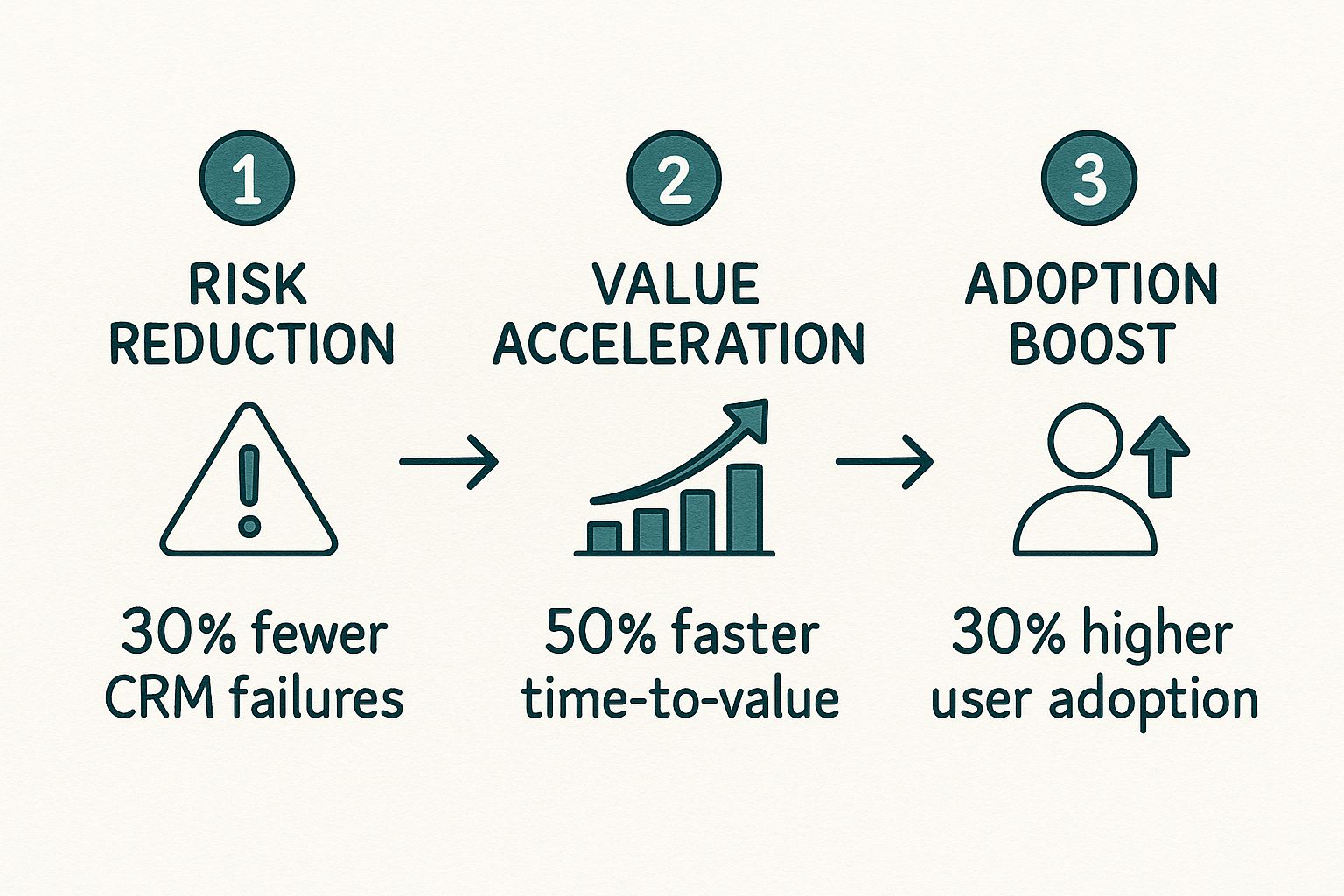
The numbers speak for themselves. Working with specialists doesn't just improve your chances of success; it dramatically shortens the time it takes to see real financial benefits from your tech investment.
How Consultants Maximise Your Salesforce Investment
When you’re working with a platform as powerful as Salesforce, a consultant's value becomes crystal clear. They ensure your setup avoids the usual teething problems and is fine-tuned to deliver a powerful return from day one.
Here’s a look at the tangible ROI they deliver in a Salesforce context:
- Better User Adoption: A consultant doesn’t just build the system; they design it for the people who will use it every day. By creating intuitive workflows and providing focused training, they ensure your team actually wants to use the platform. This leads to cleaner data and far more accurate forecasting in Sales Cloud.
- A Huge Boost in Efficiency: They’re experts at spotting and automating the manual, repetitive tasks that drain your team's time. A simple example is setting up automated case assignment rules in Service Cloud, which can slash response times and free up your support staff to focus on solving bigger problems.
- Faster Time-to-Value: With years of experience under their belt, consultants can implement Salesforce solutions in a fraction of the time it would take an internal team learning as they go. This means you start seeing those crucial benefits—like higher lead conversion or improved customer retention—months sooner.
A consultant’s core job is to make sure your Salesforce platform doesn’t just function, but performs. They are the ones who connect the dots between your business goals and the platform's incredible capabilities.
Ultimately, bringing on digital transformation consultants is an investment in certainty. It’s about ensuring your Salesforce project is delivered on time, within budget, and is enthusiastically adopted by your team—turning a major technology expense into a reliable engine for long-term growth.
Your Salesforce Digital Transformation Project Roadmap
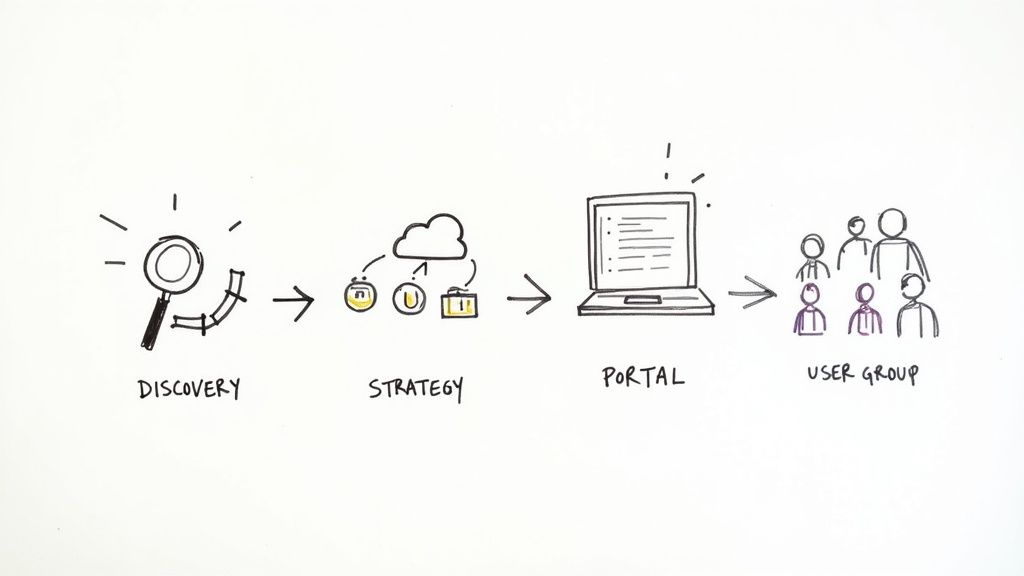
Embarking on a digital transformation can feel a bit like planning a major expedition without a map. You know where you want to go, but the path is full of unknowns and potential wrong turns. This is precisely why a structured project roadmap, guided by experienced digital transformation consultants, is so essential. It turns a massive undertaking into a series of clear, manageable stages.
A solid roadmap brings clarity to everyone involved, from the C-suite to the people on the ground. It answers the crucial 'why' behind every decision and action. More than that, it transforms an intimidating project into a logical sequence of wins, building momentum and confidence as you go.
At Adaptal, our process is a partnership. It's a phased journey that starts with understanding your biggest headaches and ends with a solution that delivers genuine, measurable change. Let's walk through what that journey looks like.
Phase 1: Discovery And Strategy
This first phase is all about deep listening. We don’t walk in talking about technology; we start by talking about your business. The goal here is to get an unvarnished, crystal-clear picture of your current processes, your team's pain points, and what you’re trying to achieve strategically.
Our consultants run workshops with your key people to map out how things work today and pinpoint the most frustrating bottlenecks. For example, we might find a professional services firm is bleeding revenue because of clunky manual invoicing and disconnected project data. That’s the kind of problem we need to solve.
Only then do we start building a strategic blueprint. This isn't some generic template; it’s a tailored Salesforce roadmap outlining exactly how specific tools will fix your specific problems. This could mean proposing Salesforce CPQ to automate quoting or using Experience Cloud to give clients a self-service portal.
Phase 2: Design And Configuration
With a clear strategy in hand, we shift into the architectural phase. This is where our technical experts translate your business needs into a functional Salesforce solution. Think of it as drawing up the detailed blueprints for your new digital operations.
We meticulously design the data model, map out user interfaces, and build the automation rules that will soon power your team’s everyday work. It’s all about creating the foundation for a system that feels intuitive and actually makes their jobs easier.
For instance, if better sales forecasting is a key goal, this is where we configure custom opportunity stages in Sales Cloud. We’ll also create validation rules to keep your data clean and build dashboards that give leadership an accurate, real-time view of the pipeline. Getting this right is critical, and you can learn more about it in our complete Salesforce implementation guide for Australian businesses.
Phase 3: Implementation And Testing
Now, the vision starts to become a reality. Our team gets hands-on, building, configuring, and integrating the solution based on the blueprints from the design phase. This stage is never a "set and forget" process; it’s highly iterative, with regular check-ins and demos to ensure what we’re building is exactly what you expected.
Rigorous testing is a non-negotiable part of this phase. We conduct multiple rounds of quality assurance, checking everything from the smallest component to the end-to-end functionality of an entire business process. No stone is left unturned.
A project isn’t a success just because the technology works. It’s a success because people use it to work better. This simple philosophy drives our approach to the final, and most important, stages.
Phase 4: Deployment And Adoption
The final phase is all about bringing the solution to your team and—most importantly—making sure they embrace it. The "go-live" event is carefully orchestrated to cause minimal disruption, often planned as a phased rollout or a weekend deployment.
But our work doesn’t stop the moment you flick the switch. We provide comprehensive, role-based training to ensure every user feels confident and capable from day one. We also stick around for post-launch support to handle any immediate questions, ensuring a smooth and positive transition. It’s this intense focus on user adoption that elevates a technology project into a genuine business transformation.
To give you a clearer picture, here’s a summary of how these stages typically unfold in a digital transformation project.
Salesforce Digital Transformation Engagement Stages
| Project Stage | Primary Objective | Consultant Activities | Salesforce-Related Example |
|---|---|---|---|
| 1. Discovery & Strategy | Understand business goals and define a clear project scope. | Conduct stakeholder workshops, analyse current processes, identify pain points, and create a strategic roadmap. | Identifying that manual quote generation is slowing sales by 30% and proposing Salesforce CPQ as the solution. |
| 2. Design & Configuration | Translate the strategy into a detailed technical blueprint. | Design the data architecture, map user journeys, configure core system settings, and create solution design documents. | Designing custom objects and fields in Sales Cloud to track project profitability and resource allocation. |
| 3. Implementation & Testing | Build, integrate, and validate the new system. | Develop custom components, configure automation (Flows), perform data migration, and conduct rigorous QA and User Acceptance Testing (UAT). | Building an integration with an accounting system and running test scripts to ensure invoices are generated correctly. |
| 4. Deployment & Adoption | Launch the solution and ensure user buy-in. | Plan the go-live, deliver targeted user training, provide post-launch support, and monitor adoption metrics. | Training the sales team on the new lead management process in Sales Cloud and creating dashboards to track user activity. |
Each stage builds on the last, ensuring that the final Salesforce solution is not only technically sound but also perfectly aligned with your business objectives and embraced by your team.
How to Choose the Right Salesforce Transformation Partner
Let’s be blunt: the single biggest decision you'll make on this journey isn't about the technology itself. It’s about who you trust to guide you through it. Picking the right digital transformation consultants is the make-or-break moment for your entire project. This isn't just about hiring a vendor; you're bringing an extension of your team on board, someone responsible for turning your vision into a real, working, and profitable solution.
Choosing well means looking past the polished pitch and the attractive price tag. You need to dig deeper into their track record, their process, and how well they’ll actually gel with your organisation. Your goal is to find a partner who is genuinely invested in your long-term success, not just focused on getting a project signed off.
Proven Salesforce Expertise
First things first: your partner needs to have deep, verifiable expertise in the Salesforce world. General IT knowledge just doesn't cut it. You’re looking for a team that truly lives and breathes Salesforce, with a solid history of successful projects across things like Sales Cloud and Service Cloud.
This expertise should be obvious from their certifications, but more importantly, from how they talk about solving real business problems. Can they explain complex setups in plain English, without hiding behind technical jargon? That's the real test.
Industry-Specific Experience
Every industry has its own quirks, rules, and customer demands. A consultant who has already navigated this terrain with businesses like yours brings a massive advantage to the table. They’ll already be familiar with the common pitfalls, specific compliance headaches, and the metrics that actually matter in your sector.
This kind of specific knowledge is a massive project accelerator.
- They can spot potential roadblocks before they become major issues.
- They’ll recommend best practices that are already proven to work in your field.
- They can design solutions that cater to your unique operational needs from day one.
A partner with industry experience doesn't need a crash course in your business. They walk in with relevant insights and a playbook for success, saving you an incredible amount of time and money.
A Collaborative and Transparent Way of Working
Pay very close attention to how a potential partner gets things done. A rigid, "our way or the highway" approach is a huge red flag. You want a consultant who champions a collaborative process, making sure your own team is involved at every step, from the initial discovery sessions right through to deployment.
Transparency is just as crucial. Your partner should be able to give you a clear roadmap for the project, provide regular and honest updates, and maintain an open line of communication for any questions or concerns. This builds trust and ensures the final result is something your team feels a true sense of ownership over.
Cultural Fit and Local Presence
This is the one people often overlook, but it’s absolutely critical. Your consultants will be working shoulder-to-shoulder with your people. If the personalities don't mesh, it can create friction and slow everything down. Look for people who are good listeners, clear communicators, and seem genuinely interested in helping your team succeed.
Having a partner who understands the Australian market is also a significant plus. The demand for local expertise is on the rise, especially as Australia's digital transformation consulting space keeps growing. The Asia Pacific market is tipped to hit USD 11.9 billion by 2025, and with Australia being a key part of that, a local partner who gets the regional nuances is invaluable. You can discover more insights about the digital consulting market in the Asia Pacific region to see just why that local knowledge is so important.
Questions to Ask Potential Salesforce Partners
To help you separate the contenders from the pretenders, here’s a list of questions to ask any digital transformation consultants you’re considering:
- Can you walk me through a case study of a Salesforce project you did for a company similar to ours?
- How will you actually measure the success and ROI of this project? What metrics will you use?
- What's your plan for getting our team to actually use the new system and manage the change?
- What does your process for support and ongoing improvement look like after we go live?
- How do you handle it when the scope changes or something unexpected pops up mid-project?
A Real-World Salesforce Transformation Story

Theory and strategy are one thing, but seeing how it all plays out in the real world is what really matters. To bring the value of a digital transformation consultant to life, let’s step away from the abstract and look at a concrete example. This is the story of a growing professional services company hitting a wall that plenty of Australian businesses will find familiar.
Their sales and service teams might as well have been on different planets. Sales lived in one system, tracking leads and deals, while the service team used a completely different tool for client issues. This created a jarring, disconnected experience for everyone—their staff and, crucially, their customers.
That wall between departments meant nobody had the full story. A salesperson might call a client, completely unaware of an urgent, unresolved service ticket. A service agent, on the other hand, had no insight into the client's history or potential for new business. This lack of a single source of truth wasn't just messy; it was actively hurting customer satisfaction and stopping them from growing.
The Business Challenge: Disconnected CRM Systems
As the company grew, the problems caused by these information silos went from being a nuisance to a serious handicap. The core issues were costing them real time and money.
Here's what they were up against:
- A frustrating customer experience: Clients were forced to repeat themselves with every interaction, making the company seem disorganised.
- Lost sales opportunities: The service team often spotted chances to upsell or cross-sell, but there was no simple way to pass that valuable intel to sales.
- Operational drag: Staff were burning hours just trying to find basic information or manually sync up details between departments, pulling them away from work that actually moved the needle.
They knew they had a great service and a talented team, but their own technology was fighting them every step of the way. This wasn't just an IT problem; it was a roadblock to their entire business strategy.
The Salesforce Solution: Crafting a Unified Platform
Our first move was to get the sales and service leaders in the same room to map out what a seamless customer journey should look like. The objective was simple: build a system where information flowed freely, giving every employee a 360-degree view of the customer. The obvious answer was to bring everything together on a single Salesforce platform.
We designed a solution around two core Salesforce products, making them work as one:
- Salesforce Sales Cloud: This would manage the entire sales process, from the first lead and tracking opportunities right through to quoting and closing the deal.
- Salesforce Service Cloud: This would handle everything after the sale, including managing support cases, building knowledge bases, and tracking service agreements.
The magic was in the integration. We set up the system so that if a service agent spotted a potential sales opportunity during a support call, they could create and assign a new lead to the sales team with a single click. It sounds simple, but this one change built a powerful bridge between the two departments. For another example of how connecting systems drives results, you can explore our work with Carer Solutions Australia, where we integrated their core systems to improve data visibility and operational flow.
The Results: Measurable Business Transformation
The moment the unified Salesforce platform went live, the impact was immediate. By simply knocking down the walls between sales and service, the company saw huge improvements right across the business.
The project delivered clear, measurable wins:
- A 30% increase in lead conversion rates, as the sales team now had the full context of a customer's history.
- A 40% reduction in customer service response times, thanks to automated case routing and instant access to client data.
- A 15% lift in cross-sell revenue within the first six months, driven entirely by the new process for the service team to flag opportunities.
This isn't just a feel-good story; it’s tangible proof of what happens when a strategic partnership with experienced digital transformation consultants meets the right technology. It shows that when you properly align your people, processes, and platform around the customer, you build a powerful engine for genuine, sustainable growth.
Partnering for the Long Haul: Future-Proofing Your Business with Salesforce
Think of digital transformation not as a project with a finish line, but as a constant state of evolution. The real goal isn't a single, massive overhaul; it's building a culture of continuous improvement that keeps your business sharp and competitive. This is where a long-term strategic partnership truly shows its worth.
A great digital transformation consultant isn't just there to fix today's problems. They're always looking ahead, helping you see what's coming over the horizon and get ready for it. Things like generative AI and hyper-automation are already changing the game within the Salesforce ecosystem. A forward-thinking partner helps you get in on these innovations early, well before your competitors even know what's happening.
Staying Ahead of the Curve with a Salesforce Partner
You can see this future-focused mindset taking hold across the Australian business landscape. IT spending is forecast to reach AU$147 billion in 2025, and a staggering 57% of organisations are upping their investment in AI projects to drive productivity. This isn't just spending for spending's sake; it shows just how vital expert guidance is for navigating complex modernisations, from adopting cloud technology to shoring up cybersecurity defences. If you want to dive deeper, you can read more about Australia’s key IT market trends and see where the smart money is going.
So, how does a long-term partner help you stay ahead?
- Spotting Opportunities: They're constantly evaluating new Salesforce features and AppExchange tools, pointing you toward the ones that will actually give you a competitive edge.
- Managing Risk: Technology moves fast, and so do the rules and regulations around it. A good consultant can help with things like streamlining compliance processes with automation, keeping your business safe and sound.
- Driving Continuous Improvement: They don't just set it and forget it. They regularly review your Salesforce instance to make sure it’s still aligned with your business goals and growing with you.
The right partnership turns your Salesforce platform from a static piece of software into a living, breathing asset—one that constantly adapts to market shifts and new technology, securing your place in the future.
The decisions you make today will define where your business is tomorrow. Bringing on a long-term partner who gets the Australian market is one of the smartest moves you can make to ensure you're ready for whatever comes next.
Ready to build a strategy that stands the test of time? Contact Adaptal today to discuss how we can unlock the full potential of your Salesforce investment.
Frequently Asked Questions about Salesforce Transformation
Stepping into a digital transformation project often raises a lot of questions. It's a big move, after all. Here, we'll tackle some of the most common queries we get from businesses thinking about bringing in a Salesforce partner. The aim is to cut through the noise and give you clear, straightforward answers.
How Much Does Hiring a Digital Transformation Consultant Cost?
This is usually the first question on everyone's mind, and the honest answer is: it varies. The cost really depends on the size and complexity of your project and the scope of work required.
But it’s far more helpful to think of it as an investment, not just an expense. A good consultant won't just give you a price; they'll work with you to map out a clear return on that investment. They should be able to show you exactly how their work will pay for itself through things like higher revenue, better efficiency, and crucially, avoiding the massive costs that come with a botched Salesforce implementation.
For Salesforce projects in particular, this investment ensures you're squeezing every drop of value from your licence fees. What's the point of paying for a powerful tool if your team doesn't use it properly?
What Is the Difference Between a General IT Consultant and a Salesforce Transformation Consultant?
It’s easy to lump all tech consultants together, but their focus is worlds apart. A general IT consultant is typically focused on your core infrastructure – the servers, networks, and hardware that keep the lights on.
A Salesforce transformation consultant, on the other hand, is a specialist who lives and breathes the Salesforce ecosystem. They’re experts in redesigning how your business operates around the customer, using the platform as their primary tool.
They don’t just install software. They know the ins and outs of Sales Cloud, Service Cloud, and Marketing Cloud and how to configure them to solve very specific business headaches. This deep, niche knowledge leads to a much faster and more effective project, with results you can actually see and measure.
The key distinction is focus. A Salesforce consultant is a business process specialist who uses technology as their tool. An IT consultant is a technology specialist who supports business operations.
How Long Does a Typical Salesforce Digital Transformation Project Take?
Project timelines can be as short as a few months for something like a clean Sales Cloud rollout, or they can stretch over a year for a large-scale transformation involving multiple parts of the business and complex integrations.
A seasoned consultant will never just give you a single, distant end date. Instead, they'll break the project down into agile, manageable phases. Each phase will have its own clear milestones and deliverables.
This approach means you start seeing real value early on, rather than holding your breath for one big, risky "go-live" day. It also builds in the flexibility to tweak the plan as we go, because business needs always change. This iterative process is fundamental to getting it right. For more detailed answers to common questions, you can also explore our main Adaptal FAQ page.
Ready to transform your business with a partner who understands your challenges and knows how to deliver results? Adaptal is here to help you get the most out of your Salesforce investment. Contact us today to discuss your project.