

Real estate lead generation is the art of attracting potential buyers and sellers and turning them into lifelong clients. For today's agencies, success isn't about casting a wide net with scattered methods; it's about building a centralised, tech-powered system with a CRM like Salesforce to capture, nurture, and close deals with consistency.
The Business Challenge: Why Traditional Lead Generation Is Broken

In a competitive market, it’s surprising how many agencies still run on a fragmented, almost chaotic approach to managing potential clients. Leads flood in from everywhere—Zillow, social media campaigns, website forms, even old-school open house sign-in sheets. The go-to tools for wrangling this influx? A messy cocktail of spreadsheets, overflowing email inboxes, and an agent's own memory.
This scattered system is a recipe for poor customer experience and lost revenue. Crucial details about a buyer's must-haves or a seller's tight timeline get lost in the shuffle. Follow-up becomes a game of chance, and massive opportunities slip through the cracks—not from lack of effort, but from a complete lack of a central CRM system. This is a common challenge we see in digital transformation projects.
The Real-World Consequences of a Disjointed System
Let me share a business challenge we've seen play out far too many times. A mid-sized agency was tracking a promising buyer over several months. The first touchpoint was a website form, which led to an email chain with one agent, and later, a property viewing with another.
Because their client data was siloed across different platforms and people:
- Missed Cues: The marketing team, completely in the dark that the buyer had already viewed properties, kept blasting them with generic "new to the market" emails.
- Delayed Follow-Up: The agent who did the viewing jotted down their notes in a personal spreadsheet, making them invisible to the rest of the team.
- Lost Opportunity: When the perfect off-market property suddenly became available, no one had the full 360-degree view of the buyer's history to make that timely, personal connection. The buyer, understandably, ended up signing with another agency.
This isn't just a one-off horror story. It's the direct result of a broken process where valuable client data is decentralised and impossible to act on, hindering sales and service efforts.
This is where a powerful CRM like Salesforce becomes essential. It’s not just an organisational tool; it’s a strategic shift that turns chaos into a predictable, scalable pipeline.
Bringing everything onto a unified platform is the foundational step in building a modern real estate lead generation engine. For agencies ready to make this leap, exploring expert Salesforce consulting services can provide a clear roadmap for implementation, ensuring your technology is perfectly aligned with your growth ambitions.
The Salesforce Solution: Building a Centralised Lead Hub
The first step in wrangling your leads is to stop the chaos. When enquiries from your website, social media ads, and open houses all land in different inboxes and spreadsheets, you’re not just disorganised—you're creating information silos that make consistent follow-up impossible. The only real solution is to establish a single source of truth within your CRM.
We recently partnered with a growing agency facing this exact challenge. They were generating a healthy volume of leads but were drowning in the admin. Inquiries from their website went to a general email inbox, Facebook leads sat in a downloadable spreadsheet, and open house contacts were scribbled on paper.
The result? A frustrating cycle of missed opportunities and slow response times. Their core business problem wasn't a lack of leads; it was a total lack of a unified system.
Creating a Unified Lead Dashboard with Sales Cloud
Using Salesforce Sales Cloud, we built them a centralised hub to automatically funnel every new inquiry into one place. This wasn't some complex, multi-month project. It was about implementing foundational Salesforce features that deliver immediate impact and improve the customer experience.
Here’s the Salesforce solution we implemented:
- Web-to-Lead Forms: We replaced their basic website contact form with a Salesforce Web-to-Lead form. Now, every online inquiry automatically creates a new lead record in their CRM, instantly assigning it to the right agent for follow-up. Simple.
- Social & Ad Integration: We connected their paid advertising platforms to Salesforce. Leads from Facebook and Google Ads now flow directly into the system, complete with data on which campaign generated them.
- Mobile App for Open Houses: Agents started using the Salesforce mobile app to capture visitor details right there at the open house. This completely eliminated manual data entry and ensured those hot leads were in the system before they even left the property.
This diagram shows the simple but powerful workflow we established to centralise their entire lead capture process.
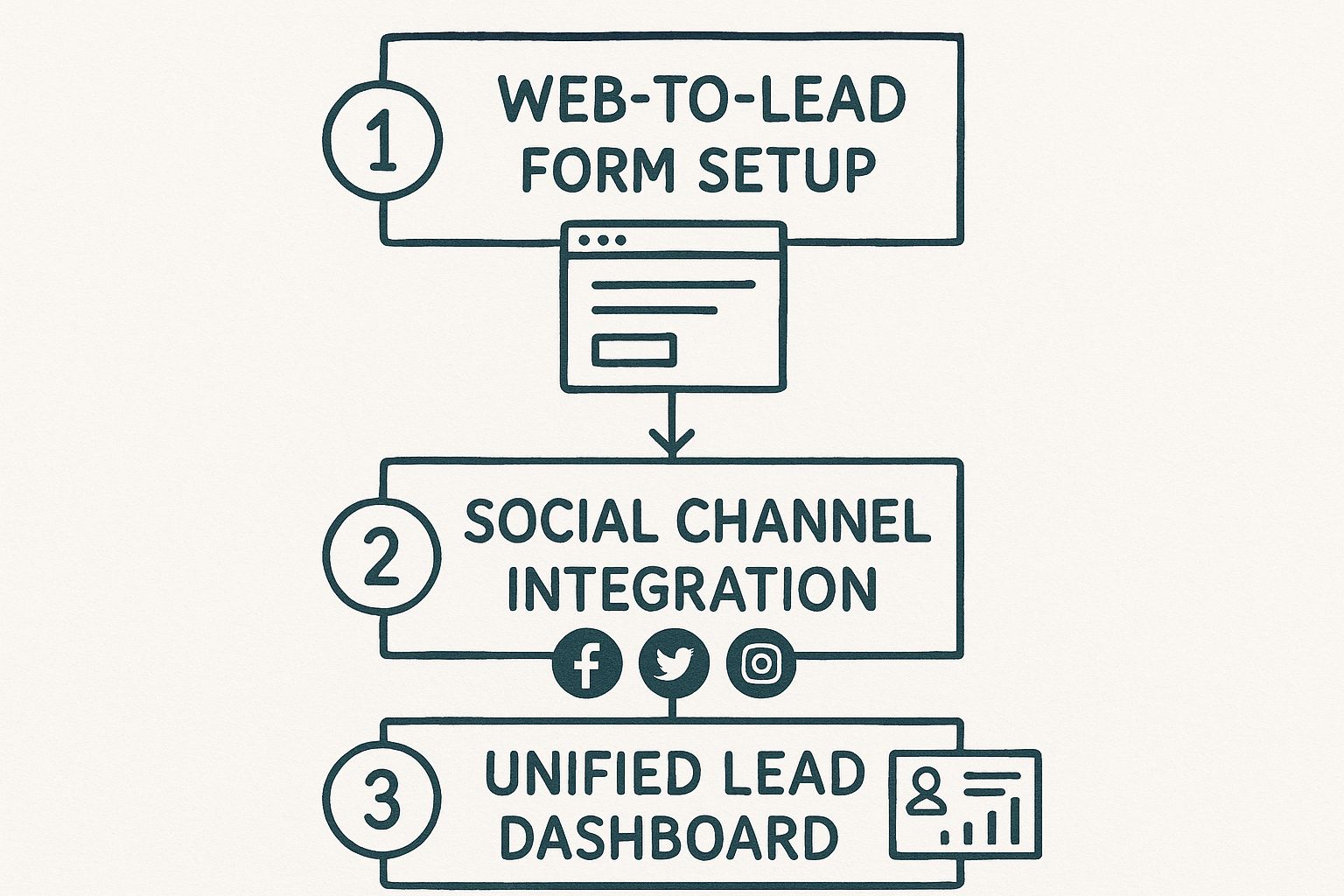
By automating the flow of information, the agency finally gained a complete, 360-degree view of every potential client from the moment of first contact. This is a key benefit of cloud solutions like Salesforce.
This unified view is absolutely critical in Australia’s property market. Research shows prospective buyers undergo an average of 460 unique research moments over nearly 20 months before purchasing. You can discover more insights into Australian marketing statistics that back this up.
Having a centralised CRM ensures no touchpoint is ever lost along the way. You can learn more about how this all fits together by exploring the real estate tech stack where Salesforce is the backbone.
Automate Nurturing with Salesforce Automation Tools

Getting a lead is one thing. Actually turning it into a sale? That’s where the real work begins. The follow-up is where most deals are won or lost.
Consistent, valuable communication is what turns a casual enquiry into a signed contract. But manual follow-up is a massive time-drain for busy agents. This is where automation becomes your agency's best friend for effective real estate lead generation.
By tapping into Salesforce's automation tools, you can build smart nurturing strategies that keep you top-of-mind without you having to lift a finger. This ensures every single lead gets timely, relevant communication, building trust from the very first click.
Using Salesforce Flow for Smart Nurturing
Picture this: a potential buyer fills out an enquiry form on your website. Instead of that lead just sitting in an inbox, Salesforce Flow can instantly kick off a personalised journey. We're not talking about a generic "thanks for your interest" email, either. We're talking about delivering real value, straight away.
A well-designed flow can do so much more:
- Send an immediate welcome email with something genuinely useful, like a first-time homebuyer's guide.
- Automatically create a follow-up task for the assigned agent to make a personal call within 24 hours.
- Add the lead to a specific campaign that drips out relevant content, like neighbourhood guides or recent market updates, over the next few weeks.
This automation means no lead ever falls through the cracks, freeing up your agents to focus on relationship building and closing deals. You can explore this more by reviewing key Account Engagement best practices that drive these results. For a deeper dive into conversational AI, it's also worth checking out the best chatbot for lead generation tools.
Prioritising Hot Leads with Lead Scoring
Not all leads are created equal. In Australia's competitive real estate market, being able to differentiate a casual browser from someone ready to transact is a huge advantage. Listings often go to the first agent who responds, making speed and priority essential.
This is where lead scoring in Salesforce completely changes the game. By assigning points to specific actions a lead takes, you can automatically surface your most engaged prospects.
Case Study in Action: A client of ours implemented a lead scoring model that awarded points for high-intent actions like viewing a property multiple times, using the mortgage calculator, or downloading a seller’s guide. One lead quickly racked up a high score after repeatedly viewing a new listing and then requesting a property valuation online.
Salesforce instantly flagged this person as a ‘hot’ lead, sending an immediate notification to the assigned agent. She called within minutes and discovered the seller was ready to list that week. She secured the listing—a direct result of the system telling her exactly who to call and when.
Scale Marketing with Salesforce Account Engagement
Automated follow-ups are a great start, but to dominate your local market, you need to think bigger. The real magic happens when you build sophisticated, multi-channel campaigns that speak directly to a prospect's needs.
This is where a true marketing automation platform like Marketing Cloud Account Engagement (formerly Pardot) completely changes the game.
It allows for incredible granularity in how you segment your contacts. Instead of a one-size-fits-all approach, you can build dynamic lists based on hyper-specific criteria. Imagine creating a list of 'buyers interested in 3-bedroom homes in a specific suburb' or 'investors who have downloaded your guide on duplexes'. That level of detail ensures every message is relevant and gets noticed.
A Real-World Example: A New Development Campaign
We recently partnered with an agency launching a campaign for a new high-end apartment development. Their goal was to build a predictable pipeline of qualified buyers long before construction was finished. Using Account Engagement, we mapped the entire buyer journey.
It started with a highly targeted social media ad, and from there, we could trace every step:
- Initial Ad Click: A prospect clicks a Facebook ad showcasing the development's luxury amenities.
- Website Engagement: They land on a purpose-built page and download the detailed floor plans, tagging them in Salesforce as a high-intent lead.
- Automated Nurturing: This triggers a tailored email series featuring virtual tours, architect interviews, and updates on local lifestyle perks.
- Final Booking: The system tracks their engagement score. Once they hit a certain threshold, an agent gets an alert to make a personal call and book them into the display suite.
Every touchpoint was tracked perfectly in Salesforce. This gave the agency a crystal-clear view of their campaign ROI and, more importantly, a pipeline brimming with genuinely interested prospects.
Our Lesson Learned: This project drove home a key lesson for us: sophisticated marketing isn't about blasting out more emails. It's about sending the right message to the right person at the right time, all powered by clean data.
When it comes to real estate lead generation in Australia, social media remains a powerhouse. For building your professional brand, LinkedIn is crucial; we recommend posting two to four times a week. Of course, attracting local buyers and sellers means mastering your online backyard. Understanding and implementing a solid strategy for local SEO for real estate is non-negotiable for pulling in geographically relevant leads.
Salesforce Lead Generation Tools Comparison
Deciding between Salesforce's core CRM and a full marketing automation platform can be tricky. It boils down to your agency's scale and ambitions. One is fantastic for managing relationships, while the other is built for creating complex, automated marketing journeys.
| Feature | Sales Cloud (Core CRM) | Marketing Cloud Account Engagement (Pardot) |
|---|---|---|
| Primary Use Case | Managing agent pipelines, tracking deals, and logging client interactions. | Building sophisticated, multi-channel marketing campaigns, nurturing leads automatically, and scoring prospect engagement. |
| Lead Nurturing | Basic email templates and task reminders for manual follow-ups. | Advanced, multi-step engagement journeys triggered by prospect behaviour (e.g., website visits, email opens, form submissions). |
| Lead Scoring & Grading | Not a native feature; requires manual qualification or third-party apps. | Robust, customisable scoring and grading rules to automatically identify the hottest leads for agents to contact. |
| Ideal for… | Individual agents or small teams focused on relationship management and deal tracking. | Growing agencies that want to scale lead generation with automated, data-driven marketing campaigns and gain deep insights into prospect behaviour. |
Ultimately, Sales Cloud is your command centre for sales activity, while Account Engagement is your engine for generating and qualifying leads at scale. Many of the most successful agencies we work with use both in tandem to create a seamless journey from initial interest right through to settlement.
The Results: Measuring What Matters with Salesforce Dashboards

All the automation and campaigns in the world don’t mean a thing if you can’t prove they’re working. The real reason to implement a system like Salesforce is simple: getting a clear, measurable return on your investment. This is where your data stops being a list of contacts and becomes your most valuable asset for effective real estate lead generation.
You can't improve what you don't measure. Salesforce Reports and Dashboards are designed to move beyond vanity metrics—like website clicks or email open rates—and focus on the key performance indicators (KPIs) that actually drive business growth.
Answering Critical Business Questions with Data
A well-configured dashboard gives a principal or team leader a live, bird's-eye view of their entire pipeline. It transforms raw data into real business intelligence, giving you straight answers to the questions that matter most.
Instead of guessing, you can finally know for sure:
- Which marketing channels deliver the highest ROI? See, clear as day, whether that big spend on Google Ads is bringing in more qualified sellers than your social media efforts.
- What is our average sales cycle length? Spot bottlenecks in your sales process and find opportunities to shorten the cycle from first call to commission.
- Which agents have the healthiest pipelines? Get a transparent look at team performance and offer support exactly where it's needed most.
Best Practice Tip: We’ve seen firsthand how a single, well-built dashboard can completely pivot an agency’s strategy. When you have concrete data showing that 80% of your high-value listings come from past client referrals, it’s a no-brainer to invest more in your client appreciation program.
This level of insight separates agencies that thrive from those that just survive. By visually tracking your lead sources, conversion rates, and sales cycle length, you can pinpoint what’s working and what’s not. It’s this data-driven approach that allows you to confidently double down on winning strategies.
Many of our clients have used these insights to achieve remarkable growth, as you can see in our portfolio of Salesforce case studies. Each story is a testament to how turning raw data into clear, visual dashboards provides the clarity needed to scale an agency effectively.
At the end of the day, Salesforce isn’t just a digital rolodex. It’s a powerful analytical engine that, when implemented correctly by a trusted Salesforce partner, gives you the business intelligence you need to build a predictable, profitable, and scalable real estate operation.
Frequently Asked Questions about Salesforce for Real Estate
When real estate agencies start looking at a proper CRM, a lot of the same questions pop up. It’s a big step. We've put together answers to some of the most common queries we hear as a Salesforce partner, covering implementation timelines to integrations with tools you already rely on.
How Long Does It Take to Implement Salesforce?
This is almost always the first question we're asked, and the honest answer is: it depends on your agency's size and complexity.
For a smaller team needing to get leads and contacts organised in Sales Cloud, we can get things up and running in a matter of weeks. Simple, clean, effective.
For a larger agency wanting to integrate multiple lead sources, build custom follow-up sequences with Salesforce Flow, and create detailed reporting dashboards, you’re looking at a more realistic timeline of a few months. Our process always starts with a discovery phase to map out your specific business needs, allowing us to provide a clear timeline before we begin.
Can Salesforce Integrate with Real Estate Portals like REA and Domain?
Absolutely. In fact, it's one of the most powerful things you can do. Connecting Salesforce with major portals like REA Group or Domain is a standard request and a massive time-saver.
This is usually done through an API integration. In plain English, this means new enquiries from these platforms are automatically funnelled straight into Salesforce as new leads. No more manual data entry, no more leads slipping through the cracks. Every single portal enquiry is captured and assigned for immediate follow-up.
Our Project Experience: The real magic isn't just capturing the lead; it's about instantly kicking off your automated follow-up journeys the second that lead hits your system. That speed is what gives our clients the edge over the competition.
Is Salesforce Too Complicated for a Small Agency?
It’s a fair concern. Salesforce is a robust platform, but that doesn't mean it has to be complicated. The trick is to start smart and focused. Nail the essentials first—like getting all your contacts in one place and tracking your sales pipeline.
We nearly always recommend a phased approach for smaller agencies:
- Phase 1: Master the basics. Get comfortable managing your leads, contacts, and opportunities in Sales Cloud.
- Phase 2: Layer in simple automation. Think automatic follow-up tasks or email alerts so nothing gets missed.
- Phase 3: Build out clean dashboards to track what matters, like which lead sources are actually bringing in deals.
Salesforce grows with you. You can start with a lean, effective system that delivers value from day one, and then add more advanced features and automation as your agency expands. It’s all about getting the win now without feeling overwhelmed.
Ready to build a predictable, scalable lead generation engine for your real estate agency? The team at Adaptal is a Salesforce partner that specialises in creating tailored CRM solutions that turn data chaos into closed deals. Let's talk about how we can help you get the most out of your CRM investment.