

Inefficient processes are more than just a daily headache; they’re a quiet drain on your resources, capping your growth potential. For many businesses, clinging to “the way we’ve always done it” is no longer a viable strategy in today’s market. That mindset leads to missed opportunities, frustrated teams, and stalled growth. Streamlining business processes with a platform like Salesforce is about systematically tearing down these roadblocks to build a more resilient, efficient, and profitable operation.
As a Salesforce partner, we’ve seen firsthand how disconnected systems and manual workflows can hold a business back. This guide shares our real-world project experience, offering practical steps and insights for decision-makers looking to leverage Salesforce for true operational excellence.
The Real Cost of Inefficient Business Processes
Inefficient processes are silent costs that pile up over time, hitting everything from employee morale to your bottom line. Picture a mid-sized business grappling with disconnected data: the sales team uses one system, the service team another, and finance is stuck with manual spreadsheets. This operational chaos creates tangible, expensive problems that we frequently help clients solve.
This scenario is far from unique. Here in Australia, the push towards operational excellence is undeniable. Research shows that while nearly 70% of Australian businesses have experimented with AI, only a small fraction have reached an advanced stage of implementation. You can discover more insights about Australia’s business growth trends to see the full picture. This gap highlights a massive opportunity for businesses ready to move beyond basic digitalisation toward genuine process optimisation powered by a robust CRM platform.
The Domino Effect of Flawed CRM Workflows
When your core operations are fragmented, the consequences ripple across the entire organisation. These issues directly torpedo revenue and customer loyalty. Based on our project experience, here are the most common challenges we see:
- Lost Leads and Inaccurate Quotes: Sales reps waste hours manually creating quotes from outdated price lists in disconnected spreadsheets. This leads to errors and delays that send potential customers straight to competitors.
- High Customer Churn: Service teams without a complete customer history in their CRM struggle to resolve issues effectively. This creates a poor experience where clients feel misunderstood and undervalued, eventually driving them away.
- Wasted Labour Hours: Your team gets bogged down in low-value, repetitive tasks like data entry or chasing approvals. They should be focused on strategic initiatives that grow the business, but they’re stuck in administrative weeds instead.
The true cost isn’t just wasted time; it’s the compounding effect of missed revenue, poor decision-making from flawed data, and the inability to scale.
Ultimately, these daily struggles translate into measurable business damage. This reality creates an urgent need for a structured approach to streamlining business processes. It positions a platform like Salesforce not just as another tool, but as the foundational solution for building scalable, efficient operations.
What Streamlining a Process in Salesforce Actually Looks Like
Let’s pull back the curtain on what streamlining business processes means in a Salesforce context. Think of the difference between a frantic home kitchen and a professional chef’s station—everything has a purpose and a place. Streamlining isn’t about telling your team to work faster; it’s about removing friction, cutting out waste, and engineering a process within your CRM that delivers predictable, high-quality results every time.

This philosophy is captured by frameworks designed to maximise value while eliminating inefficiency. Understanding a concept like the Lean methodology provides a solid foundation. It trains you to focus on what the customer values and ruthlessly cut everything else.
When you bring this mindset into a Salesforce environment, it all boils down to a practical framework built on three core pillars.
The Three Pillars of a Streamlined Salesforce Process
Getting your operations running like a well-oiled machine inside your CRM isn’t a one-and-done task. As Salesforce partners, we build a strong foundation for our clients with three strategic initiatives that support each other. Get these right, and you’ll create a robust and efficient system that drives your business forward.
1. Standardisation
This is the starting block. It’s where Salesforce becomes your single source of truth. No more data scattered across spreadsheets, email threads, or sticky notes. Every customer interaction, sales opportunity, and service ticket lives in one central place. This consistency means everyone on your team is working from the same playbook.
2. Automation
Once you have consistent, standardised processes, you can automate them. This is where the magic happens in Salesforce. Using tools like Flow, you can take repetitive tasks off your team’s plate—think lead assignments, follow-up reminders, and quote approvals. This frees up your people to focus on high-value work that requires a human touch, like building strong client relationships.
3. Optimisation
A streamlined process is never static. With Salesforce Reports and Dashboards, you get a real-time, bird’s-eye view of performance. You can instantly spot bottlenecks, analyse trends, and make sharp, data-driven decisions to fine-tune your workflows.
Let’s look at how this plays out in the real world with a before-and-after scenario common in our projects.
Before and After: A Salesforce Process Transformation
| Business Area | Manual Process (Before) | Streamlined Process with Salesforce (After) |
|---|---|---|
| Lead Management | Leads manually entered from web forms into a spreadsheet. Sales reps pick their own leads. | Leads automatically captured from web forms into Sales Cloud and routed to the right rep based on territory and workload. |
| Sales Quoting | Quotes created in Word/Excel. Prone to errors and version control issues. | Standardised quote templates generated in Salesforce CPQ with one click, ensuring accuracy and faster approvals. |
| Customer Support | Support tickets managed via a shared email inbox. Slow response times and lost requests. | Tickets automatically created in Service Cloud and assigned. Escalation rules ensure urgent issues are handled promptly. |
| Reporting | Manually compiling data from multiple sources for a weekly report. Time-consuming and often outdated. | Real-time dashboards provide instant visibility into KPIs, updated automatically. |
The difference is night and day. It moves your team from reactive fire-fighting to proactive, strategic work.
A streamlined process feels different. It’s the confidence of knowing a hot lead is followed up in minutes and a customer issue is instantly routed to the right person—all powered by automation.
This structured approach is the heart of any successful digital transformation. Getting it right often requires the expertise of a Salesforce partner who can align technology with your business goals. You can learn more about the role of Salesforce development consultants in digital transformation.
Our Blueprint for Streamlining With Salesforce
Taking on a project to streamline your business processes can feel daunting. With a clear, strategic blueprint, it becomes manageable and effective. Drawing from our experience with over 110 Salesforce implementations, we’ve honed a four-stage approach that methodically turns ambitious goals into tangible results. The secret? Start small, aim for high-impact areas first, and let early wins build momentum.
This systematic improvement is becoming non-negotiable. The Australian market for Business Process Management (BPM) is predicted to grow at an astonishing 22.7% CAGR between 2025 and 2030. Businesses are laser-focused on operational efficiency, and they’re using platforms like Salesforce to get there. You can read the full research about the Australian BPM market to get a sense of this shift.
Stage 1: Process Mapping and Discovery
You can’t fix what you can’t see. The first step is always Process Mapping. We sit down with you to pinpoint the processes causing the most pain. We ask questions like, “What’s the one thing that always slows your team down?” or “Where do most customer complaints come from?”
Often, the best places to start are core workflows like your lead-to-cash cycle or the case resolution process. Why? Because improvements here send positive ripples across the entire organisation. This discovery phase gives us a clear picture of every step, bottleneck, and manual workaround.
Stage 2: Solution Design and Salesforce Alignment
Once we’ve identified the problem, we move into Solution Design. This is where we match your pain points to the right tools within the Salesforce ecosystem.
- Struggling to manage your leads? We’ll map out a solution in Sales Cloud that automates lead assignment and follow-up.
- Is creating complex quotes a manual nightmare? We can configure Salesforce CPQ (Configure, Price, Quote) to standardise the process.
- Feeling blind to customer issues? We’ll architect a Service Cloud setup that gives your team a 360-degree view of every customer.
This flow shows how we bridge the gap from mapping problems to implementing real solutions.
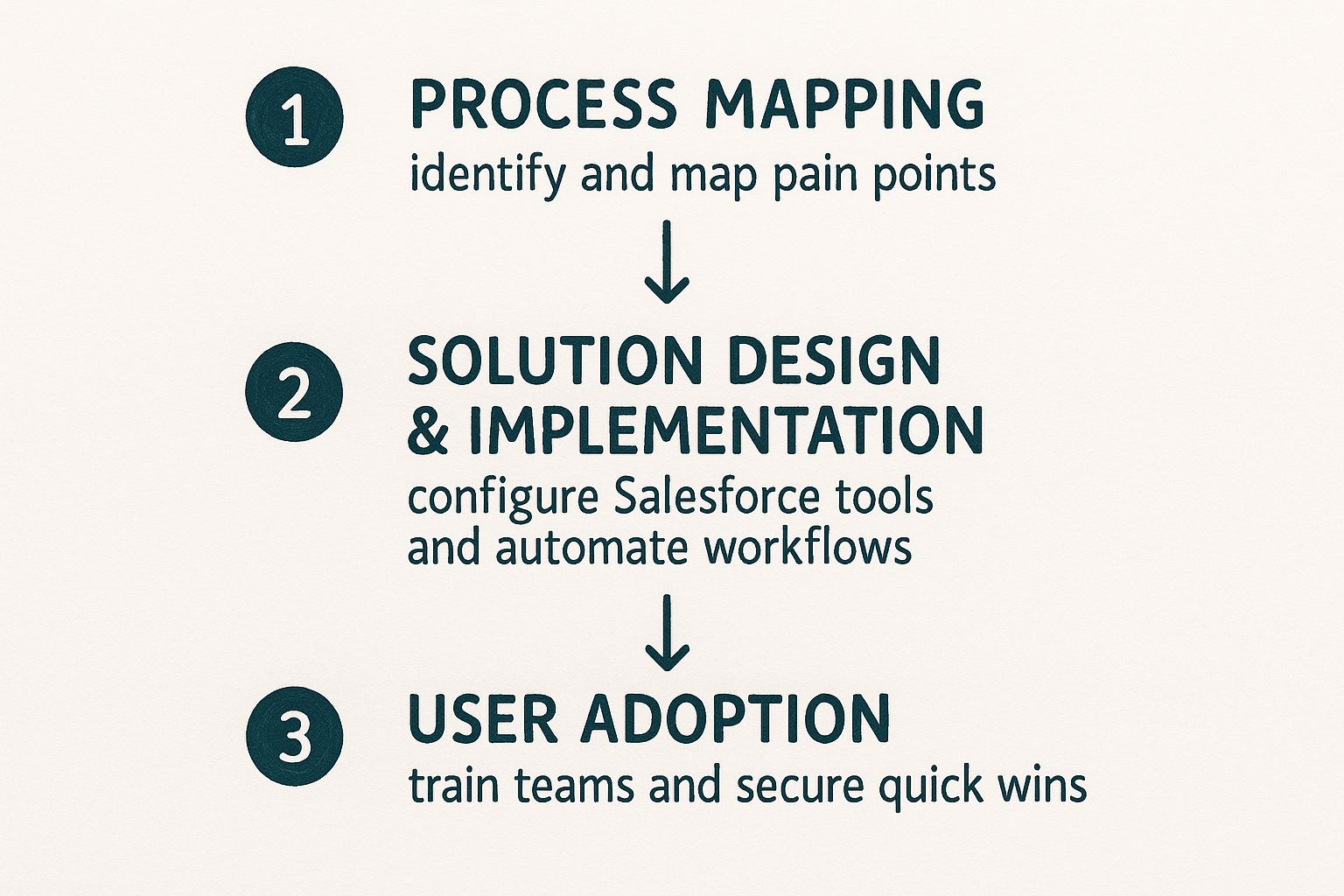
As the infographic shows, it’s a clear path from understanding your unique challenges to achieving real-world results through smart technology and team enablement.
Stage 3: Implementation and Automation
With a solid design locked in, we begin the Implementation. This is where we bring the solution to life inside Salesforce, using powerful tools like Salesforce Flow and Approval Processes to build the automated workflows that eliminate tedious manual work.
Our goal isn’t just to automate for the sake of it. It’s to build a system that makes the right way of doing things the easiest way for your team.
Stage 4: User Adoption and Continuous Improvement
Finally, we focus on User Adoption. A perfectly designed process is useless if your team doesn’t use it. We prioritise training, provide clear documentation, and focus on securing quick wins that show immediate, undeniable value.
Starting with a small, successful project is key to building the confidence needed to drive broader change. This phased approach is the bedrock of a successful project. To get into the details, take a look at our comprehensive Salesforce implementation guide for Australian businesses.
Case Study: Streamlining a Manufacturer’s Sales and Service Operations
Theory and best practices are one thing. The real proof is seeing what happens when process streamlining is applied to a real-world business. Let’s look at a story of our partnership with an Australian manufacturer who was wrestling with serious operational friction.
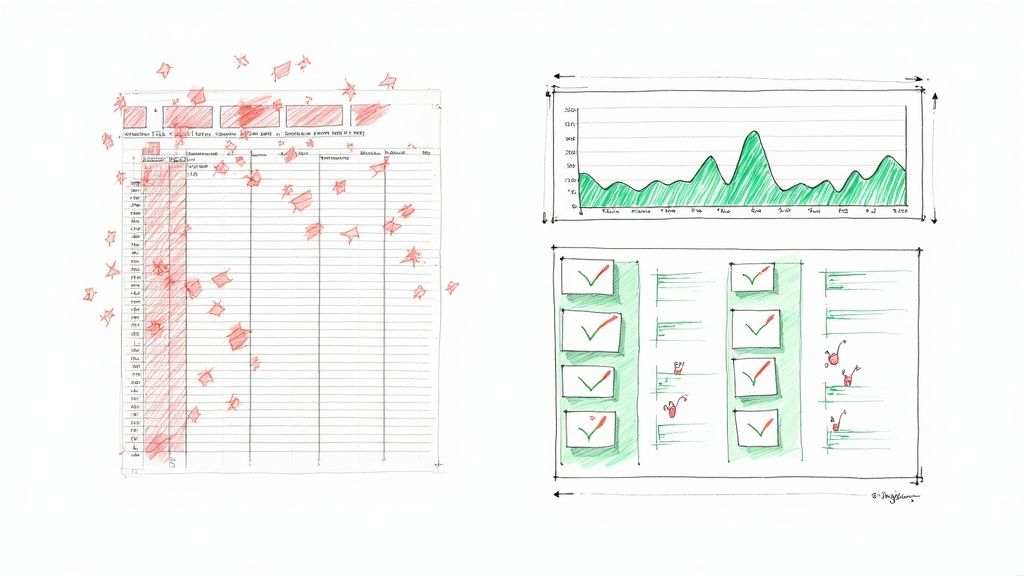
This company was stuck in a messy cycle of inefficiency poisoning both its sales and service departments. The problems were tangled together, creating a domino effect of mistakes and unhappy customers that was capping their growth.
The Business Challenge: Disconnected Operations
The manufacturer’s sales team was drowning in a complex quoting environment. Reps pieced together quotes manually, wrestling with chaotic spreadsheets and out-of-date price lists. This wasn’t just slow; it was a recipe for constant errors, inconsistent pricing, and a clunky approval process that stalled deals.
Meanwhile, their service department was flying blind. They had zero visibility into a customer’s purchase history. Every support call was a fresh start, forcing frustrated customers to repeat their stories and leading to painfully slow resolutions. It was a textbook case of departmental silos creating a fractured customer experience.
Our Salesforce Solution: A Unified CRM Platform
To untangle these problems, we mapped out a two-pronged Salesforce solution. The goal was simple: create a single, unified view of the entire customer journey.
Our strategy involved:
- Sales Cloud with CPQ: We implemented Salesforce CPQ (Configure, Price, Quote) to completely rebuild their quoting process. This system automated everything, replacing error-prone spreadsheets with a guided selling experience that ensured every quote was accurate and moved through a standardised approval workflow.
- Service Cloud Implementation: Next, we rolled out Service Cloud to give their support team a complete 360-degree view of every customer. An agent could instantly see a customer’s full purchase history, past service cases, and any open sales deals from a single screen.
By plugging their sales and service data into a single cloud platform, we knocked down the walls between the teams. For the first time, everyone was working from the same live customer information.
The Results: Faster, Smarter, and More Profitable
The difference was felt almost immediately. By connecting these once-separate functions, the manufacturer unlocked a new level of operational effectiveness.
Here’s what that looked like in numbers:
- A 30% reduction in the time it took to generate a complex quote.
- A 15% increase in overall quote accuracy, which stamped out costly pricing mistakes.
- 25% faster case resolution times for the customer service team.
This project is a perfect example of the tangible returns from a smart approach to streamlining. It shows how the right Salesforce partner can turn disjointed, manual workflows into a powerful engine for growth.
Check out more stories like this in our library of Salesforce case studies to see how we help businesses solve their biggest challenges.
Using Automation and AI to Supercharge Your Processes
You’ve standardised your workflows and automated repetitive tasks. That’s a massive win for efficiency. But what’s next on the horizon for digital transformation?
The next leap forward isn’t just about making your processes faster; it’s about making your entire operation smarter. This is where Artificial Intelligence (AI) and intelligent automation tools like Salesforce Einstein change the game.
AI goes beyond simple, rule-based tasks. It introduces a predictive layer that helps your teams anticipate customer needs, spot hidden opportunities, and solve problems before they escalate. This intelligence transforms your CRM from a system of record into a proactive engine for growth, guiding your team towards better decisions.
The push towards intelligent automation is picking up steam. A staggering 78% of Australian businesses plan to increase their spending on AI-driven services by 2025, which shows where the industry is heading.
Making Your Operations More Intelligent with Salesforce Einstein
Salesforce Einstein embeds practical AI capabilities directly into the workflows your team already uses. It acts like a personal data scientist for every employee, constantly analysing your data to uncover patterns and make intelligent recommendations.
Here are a few real-world examples of how we leverage Einstein for our clients:
- Einstein Lead Scoring: Instead of sales reps guessing which leads to chase first, Einstein analyses historical data to automatically score new leads based on their likelihood to convert. This means your team can immediately focus their energy on the hottest opportunities.
- Einstein Case Classification: For your service team, Einstein can automatically read incoming support cases, understand their intent, and route them to the perfect agent with the right skills. This simple step slashes response times and improves customer satisfaction.
- CRM Analytics: For a deeper dive, tools like CRM Analytics (formerly Tableau CRM) use AI to sift through complex datasets and find bottlenecks or opportunities you never knew existed. You might uncover a hidden trend in customer churn or identify an untapped market segment.
By infusing your processes with this intelligence, you shift from being reactive to predictive. Your business can anticipate what’s coming next and act on it, creating a powerful competitive edge.
A practical way to get started is by extracting data from invoices with AI, which eliminates hours of manual data entry. Similarly, advanced automation can be configured for complex document management. As an example, you can see our approach for how to expose a file via Salesforce Flow to get a sense of just how powerful this can be.
Working with a forward-thinking Salesforce partner helps you solve today’s challenges while building an intelligent, predictive foundation for whatever comes next.
FAQ: Streamlining Business Processes in Salesforce
Thinking about using a powerful platform like Salesforce to sharpen up your business processes naturally brings up a few questions. Drawing from our experience across dozens of projects, here are answers to the most common queries we hear from business leaders.
What is the first step to streamlining in Salesforce?
The most critical first step is discovery and process mapping. Before building any automation, you must have a crystal-clear picture of your current state. Think of it like a doctor diagnosing an illness before prescribing a treatment.
When we partner with clients, we help them pinpoint one key process that’s causing the most significant pain—this could be lead follow-up, customer onboarding, or quote generation. We then map out every step, decision point, and manual workaround. This exercise shines a light on the real bottlenecks and clarifies where Salesforce automation will deliver the biggest and fastest impact.
The goal of mapping isn’t just to document what you do now. It’s to find the specific moments of friction that can be eliminated with smarter workflows and targeted automation within the Salesforce platform.
How long does it take to see results from a Salesforce project?
While a full-scale digital transformation is a marathon, not a sprint, you should see tangible results quickly. The secret is to start with focused, high-impact projects.
A well-defined initiative—like automating lead assignment rules in Sales Cloud or setting up case escalation rules in Service Cloud—can often be rolled out in a matter of weeks. These changes deliver almost immediate improvements in metrics like lead response times. As experienced Salesforce partners, we strategically target these “quick wins” first to build momentum and demonstrate a clear, early return on investment (ROI).
Can we streamline processes without a major IT project?
Absolutely. One of the greatest strengths of the Salesforce platform is its accessibility. Many of the most powerful tools for streamlining business processes, like the intuitive Salesforce Flow Builder, are designed for Salesforce administrators and savvy business users—not just developers.
Your own team can build sophisticated automations like email alerts, task creation, and record updates without writing code. Our goal as a Salesforce partner is to empower your internal teams, giving them the skills and confidence to manage and continuously improve their own processes. This self-sufficiency reduces your long-term reliance on major IT interventions and builds a culture of agility.
Ready to stop wrestling with inefficient workflows and unlock the full potential of your business? The team at Adaptal is a trusted Salesforce partner specialising in helping Australian businesses transform their operations. Contact us today for a consultation to discuss how we can build a blueprint for your success.