

Business transformation consulting is much more than a simple tune-up; it’s a strategic partnership designed to fundamentally reshape your company's operations, culture, and technology. This isn't about minor adjustments. It’s about making core changes that drive significant growth and efficiency, with powerful platforms like Salesforce acting as the technological backbone.
As a Salesforce partner, we see this firsthand. True transformation isn't just about implementing new software; it's about leveraging the Salesforce platform to solve real-world business challenges in sales, service, and marketing.
What Are Business Transformation Services in a Salesforce Context?

Picture your business as a classic house. You could give it a fresh coat of paint, which might make it look better for a little while. But real transformation means redesigning the floor plan, updating the plumbing, and rewiring the electrical systems to meet modern demands. That's what business transformation consulting does—it’s the full architectural redesign for your organisation, with Salesforce as the blueprint.
It’s a holistic approach that digs much deeper than any surface-level fix. The whole point is to fundamentally rethink how your business runs to unlock substantial improvements in performance and scalability. This isn’t just about plugging in Salesforce; it's about building a more efficient, agile, and customer-centric company from the ground up.
The Core Components of a Salesforce Transformation
The process always starts with a comprehensive review of your entire operational model. As Salesforce consultants, we work alongside your team to pinpoint bottlenecks, outdated processes, and the areas where CRM technology can create the biggest impact. The focus is on getting your people, processes, and technology all aligned with your main business goals.
Typically, this involves a few key activities:
- Process Re-engineering: Systematically analysing and redesigning workflows—like lead-to-cash or case resolution—to cut out waste, reduce costs, and improve the customer experience within the Salesforce ecosystem.
- Technology Implementation: Integrating robust platforms like Salesforce Sales Cloud, Service Cloud, or Marketing Cloud to automate tasks, unify data, and create a single source of truth across all departments.
- Change Management: Carefully guiding your team through the transition to Salesforce, making sure everyone is on board to ensure high user adoption and foster a culture that embraces continuous improvement.
- Data Strategy: Building frameworks within Salesforce to capture, analyse, and act on business data, turning raw insights from CRM reports and dashboards into a genuine competitive advantage.
Salesforce as the Blueprint for Change
For so many modern organisations, Salesforce is the central nervous system for their transformation. It provides the essential tools to connect sales, service, marketing, and operations into one cohesive ecosystem. Instead of disjointed departments working in silos, Salesforce creates a unified, 360-degree view of the entire customer journey.
Many business transformation projects are laser-focused on delivering significant process improvement strategies, and this is where a platform like Salesforce really shines. By automating manual tasks and providing real-time data, it empowers teams to work smarter, not just harder.
The following table breaks down the key pillars of a Salesforce-led transformation, showing how the platform underpins each critical area of change.
Key Pillars of Salesforce-Driven Business Transformation
| Transformation Pillar | Description | Example Salesforce Solution |
|---|---|---|
| Customer Experience | Creating seamless, personalised interactions across all touchpoints, from marketing to sales and service. | Salesforce Service Cloud provides a unified agent console to manage customer enquiries from any channel. |
| Operational Efficiency | Automating manual processes and streamlining internal workflows to reduce costs and increase productivity. | Salesforce Flow automates complex business processes, like lead routing or approval workflows, without code. |
| Sales Performance | Empowering sales teams with better tools, data, and insights to close deals faster and more effectively. | Salesforce Sales Cloud offers lead management, opportunity tracking, and forecasting tools in a single platform. |
| Data-Driven Decisions | Centralising data to provide a single source of truth and using analytics to guide strategic choices. | Tableau (a Salesforce company) visualises complex data, revealing trends and insights for better decision-making. |
This synergy between process and technology is what truly unlocks an organisation’s potential.
A successful Salesforce transformation isn't about the technology alone; it’s about using technology as a catalyst to enable better business processes and a more customer-centric culture.
If you want a deeper look into the practical steps of bringing this technology into your business, our detailed Salesforce implementation guide for Australia provides a clear roadmap.
Ultimately, engaging business transformation consultants is an investment in your company’s future. It’s about building a robust operational foundation that not only solves today's challenges but also positions you to seize tomorrow's opportunities with confidence.
Why a Salesforce-Led Digital Transformation Is No Longer Optional
In today's market, standing still is the fastest way to fall behind. The pressure to adapt is constant, and businesses clinging to old ways of working are finding that what worked even five years ago is now a major liability. This isn't about chasing the latest trend; it's about survival.
Picture a business drowning in a sea of disconnected spreadsheets and clunky, legacy software. The sales team is blind to what the service team is doing, marketing has zero real insight into customer behaviour, and leadership is making decisions based on data that’s already weeks out of date. It’s a surprisingly common scenario, and it’s a massive barrier to growth.
The Shift from Legacy Systems to a Unified CRM Platform
This is where a strategic digital shift becomes a lifeline. For many Australian companies, moving to a unified cloud platform like Salesforce isn't just an IT upgrade; it’s a complete operational overhaul. By embracing cloud technology, automation, and advanced analytics, they’re not just swapping out old software—they’re redesigning their entire business model around the customer.
This migration allows them to finally break down the information silos that cripple efficiency. Suddenly, every department has access to the same real-time customer data, creating a single, cohesive view of the business. This move from fragmented data to a single source of truth in Salesforce is the cornerstone of modern business agility.
The Tangible Business Outcomes of a Salesforce Transformation
Adopting a modern CRM platform delivers concrete, measurable results that ripple through the entire organisation. The benefits are felt everywhere, from the executive suite right down to the front lines of customer service.
Key outcomes typically include:
- Enhanced Data Visibility: Gaining a complete, 360-degree view of every customer interaction in Salesforce, which allows for truly personalised service and smarter marketing.
- Smarter, Faster Decision-Making: With real-time Salesforce dashboards and analytics, leaders can shift from reactive problem-solving to proactive strategy based on what's happening right now, not what happened last month.
- Increased Operational Efficiency: Automating repetitive, manual tasks with Salesforce Flow frees up your people to focus on high-impact activities, like building customer relationships and driving innovation.
The difference between old and new is stark. The graphic below shows just how dramatic the performance uplift is when a business moves from legacy systems to a modern digital platform.
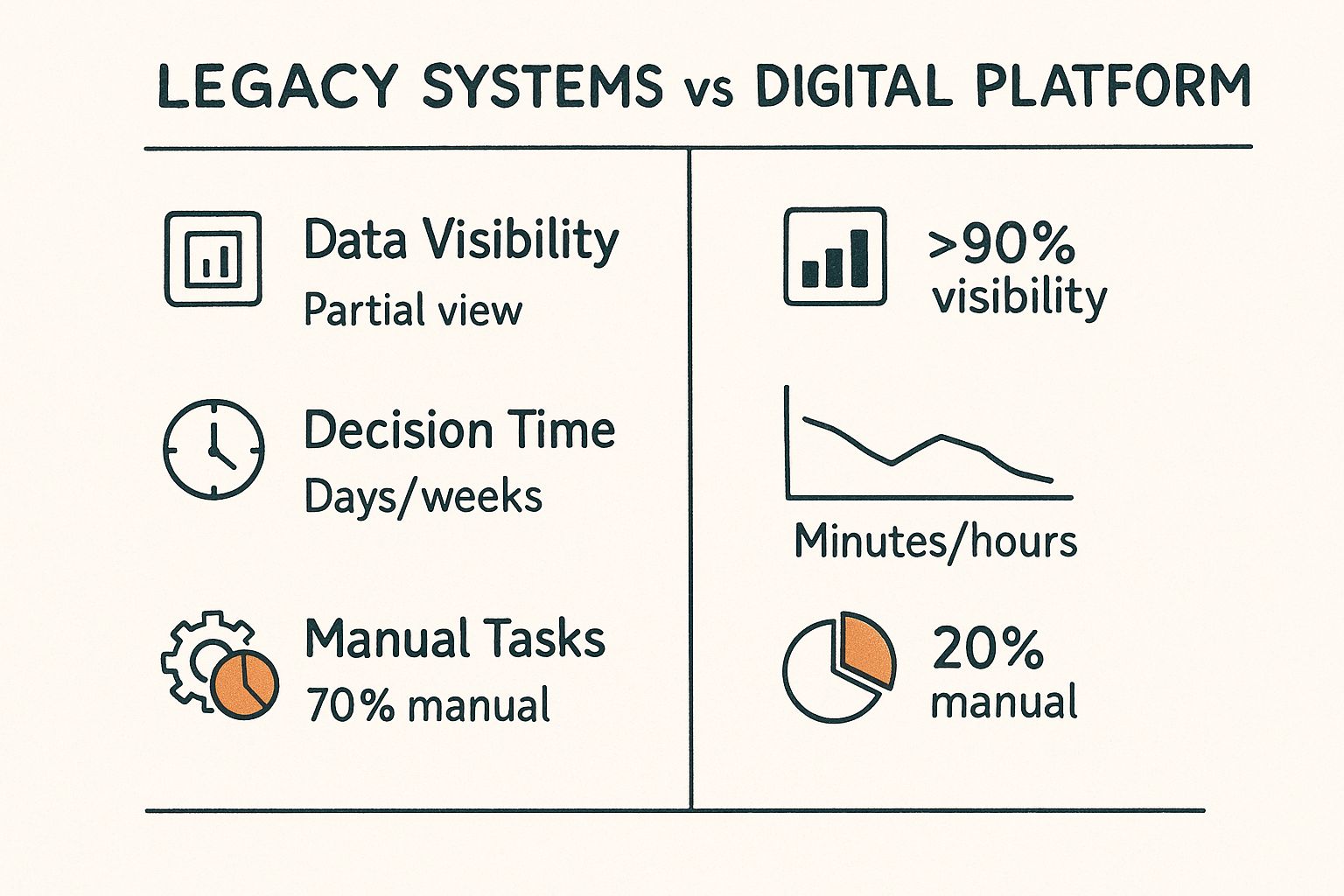
As you can see, a unified platform radically improves visibility, cuts down decision-making time, and slashes the hours wasted on manual work.
This isn't just a fleeting trend; it’s a core component of modern business strategy in Australia. In fact, the demand is fuelling massive growth in the local consulting market. Projections show the Australian consulting services market is set to grow at a CAGR of about 6.7% from 2025 to 2033, hitting a market size of roughly USD 10.1 billion by 2033. You can explore more data on this trend to get the full picture of its impact.
For modern businesses, digital transformation is not an expense—it's a strategic investment in resilience, efficiency, and future growth. It’s about building an organisation that can adapt and thrive no matter what the market throws at it.
Ultimately, making the choice to transform your business digitally is about building a more intelligent, connected, and customer-focused organisation. It provides the foundation you need to not only compete but to lead in an ever-changing world.
How Salesforce Transformation Consultants Drive Real Change

So, what does a business transformation consultant actually do day-to-day? Their role is a world away from simply recommending new software. Think of them as architects of change, meticulously turning high-level strategy into tangible, on-the-ground reality within the Salesforce ecosystem.
This isn't about just installing technology; it's about fundamentally re-engineering the core processes that make your business tick. A true Salesforce partner gets involved in every technical and human detail to ensure your investment delivers real, measurable value.
Re-engineering Core Business Processes for Salesforce
Before a single line of code is written, a great consultant starts by mapping out your existing workflows. They dive deep to find the bottlenecks, the manual workarounds, and all those inefficient little steps that are holding your teams back. The goal is to design leaner, smarter processes that put the customer at the absolute centre of everything.
Case Study Example: We worked with a logistics company struggling with inefficient delivery routing. Their field technicians were wasting hours manually planning routes, leading to delays and high fuel costs. The business challenge was a lack of automation and real-time data. By first re-engineering their dispatch process, we then implemented Salesforce Field Service to automate route optimisation. The result was a 80% reduction in planning time and a significant boost in on-time deliveries.
This process-first approach makes sure the Salesforce technology serves the business strategy, not the other way around.
Implementing Powerful Salesforce Solutions
With streamlined processes mapped out, the next step is to bring in the right technology to power them. As a Salesforce partner, we see firsthand how the platform becomes the engine for change. But this involves much more than just setting up a few user accounts.
It’s about:
- Custom Configuration: Moulding the Salesforce platform—be it Sales Cloud, Service Cloud, or Experience Cloud—so it aligns perfectly with your new business processes. It should feel like a natural extension of your team's workflow.
- System Integration: Connecting Salesforce with your other critical systems, like accounting software (Xero, MYOB) or your ERP. This creates a single, unified view of your business data.
- Smart Automation: Building workflows in Salesforce Flow to handle the repetitive stuff, from assigning new leads in Sales Cloud to escalating support cases in Service Cloud.
A successful technology implementation isn't measured by features, but by how well it empowers your people. It should act as a catalyst for efficiency, not another hurdle for them to jump over.
Managing the Human Side of Change and Salesforce Adoption
This is one of the most critical—and most frequently overlooked—parts of the job: change management. You can have the most advanced technology in the world, but it will fail if your team doesn’t understand its value or how to use it properly.
A consultant’s job is to guide people through that transition. This means creating a clear communication plan, delivering practical training, and setting up support systems to help everyone embrace the new way of working in Salesforce.
Case Study Example: Imagine a sales team moving from familiar spreadsheets to Salesforce Sales Cloud. Without a plan, they might resist the new CRM, seeing it as just more admin. We developed a targeted adoption strategy that showed them exactly how Sales Cloud would help them close deals faster and earn more commission. By focusing on "what's in it for them," we hit a 95% user adoption rate within the first three months.
You can see how we handle these projects in our collection of Salesforce case studies.
Building a Data-Driven Culture with CRM Analytics
Finally, business transformation services help you build a culture where decisions are driven by data, not just guesswork. By centralising all your information in a platform like Salesforce, you create a single source of truth for the entire organisation.
Consultants help you set up the right reports and dashboards, often using tools like Tableau. This gives your leadership team real-time visibility into key performance indicators (KPIs), allowing for agile and informed decision-making. The result is a business that can proactively spot trends, jump on opportunities, and pivot its strategy based on hard evidence.
Turning Economic Shifts into Strategic Opportunities with Salesforce

Most businesses see economic uncertainty and supply chain chaos as major threats. Fair enough. But these pressures can also be powerful catalysts for change, forcing organisations to finally ditch outdated processes and build something far more resilient.
Today's market is a pressure cooker, and it's speeding up the need for real, fundamental business transformation. The companies that get on the front foot aren't just surviving this chaos; they're actually turning it into a competitive edge. This is exactly where smart investments in a flexible platform like Salesforce pay off.
Case Study: Solving Supply Chain Chaos with Salesforce
We recently worked with a mid-sized Australian manufacturer who was completely drowning in supply chain problems. Unpredictable shipping delays and material shortages were creating massive production bottlenecks and, frankly, ruining their customer relationships. Their whole operation ran on a messy collection of disconnected spreadsheets and manual inventory tracking, leaving them flying blind.
The business challenge was a crippling lack of visibility. They couldn't forecast demand properly, track their inventory in real-time, or give customers a heads-up about delays. It was a purely reactive approach, and it was costing them a fortune in both money and trust.
The Salesforce Solution for End-to-End Visibility
Our team jumped in and designed a solution built on the Salesforce platform, with one clear goal: create a single, unified view of their entire supply chain. This wasn't just about installing some new software. It was a ground-up overhaul of how they managed their entire operation.
The Salesforce solution focused on a few key areas:
- Integrating Inventory Management: We connected their inventory systems directly into Salesforce. Suddenly, sales and service teams had real-time data on stock levels and material availability at their fingertips.
- Automating Supplier Communication: Using Salesforce Experience Cloud, we built a secure portal for their suppliers. This automated everything from order updates to shipment tracking, cutting out endless back-and-forth emails.
- Proactive Customer Service: With Salesforce Service Cloud, their support team could spot potential delays before they hit the customer. This allowed them to get proactive, manage expectations, and keep their clients in the loop.
By automating these crucial processes and pulling all their data into one place, we gave them the end-to-end visibility they were so desperate for.
Results: Building a Resilient Organisation
The impact was almost immediate. Within six months, the results were clear: the client had slashed production delays by 40% and boosted their on-time delivery rate by over 30%. But more importantly, they built a more agile, resilient operation that could handle future disruptions with confidence.
Investing in business transformation consulting services is no longer just about getting ahead; it's about building the operational muscle you need to thrive in any economic climate. It turns your organisation from a victim of market shifts into a master of them.
This kind of proactive change is fuelling massive growth in the consulting world. Between 2025 and 2034, Australia's consulting market is tipped to grow at a CAGR of 7.5%, potentially hitting AUD 29.78 billion by 2034. A huge part of that growth comes from the simple fact that about half of Australian businesses know they need help actually putting their transformation plans into action. Learn more about the Australian consulting market outlook.
This story really shows that when you treat economic pressure as an opportunity to innovate with cloud solutions like Salesforce, you can come out the other side stronger and more competitive than ever.
How to Choose the Right Salesforce Transformation Partner
Picking the right Salesforce partner for your business transformation is probably the most crucial decision you'll make. This isn't just about hiring a vendor to install software; it’s about finding a guide to help you navigate the tricky, interconnected changes across your tech, processes, and people.
Get this right, and you've got a partner who understands your vision and can deliver results. Get it wrong, and you're staring down the barrel of costly delays and a project that never delivers its promised ROI.
The market is flooded with firms claiming to offer business transformation consulting services, but they're not all the same. Some are pure tech implementers, heads-down in the code. Others are high-level strategists who might not understand the nuts and bolts of a platform like Salesforce. You need someone who can live in both worlds—a team that grasps the big picture and the tiny details of making technology work for your business.
The Dangers of a Tech-Only Approach
Let me share a cautionary tale. A company once chose a vendor based on their technical skills alone. These folks were brilliant coders and could configure anything you asked for. The problem? They had almost zero understanding of the company’s real-world operational headaches or the human side of making a change.
The result was a complete mess. They delivered a technically perfect Salesforce system that nobody wanted to use. It was clunky and completely misaligned with how the teams actually did their jobs day-to-day. User adoption tanked, and the multi-million dollar investment delivered zero return. That’s what happens when technology is implemented in a vacuum.
Essential Criteria for Your Salesforce Partner Checklist
To avoid that kind of disaster, you need a partner with a balanced, holistic view. They have to be more than just a Salesforce expert; they need to be a genuine business consultant who understands that technology serves people, not the other way around.
Here’s a simple checklist to keep in mind when you’re evaluating your options:
- Deep Industry Expertise: Do they actually get your world? A partner who speaks your language can design Salesforce solutions for problems you actually have.
- Proven Salesforce Proficiency: Look for official Salesforce certifications and a solid history of successful projects. Ask for case studies or client testimonials to see how they handle tools like Sales Cloud, Service Cloud, and Experience Cloud.
- A Clear and Collaborative Methodology: A great partner will be transparent about their process, covering everything from discovery and design to implementation and support, keeping you in the loop every step of the way.
- Dedicated Focus on User Adoption: A project's success is measured by how much your team actually uses the new system. Your partner must have a solid change management and training plan to get your people excited about the new tools.
Choosing a partner is like hiring an architect to design your dream home. You wouldn't just hire someone who knows how to lay bricks; you'd hire someone who listens to your vision, understands your lifestyle, and creates a blueprint for a space where you can truly thrive.
Finding the right fit is all about alignment. A partner who wants to understand your business goals before they even start talking about technology is a partner committed to your long-term success. If you want a closer look at what this kind of partnership involves, you can explore our approach to Salesforce consulting services.
Ultimately, the right transformation partner becomes an extension of your own team. They bring the strategic guidance and technical chops needed to turn your vision into a reality.
Building a Future-Proof Business with Salesforce
A successful transformation isn't a one-and-done project. It's the start of a continuous evolution. The real goal of business transformation consulting is to build a foundation for long-term growth and agility, helping your organisation not only navigate today's market but also anticipate tomorrow’s curveballs.
Think of it like swapping a fixed paper map for a dynamic GPS. Instead of sticking to a rigid, predetermined route, a modern operational model built on a platform like Salesforce lets you recalibrate in real time. You can respond instantly to market shifts, customer needs, and new opportunities as they pop up.
Driving Long-Term Value and Sustainability with Your CRM
Beyond the immediate wins in efficiency, modernising your operations with Salesforce creates value that lasts. A huge priority for Australian businesses right now is solid Environmental, Social, and Governance (ESG) reporting. Everyone from investors to customers is demanding more transparency in these areas.
Salesforce gives you the tools to track and manage this critical data without the headache. With Salesforce Net Zero Cloud, for instance, organisations can monitor their carbon footprint and other sustainability metrics. This turns a compliance task from a burden into a strategic advantage, showing a real commitment to corporate responsibility.
A well-executed transformation builds more than just an efficient business; it creates an adaptable organisation that is resilient, responsible, and ready for whatever comes next. This is the core of future-proofing.
This twin focus on sustainability and digitalisation is a massive force. In 2024, the Australian consulting services market was valued at around USD 9.1 billion, and forecasts show it could nearly double to USD 18.8 billion by 2034. A key driver behind this boom is the growing demand for sustainability and environmental responsibility consulting. You can read more about the Australian consulting market forecast to see just how these trends are shaping the industry.
Creating an Agile and Evolving Organisation
Ultimately, the goal is to weave a culture of continuous improvement into the fabric of your business. When you break down data silos with a unified CRM and automate workflows, you empower your teams to be more proactive and innovative.
Imagine your marketing team using Salesforce Marketing Cloud and seeing real-time service issues from Service Cloud. They can immediately adjust their messaging to be more sensitive and relevant. Or your sales team in Sales Cloud getting alerts about a customer's recent support case before making a call.
This level of interconnectedness, all powered by a unified CRM, fosters an agile environment where data flows freely and decisions are made fast. Bringing in business transformation consultants isn't just a project cost; it's a strategic investment in building this kind of enduring market leadership—a business that doesn’t just survive the future, but actively shapes it.
Salesforce Transformation FAQ
It's natural to have questions when you're thinking about reshaping your business, especially when a platform as powerful as Salesforce is involved. Here are a few of the most common queries that come up when we chat with business leaders and decision-makers.
What is a typical timeline for a Salesforce transformation project?
This really depends on the scale of your ambition. A tightly focused project, like rolling out Salesforce Sales Cloud for one team, could be wrapped up in as little as three to six months.
But if we're talking about a more sweeping overhaul—involving multiple departments, tricky integrations with systems like Xero or MYOB, and a big focus on helping your team adapt—you’re likely looking at a journey of 12 to 24 months. The smart way to tackle this is in phases, so you start seeing real value at every step.
How do you measure the ROI of a Salesforce transformation?
Measuring the Return on Investment (ROI) is a mix of art and science, tracking both hard numbers and the softer, cultural shifts. Before we even start, we'll sit down with you to lock in the Key Performance Indicators (KPIs) that matter most.
These usually fall into two camps:
- Quantitative Metrics: Things you can count, like a jump in sales revenue, lower operating costs, shorter sales cycles, and better customer retention rates tracked in Salesforce.
- Qualitative Metrics: The human element, like a boost in team morale, Salesforce user adoption rates, and higher customer satisfaction (CSAT) scores.
A truly successful transformation doesn't just deliver a financial win. It builds a more nimble, efficient, and data-savvy culture that keeps paying dividends long after the project officially ends.
What are the main costs involved in working with a Salesforce partner?
The main investments in a transformation project typically include consulting fees, software licences (like your Salesforce subscriptions), and sometimes hardware upgrades. You'll also want to factor in the internal cost of your team's time for training and getting involved in the process.
Any good Salesforce partner will lay out a completely transparent, detailed cost breakdown right from the start. This means no nasty surprises down the road, and you can budget for the whole journey with confidence, from the first chat to ongoing support. For more information, you might find resources like these additional frequently asked questions helpful.
At Adaptal, we partner with Australian businesses to turn ambitious goals into reality. As a trusted Salesforce partner, our expert team provides the strategic guidance and technical proficiency needed to drive meaningful change with the Salesforce platform.
Ready to start your transformation journey? Contact us for a consultation and discover how we can build a more resilient and future-proof business together.