

Change management consulting is the art and science of guiding an organisation's people, processes, and culture through a major shift, like rolling out a new CRM like Salesforce. The real aim is to get everyone on board, slash resistance, and make sure the technology investment actually delivers on its promise and return on investment.
Why Tech Is the Easy Part of a Salesforce Transformation
It’s a common mistake to think that implementing a powerful platform like Salesforce is the finish line for a digital transformation project. In reality, the technology is just the starting point.
Think of it this way: you could give a world-class orchestra a set of brand new, state-of-the-art instruments. But without a skilled conductor to lead them and musicians who know how to play the new pieces, all you’ll get is expensive noise, not a symphony.
That’s the perfect analogy for a Salesforce rollout. The platform itself has incredible potential for your sales, service, and marketing teams, but its success hinges entirely on your people. Change management consulting is the conductor that makes sure every team member understands their part, feels confident with the new tools, and works in harmony to hit those big business goals. It's not just some IT add-on; it's a core business discipline focused squarely on the human side of your Salesforce project.
Shifting Focus from Systems to People
Too many organisations pour their budget into technical configuration while completely overlooking the very people who will make or break the project's success. This is exactly where most CRM projects stumble. A successful Salesforce implementation needs a deliberate focus on aligning your team's mindset and daily habits with the new system's power. For a deeper look into the cultural hurdles that go beyond the tech, check out this article on Digital Transformation And Culture Change: Overcoming Barriers To Achieve Success.
Great change management gets ahead of the curve by answering the core questions every employee is quietly asking:
- "What's in it for me?" This means clearly showing how Salesforce will make their job easier, more efficient, and more rewarding.
- "How will this change my day-to-day work?" It’s about providing hands-on, role-specific training and support that builds genuine confidence and skill.
- "Why are we doing this now?" This requires painting a compelling picture that connects the new CRM directly to the company's wider vision and goals.
The Strategic Value of a Salesforce Partner
As a Salesforce partner, we've seen this exact scenario play out time and time again. The projects that knock it out of the park are always the ones that prioritise user adoption right from day one.
A consultant's role goes way beyond the technical setup. It’s about crafting a strategy that prepares your entire organisation for a new way of working. This proactive approach ensures your investment in Salesforce doesn't just turn into a glorified database, but becomes a central engine for growth and efficiency. You can learn more about this strategic advantage by understanding the role of Salesforce development consultants in digital transformation.
By framing the project around your people, you turn a simple technology rollout into a genuine business evolution.
The Hidden Costs of Ignoring the Human Element in a Salesforce Project
Investing in a powerful platform like Salesforce without also investing in your people is a bit like buying a high-performance race car but never teaching anyone how to drive it. The potential is massive, but the real-world results are often disappointing and expensive. When the human side of the equation is ignored, the hidden costs of a technology project start to creep in, undermining the very goals you were trying to achieve.

These aren't just abstract risks; they are real, tangible failures that we, as a Salesforce partner, have helped countless organisations navigate. Without structured change management consulting, businesses often face a painful reality that goes far beyond a simple failed IT project.
When User Adoption Plummets
The most immediate and damaging cost is plummeting user adoption. Your team, comfortable with their old methods and spreadsheets, suddenly sees the new CRM not as a tool for success but as a confusing obstacle standing in their way.
This isn't just passive indifference; it often evolves into active resistance. Sales teams create workarounds, service agents revert to old habits, and the expensive, highly customised Salesforce instance gathers digital dust.
The result? A catastrophic loss of ROI before the system even gets a chance to prove its worth. Data becomes fragmented, collaboration breaks down, and the promised "single source of truth" remains an elusive dream.
The Problem of Productivity Decline
Another significant cost is the frustrating and often prolonged dip in productivity. When employees aren't properly prepared for a new system like Sales Cloud or Service Cloud, they struggle. Simple tasks that once took minutes now take much longer as they navigate unfamiliar screens and processes.
Imagine this common scenario: a company merges two sales teams onto a single Salesforce Sales Cloud instance, each with its own legacy system.
- The Business Challenge: Two sales teams with different processes are being merged into one Salesforce Sales Cloud org, causing anxiety and resistance.
- The Salesforce Solution: A unified Sales Cloud implementation designed to streamline lead-to-close processes for the combined team.
- The Results Without Change Management: Without a clear communication plan, both teams feel their established workflows are being threatened. A one-size-fits-all training session fails to address unique concerns, leaving many feeling unprepared. As reps stumble through the new system, call volumes drop, follow-ups are missed, and sales targets are jeopardised, directly impacting revenue.
This productivity decline isn't a short-term blip. It can persist for months, eroding morale and creating a negative perception of the very technology meant to boost performance.
How Expert Consulting Mitigates Risk
This is precisely where expert change management consulting steps in as a critical risk mitigation strategy. It’s not about sending more emails or holding extra training sessions; it’s a strategic approach to understanding and guiding human behaviour through a period of disruption. A consultant works to build genuine buy-in from the ground up.
This proactive focus turns resistance into engagement and confusion into confidence. Mitigating these hidden costs often requires adopting a people-centric approach to digital transformation that places employee needs right at the centre of the project.
By addressing the "why" and "what's in it for me" for every single user, you don't just implement software; you build a culture that's ready for continuous technological evolution. This ensures your Salesforce investment not only survives the go-live date but thrives, accelerating your return on investment and creating a true competitive advantage. The focus shifts from merely installing a tool to empowering your people to succeed with it.
A Proven Framework for Salesforce Change Projects
Successful Salesforce transformations don't just happen; they're the result of a deliberate, structured framework. You can't simply install the software and cross your fingers, hoping for the best—that’s a surefire way to end up with low adoption and wasted potential. Instead, a proven methodology makes sure every step, from the initial planning right through to long-term optimisation, is managed with your people at the very centre of it all.
Our battle-tested framework for change management consulting is designed to steer organisations through the inevitable complexities of a Salesforce-driven shift. It’s a structured approach that builds momentum, tackles challenges before they become roadblocks, and ensures the technology actually delivers on its strategic promise.
This framework is built on four distinct yet interconnected phases, each with specific goals and activities designed for the unique demands of a Salesforce project.
Phase 1: Discovery and Strategic Alignment
Before anyone writes a single line of code, we need to understand the lay of the land. This initial phase is all about deep listening and smart planning. The goal is to perfectly align the technical side of the Salesforce project with your company's bigger business goals and—most importantly—to understand how it's going to affect your people.
A core activity here is conducting detailed stakeholder impact assessments. We pinpoint every group affected by the change, from the executive team and sales managers down to frontline service agents and marketing coordinators. From there, we map out exactly how their day-to-day roles, processes, and responsibilities will change. This lets us get ahead of any friction, identify potential resistance, and figure out where the most support will be needed.
Phase 2: Engagement and Communication
Once we have a clear picture of the 'what' and 'who', the next phase is all about building awareness and creating a real desire for the change. This is where a generic, one-size-fits-all communication plan completely misses the mark. Real engagement means delivering the right message to the right audience at the right time, answering that one crucial question everyone has: "What's in it for me?"
For a sales team moving to Sales Cloud, it’s about highlighting how automation will slash their admin time, freeing them up to do what they do best—sell. For a support team adopting Service Cloud, it’s about showcasing how a single view of the customer will help them solve issues faster and send satisfaction scores through the roof. The communication needs to be consistent, transparent, and always focused on the benefits.
The infographic below shows the foundational steps of this strategic planning, which are essential for getting your goals and resources aligned from the start.
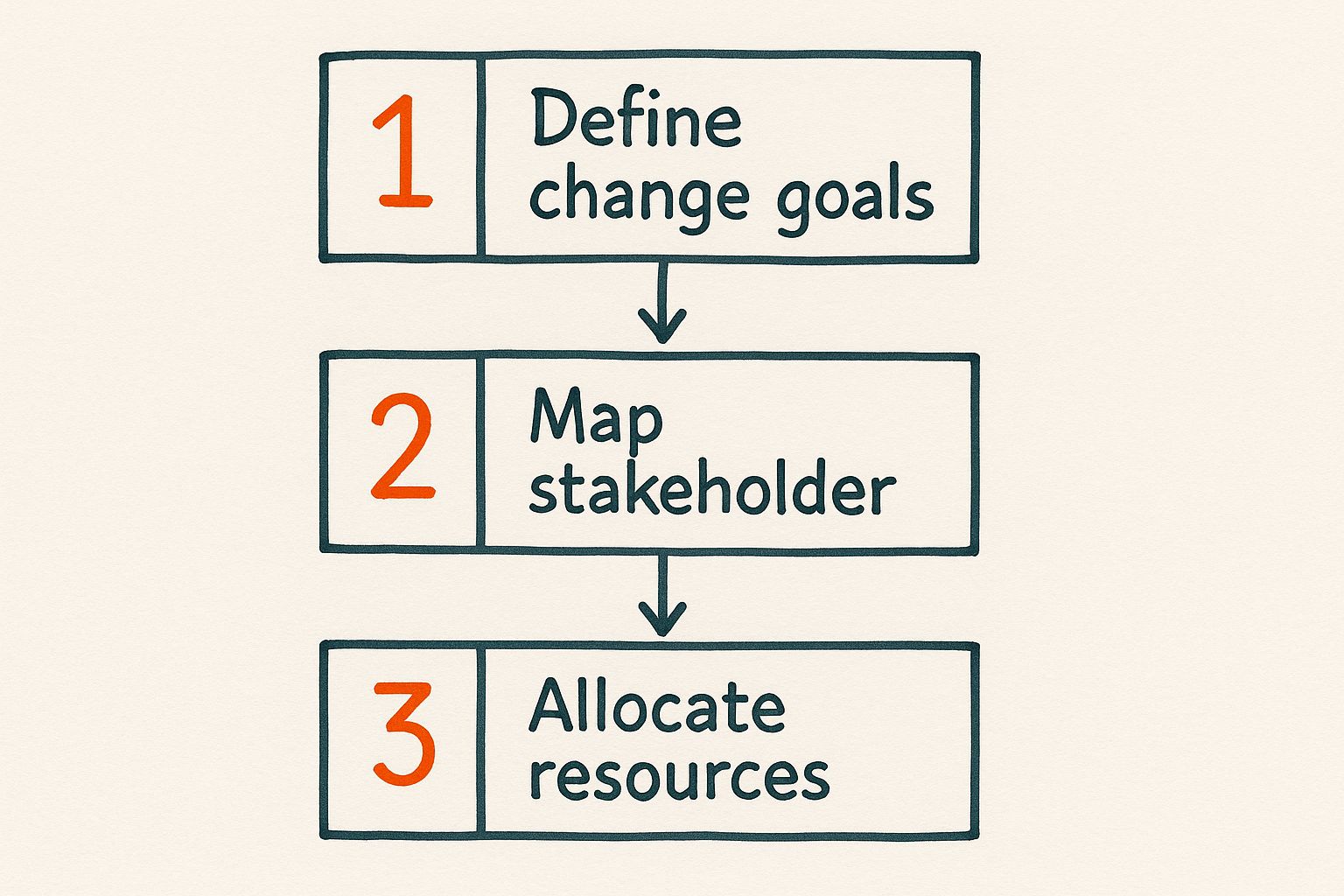
This flow highlights a critical point: defining goals, mapping out stakeholder roles, and allocating resources have to happen early to create a solid foundation for the entire project.
Phase 3: Training and Enablement
Knowledge is the bridge that turns resistance into adoption. This phase is less about the theoretical benefits and more about building practical, real-world confidence and skills. Generic, off-the-shelf training sessions just don't cut it because they don't reflect how your employees actually work every day.
Our approach is to develop role-based learning paths. We create a mix of hands-on, interactive workshops and custom-built Salesforce Trailhead modules that are specific to your business processes.
- Sales Representatives might get a learning path focused on lead management, opportunity tracking in Sales Cloud, and using the mobile app on the go.
- Service Agents would have a curriculum centred on case management, knowledge articles, and omni-channel support in Service Cloud.
- Marketing Teams would be trained on building campaigns and tracking engagement within Account Engagement (Pardot).
This tailored enablement makes sure every user feels competent and ready from day one. It's a critical part of our comprehensive Salesforce consulting services.
Phase 4: Reinforcement and Optimisation
Going live is a huge milestone, but it's definitely not the end of the journey. This final phase is all about keeping the momentum going, embedding new habits, and continuously improving the system. After all, change is a process, not a one-off event.
Reinforcement means celebrating early wins, sharing success stories, and providing ongoing support through things like floor walkers or dedicated super-users. Optimisation involves setting up feedback loops—like user surveys or focus groups—to gather insights on what’s working and what could be better. This data feeds directly into future enhancements, making sure your Salesforce platform evolves right alongside your business.
This sustained effort is crucial, especially as the Australian management consulting market is projected to hit USD 10.4 billion by 2033, driven by the demand for digital transformation expertise. You can discover more insights about this market growth on IMARC Group. By following this structured framework, we turn a simple technology implementation into a lasting business transformation.
Weaving Proven Methodologies into Your Salesforce Rollout
A solid framework gives you the roadmap, but world-class change management consulting also leans on proven, industry-recognised models. These aren't just dusty theories from a textbook; they are powerful tools built on a deep understanding of the human psychology behind change. At Adaptal, we don’t just follow these models blindly. We weave their core principles directly into our own Salesforce-specific framework to build a strategy that’s both practical and powerful.
Think of it like building a house. Our framework is the architectural blueprint—the specific plan designed just for your Salesforce implementation. The established methodologies are the universal principles of engineering and physics that guarantee the structure is sound. By combining both, we create something that doesn't just look good on paper but is truly built to last.
Getting this right is more critical than ever. Technology consulting is on track to be the fastest-growing slice of the Australian management consulting market, with a projected annual growth rate of 7.52% through 2030. This surge in digital projects is cranking up the demand for expert guidance that actually works. You can read the full research about this market trend on Mordor Intelligence.
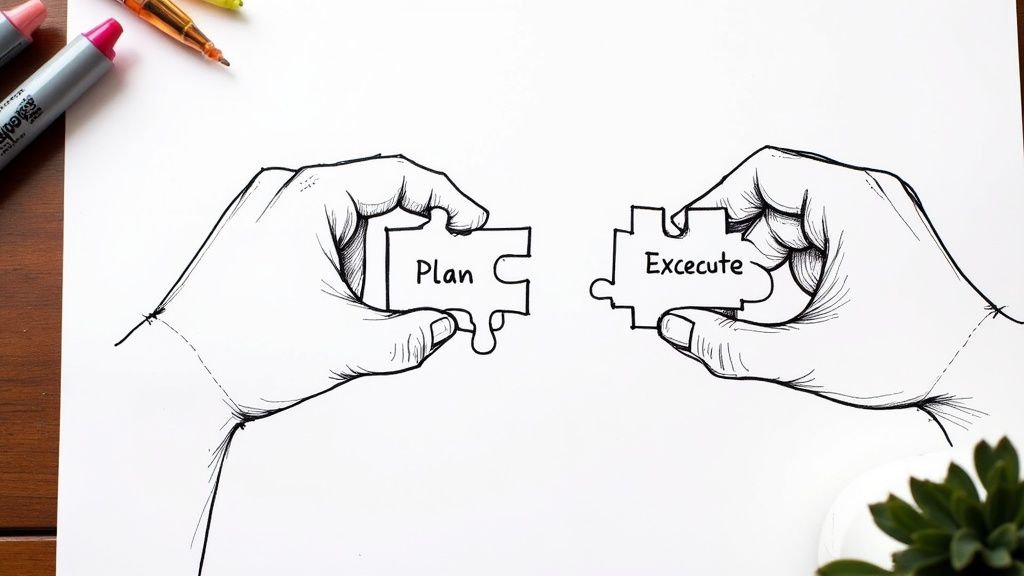
The ADKAR Model in a Salesforce Context
One of the most effective and human-centric models out there is Prosci's ADKAR® Model. It breaks down any successful change into five key milestones that every single person must achieve. We don't just talk about these milestones; we translate them into tangible actions for your Salesforce project.
- Awareness of the need for change.
- Our Action: We go way beyond a simple project announcement email. We build a communication plan that hits home, clearly explaining the business pains the new CRM will solve—like frustrating data silos or clunky sales processes that everyone hates.
- Desire to jump in and support the change.
- Our Action: This is all about answering the "What's In It For Me?" question for every user. We work with managers to spotlight how Sales Cloud automation means less manual data entry for reps, or how Service Cloud gives agents the tools to resolve customer issues in record time.
- Knowledge on how to actually make the change.
- Our Action: Forget generic, one-size-fits-all training. We deliver role-specific, hands-on workshops and custom Trailhead modules that teach teams to use Salesforce in the context of their real, day-to-day tasks.
- Ability to put new skills and behaviours into practice.
- Our Action: We’re here to bridge the gap between knowing what to do and actually doing it. This means creating "day-in-the-life" scenarios, setting up a network of super-users for post-launch support, and providing quick reference guides to build confidence on the ground.
- Reinforcement to make the change stick.
- Our Action: We help you establish feedback loops and, just as importantly, celebrate the early wins. By showcasing dashboards that highlight initial successes, we build momentum and lock in the new habits for the long haul.
Kotter’s 8-Step Process for Leading Change
Another cornerstone of our approach is Kotter's 8-Step Process, which focuses on creating the right environment for change across the entire organisation. It’s a strategic roadmap for building momentum and embedding new ways of working deep into your company's culture.
We adapt Kotter’s steps to tackle the unique challenges of a cloud technology adoption, ensuring leadership is driving the bus and the whole organisation feels invested in the destination.
A perfect example is Step 2: "Create a Guiding Coalition." In a Salesforce project, this means so much more than just getting an executive to sign off.
It translates into identifying and empowering a cross-functional team of influential 'Salesforce Champions'.
These champions are respected peers from every corner of the business—a top-performing salesperson, a veteran service agent, a tech-savvy marketing coordinator. We give them early access and training, turning them into passionate advocates who can bust myths, build excitement, and provide on-the-ground support to their colleagues.
This kind of grassroots leadership is often the secret ingredient that turns a top-down mandate into a genuine bottom-up movement. By blending these proven models with our hands-on experience, we ensure your Salesforce project is guided by both strategic wisdom and practical, real-world application.
Bringing Change Management to Life: A Service Cloud Case Study
Theory and frameworks have their place, but nothing tells the story of great change management consulting like a real-world example. It’s time to step away from the abstract and into the trenches with a story we see all too often – and one we love to help solve. This is how a people-first approach turns a technology project into a genuine business victory.
The Business Challenge: A Broken Customer Support System
A growing B2B services company faced a customer support team at its breaking point. They were a fantastic, dedicated group, but they were fighting a losing battle every single day against their own internal systems.
- Siloed Customer Data: Critical information was everywhere and nowhere all at once—scattered across spreadsheets, ancient databases, and even personal email inboxes. Agents had no single source of truth, forcing frustrated customers to repeat their history every time they called.
- Inefficient Manual Processes: Simple tasks felt impossibly hard. Escalating a case or finding a relevant knowledge article was a clunky, time-consuming mess. This led to long call times and agents who felt completely powerless.
- Plummeting Agent Morale: The team felt like they were being set up to fail. Day in and day out, they faced unhappy customers but lacked the tools to actually fix the problems, creating a vicious cycle of burnout and disengagement.
The Salesforce Solution: A Human-Centred Service Cloud Rollout
The leadership team knew technology was the answer and made the call to implement Salesforce Service Cloud. But they wisely recognised that just flicking a switch on new software wouldn't fix the deep-seated human challenges. That’s where we came in.
Our work didn't start with system configurations. It started with people. We knew the biggest hurdle wasn't going to be the technology; it was the fear and resistance from the very agents it was meant to help—especially the veterans who had become masters of navigating the old, broken system.
We kicked things off with listening sessions, not just with managers, but with the agents on the frontline. This helped us uncover their real fears: "Is this new system going to make my job harder?" "Am I even going to be able to learn it?" "Is this just another way for management to track my every move?"
With that raw, honest feedback, we built a plan that tackled their concerns head-on.
- A "What's In It For You" Communication Plan: We ditched the corporate jargon and focused our messaging on real, personal benefits. We showed them exactly how Service Cloud would kill off tedious data entry, give them a customer's entire history in a single click, and let them solve problems on the first call.
- Hands-On, Confidence-Building Training: Forget generic demos. We created role-specific training sessions using real-world scenarios the agents dealt with every day. This wasn't about learning a tool; it was about mastering their workflow, building their confidence long before the system ever went live.
- Empowering Salesforce Champions: We hand-picked a few influential veteran agents and brought them into the inner circle. They got early access and extra training, becoming our on-the-ground advocates who could calm nerves and build genuine enthusiasm from the inside out.
The Results and Benefits: Adoption-Driven Success
Because we'd focused so much on the human side of the change, the team wasn't just ready for the new system—they were actually excited to use it. The results followed quickly, and they were a direct outcome of blending powerful Salesforce technology with thoughtful change management.
The outcomes were clear and measurable:
- A 30% increase in first-call resolution rates within the first quarter, as agents could finally see everything they needed in one place.
- User adoption rates shot to 95% within 60 days—blowing industry averages out of the water—because the team felt like it was their platform.
- A significant, measurable jump in agent satisfaction scores. They finally had the tools they needed to be great at their jobs.
This project is the perfect example of a simple truth: the success of any Salesforce implementation is directly tied to the quality of the change management behind it. For more examples of how we've driven similar results, feel free to explore our other Salesforce case studies.
Sustaining Momentum After Your Salesforce Go-Live
Getting your Salesforce platform up and running is a huge win, but it’s really just the starting line, not the finish. That period right after you go-live? That’s where the real magic happens. It’s when new ways of working start to become second nature, truly embedding the change into your company’s DNA.
Without a solid plan to keep the energy high and push for continuous improvement, even the most successful projects can fizzle out. User adoption can drop off, and all that hard work risks going to waste. This is why effective change management consulting is so much more than just managing the initial rollout.
The whole point is to turn a one-off project into a lasting competitive advantage. It’s about building the right structures to make sure your investment in CRM and cloud solutions keeps delivering more and more value, long after the launch-day confetti has settled.
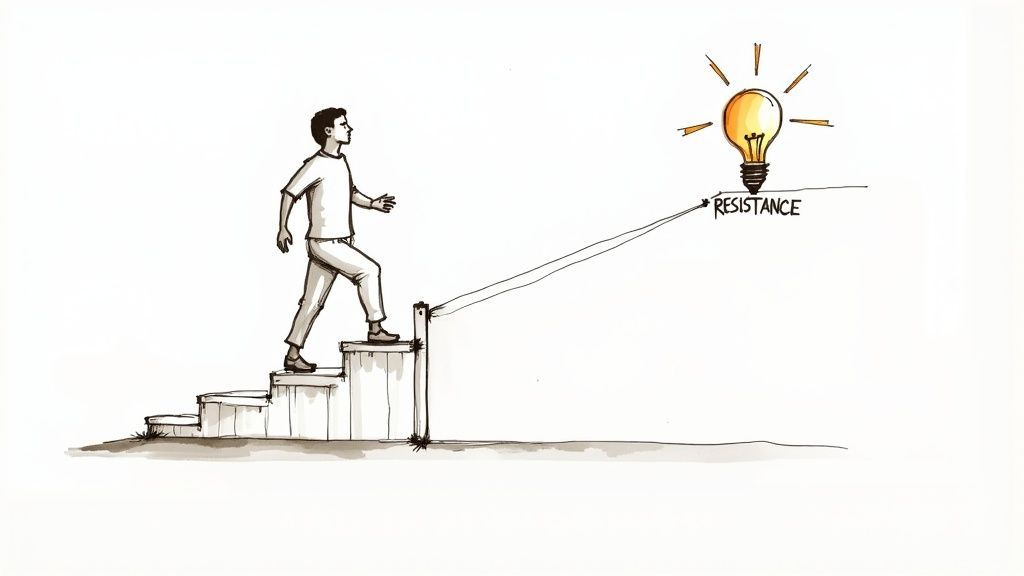
This is precisely where your Salesforce partner steps in, helping you shift from "project mode" to a culture of constant optimisation.
Establishing a Salesforce Centre of Excellence
One of the smartest moves you can make is to set up a Salesforce Centre of Excellence (CoE). Think of it as a central command hub for everything Salesforce in your business. This dedicated internal team provides the governance, support, and strategic direction needed to keep the platform humming.
A well-run CoE takes ownership of a few key things:
- Managing Future Enhancements: They prioritise and roll out new features and system updates in a way that doesn’t throw a spanner in the works for your current operations.
- Ensuring Data Quality: They set the rules and enforce the standards needed to keep your CRM database clean, reliable, and trustworthy.
- Providing Ongoing Support: They become the go-to experts for user questions, troubleshooting, and any advanced support needs.
This centralised approach stops the platform from becoming a fragmented mess or slowly falling out of date. It ensures Salesforce always stays aligned with where your business is heading.
Creating Continuous Learning Pathways
Training can't just be a one-and-done event at launch. To keep people skilled and excited, you need to build continuous learning pathways. This means moving beyond the initial onboarding and giving your team regular opportunities to sharpen their Salesforce skills.
It could be anything from creating a custom Trailhead mix for your team to tackle, hosting monthly "lunch and learn" sessions to share new tips, or offering specialised training when new features are rolled out. The aim is to create a learning culture where people feel empowered to truly master the platform.
These ongoing efforts are absolutely essential for long-term success. You can dive deeper into these strategies in our complete Salesforce Implementation Guide for Australian businesses.
Implementing Feedback Loops and Celebrating Wins
If you want your team to stay invested, you have to show them their input actually matters. Setting up structured feedback loops—like regular user surveys, a digital suggestion box, or small focus groups—is a game-changer. It gives everyone a voice and provides you with priceless insights into what’s working and what could be better.
And don't forget to celebrate the wins, especially the early ones.
When a sales team absolutely smashes its target using a new dashboard, or the service team hits a record-high customer satisfaction score, broadcast that success! It reinforces the value of the new system, keeps everyone motivated, and shows in real-terms that the change is making a positive difference for everyone.
This focus on tangible results is a huge deal in the Australian consulting services market, which was valued at USD 9.1 billion in 2024. As businesses continue to modernise, the demand for expertise that drives lasting results is skyrocketing, with forecasts expecting the market to hit USD 18.8 billion by 2034. You can learn more about these market trends and forecasts from Expert Market Research.
Frequently Asked Questions About Salesforce Change Management
Even with a solid strategy in place, leaders still have questions about the human side of a Salesforce project. Here are some straightforward answers to the questions we hear most often in our change management consulting practice.
What is the most critical success factor in a Salesforce project?
While training and communication are essential, the single biggest game-changer is active and visible executive sponsorship. When the leadership team consistently champions the project, it sends a clear, powerful message to the entire organisation. Commitment from the top sets the tone, explaining the "why" behind the change and ensuring the project has the resources it needs. It signals to everyone that this isn't just an IT initiative; it's a core business priority.
How do you measure the ROI of change management consulting?
Measuring the return on your change management investment connects people-focused activities directly to financial and operational success. We use a balanced scorecard approach:
- Quantitative Metrics: These are the hard numbers, such as user adoption rates in Salesforce, improvements in data quality, shorter sales cycles, or faster case resolution times.
- Qualitative Metrics: We also gauge how people are feeling through employee surveys, manager feedback, and tracking the number of resistance-related support tickets. A drop in those tickets is a clear sign of success.
When should we bring in a Salesforce change management consultant?
As early as possible. Ideally, a change management consultant should be involved from the beginning, during the initial discovery and strategic planning phase. When change management is woven into the project plan from day one, it’s not an add-on; it’s part of the project’s DNA. This proactive approach helps spot potential roadblocks, ensures user needs shape the final solution, and prevents misinformation from spreading, ultimately saving time and money.
Ready to ensure your next Salesforce project delivers real business value? The team at Adaptal specialises in weaving expert change management into every implementation, turning technology rollouts into genuine business breakthroughs. As a trusted Salesforce partner, we help you navigate the complexities of digital transformation.
Contact us today for a consultation and let's talk about how we can help your team embrace change and unlock the true power of Salesforce.