
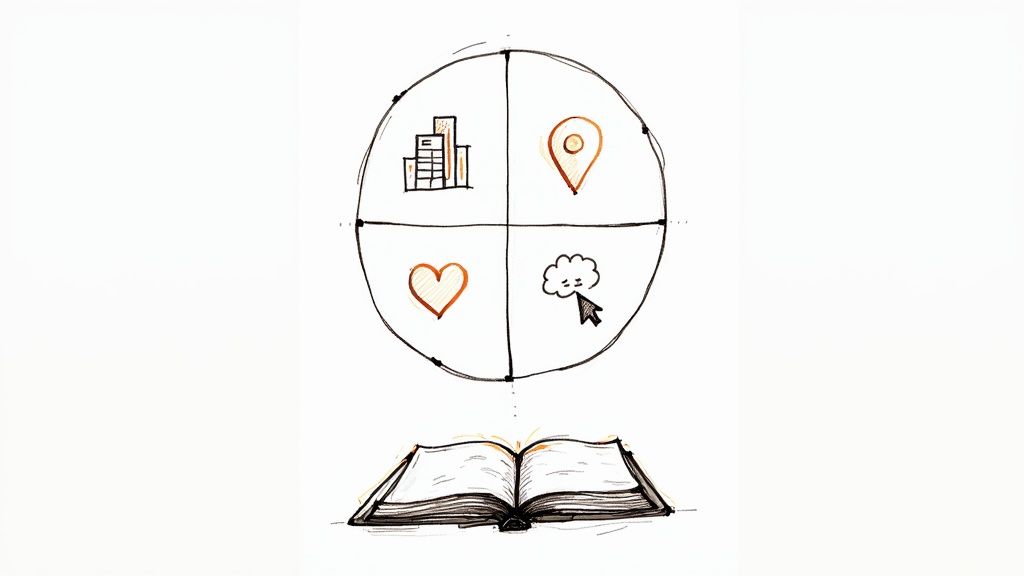
Customer segmentation is the practice of dividing your customer base into smaller, more manageable groups based on shared characteristics. Instead of broadcasting the same message to everyone, this strategic approach, powered by a CRM like Salesforce, allows you to have more relevant conversations, create personalised experiences, and offer solutions that solve real problems for each specific group. For any organisation undergoing a digital transformation, mastering customer segmentation is a critical step.
Moving Beyond a One-Size-Fits-All CRM Approach
Think of your entire customer list as a giant, unsorted library. Without any organisation, trying to find the right book for the right person is a nightmare. You might end up recommending a dense technical manual to someone looking for a light-hearted novel. Customer segmentation is your cataloguing system; it’s how you create specific sections—like 'High-Value Enterprise Clients', 'New Leads from Manufacturing', or 'At-Risk SMB Accounts'—to make sense of the chaos within your CRM data.
This means you can stop blasting generic messages and start connecting with each group in a way that truly resonates. As a Salesforce partner, we see this challenge frequently. Businesses are sitting on mountains of valuable data in their Salesforce org, but struggle to turn it into actionable insights that drive sales, service, and marketing automation.
The core issue is simple: without effective segmentation, you can’t deliver the personalised experiences that 70% of consumers now expect for their loyalty. You have all the right "books" (customer data), but no system to organise them for your team.
Your CRM holds the key to unlocking deeper customer relationships. By organising your contacts into meaningful segments, you transform raw data into a strategic asset that drives every interaction, from marketing automation in Pardot to sales outreach in Sales Cloud.
Before we dive into specific models, it’s helpful to understand the core concepts at a glance. Think of this table as your quick reference guide for segmenting data within Salesforce.
Core Customer Segmentation Concepts Explained
| Concept | Simple Analogy | Business Goal in Salesforce |
|---|---|---|
| Demographics | Sorting people by age, location, and gender—like organising a yearbook by graduation year and city. | To target ads and offers that are relevant to a person's life stage and location. |
| Psychographics | Grouping people by their hobbies, values, and lifestyle—like creating playlists for different music tastes. | To craft messaging that connects with customers' personal beliefs and interests. |
| Behavioural | Dividing customers based on what they do: what they buy, how often, and how they use a product. | To reward loyal customers, re-engage inactive ones, and predict future purchases. |
| Firmographics | For B2B, this is like demographics for companies: industry, size, and revenue. | To tailor sales pitches and solutions to the specific needs of different businesses. |
This table covers the fundamentals, but the real power comes from combining these concepts within your CRM to build a truly nuanced picture of your audience.
How Salesforce Enables Powerful Segmentation
Salesforce is purpose-built to be your master segmentation engine. It provides the tools to organise and understand your audience with incredible precision, letting you group customers based on a massive range of shared traits for a much smarter approach to engagement.
For instance, using standard Salesforce functionality, you can easily build segments using data points like:
- Industry and Company Size: Customise your B2B messaging for a small professional services firm versus a massive enterprise in the construction sector using standard Account fields.
- Purchase History: Treat first-time buyers differently from your repeat customers by creating campaigns based on Opportunity data to drive perfectly timed upselling or cross-selling.
- Engagement Level: Use data from Marketing Cloud Account Engagement (Pardot) to spot highly engaged prospects ready for a sales call, separating them from those who need more nurturing.
- Geographic Location: Run promotions or events specific to a region by segmenting Leads and Contacts by their city, state, or territory.
Getting this foundation right is the first step toward creating highly personalised customer journeys. By putting the powerful cloud solutions within the Salesforce ecosystem to work, you ensure every message lands with the right person at the right time—driving real, measurable business results.
Why Segmentation Is a Game Changer for Your Business

In a crowded market, treating every customer the same way is a surefire recipe for wasted resources and missed opportunities. Knowing what customer segmentation is is one thing, but internalising its importance is what separates market leaders from the rest. It’s no longer an optional strategy; it’s a core component of sustainable growth, powered by your CRM.
By ditching the one-size-fits-all mindset, you connect marketing and sales efforts directly to tangible business outcomes. This shift helps you maximise marketing ROI, build genuine customer loyalty, and make your sales process far more efficient.
This strategic focus is only becoming more important. Customer segmentation is a huge driver behind the expansion of Australia's customer analytics market, which is on track to hit USD 1,024.1 million by 2030. This growth is all about businesses using their data to carve out specific audience segments and hit them with precision-targeted campaigns.
Case Study: Transforming a Sales Challenge into a Growth Opportunity
As a Salesforce partner, a common business challenge we encounter is low lead conversion rates. Our clients often generate plenty of initial interest, but their follow-up feels generic and fails to connect with what different prospects actually need. This is exactly where segmentation implemented within Salesforce can save the day.
The Business Challenge: A B2B tech company we worked with was facing this exact problem. Their sales team was using the same generic follow-up emails and call scripts for every lead, whether it was a small startup or a large enterprise. Unsurprisingly, engagement was low and their pipeline of qualified meetings was thin.
The Salesforce Solution: We helped them implement a clear segmentation strategy within their Salesforce CRM. They started by grouping leads based on two simple but powerful criteria: company size (firmographics) from the Account object and past engagement (behavioural) tracked via Marketing Cloud Account Engagement. This simple tweak gave their sales team the context they desperately needed to personalise their approach.
Driving Real Results with Salesforce
With these new segments active in Salesforce, the company could finally tailor its outreach. The results were immediate and impressive.
- For small businesses: The sales team sent targeted emails highlighting the solution's affordability and quick setup.
- For enterprise leads: They switched focus to case studies proving scalability, security, and long-term ROI.
- For highly engaged leads: Any prospect who downloaded a whitepaper or attended a webinar was automatically added to a high-priority call list in Sales Cloud for a prompt, personalised follow-up.
By simply leveraging their existing Salesforce data to understand who they were talking to, the company stopped wasting time on irrelevant pitches. Every interaction became more meaningful because it spoke directly to the prospect's likely pain points and business goals.
The Results: This tailored strategy, powered entirely by Salesforce, led to a 35% uplift in qualified meetings within the first quarter alone. This project, much like the successes we've documented in our Salesforce case studies, shows how segmentation isn't just marketing theory. It's a practical, results-driven approach that turns frustrating business challenges into measurable growth when implemented correctly in a powerful CRM like Salesforce.
Exploring the Four Main Types of Customer Segmentation
Knowing what customer segmentation is sets the stage, but the real value comes from understanding how to group your audience effectively. The four main types of segmentation provide a practical framework for organising your customers. Think of them as different lenses you can use to view your audience, helping you spot valuable patterns right inside your Salesforce CRM.
Each model answers a fundamental question about your customers, giving your sales, service, and marketing teams the context they need to create more relevant and personal experiences.
This diagram shows how these key segmentation models branch out, helping you categorise customers based on who they are, where they are, why they buy, and what they do.
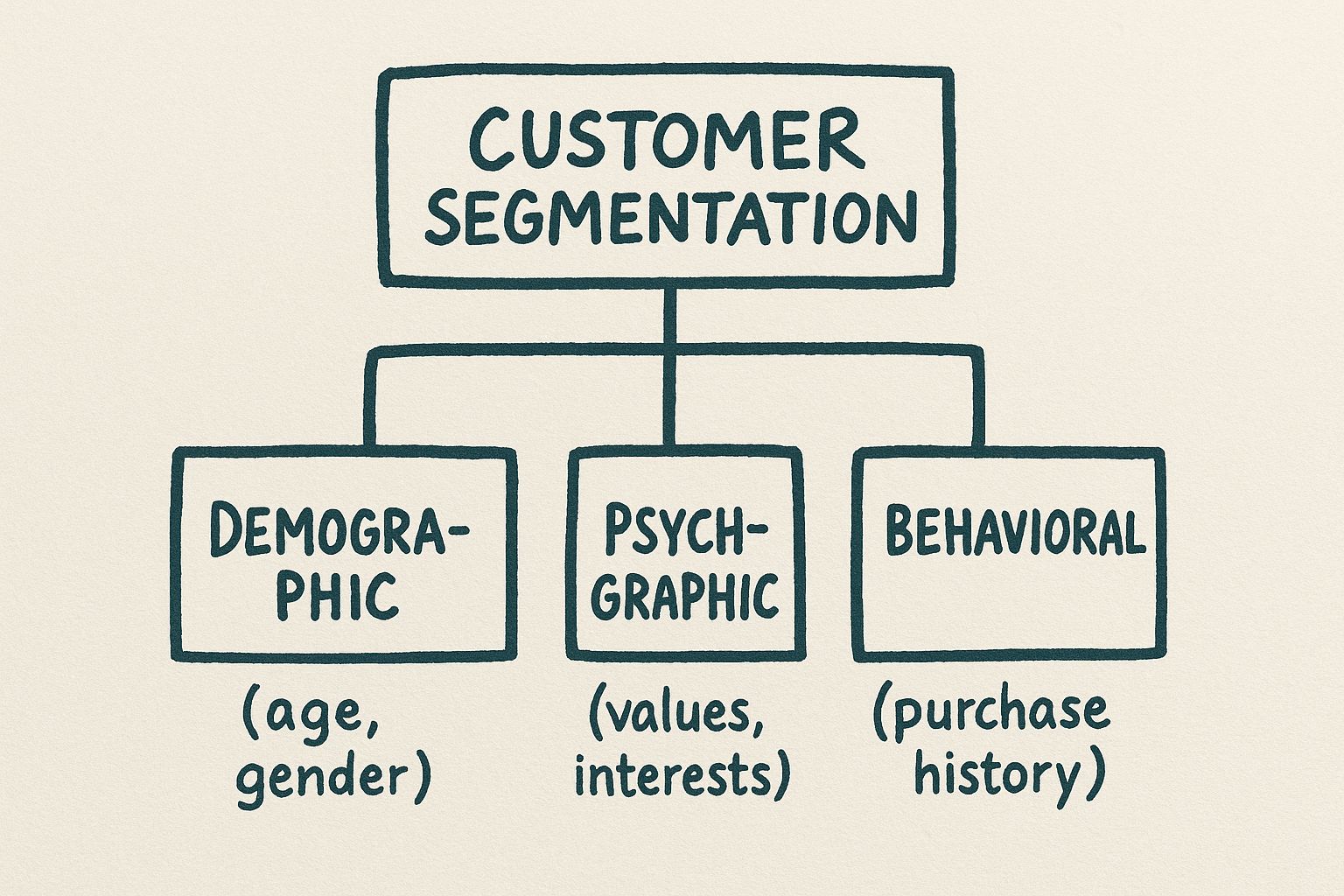
As you can see, each model draws on distinct data points—from basic demographics to detailed purchase histories—to build a richer, more complete picture of your customer base within Salesforce.
Let's break them down from a Salesforce perspective.
A Practical Comparison of Segmentation Models in Salesforce
This table breaks down what each segmentation type is, the data it relies on, and a real-world example of how you might apply it within the Salesforce platform.
| Segmentation Model | Key Data Points | Salesforce Use Case Example |
|---|---|---|
| Demographic (The Who) | Age, gender, income, job title, company size, industry. | A professional services firm filters its Account records by the 'Industry' field to send finance-specific content to banking clients and logistics content to manufacturing clients. |
| Geographic (The Where) | Country, state, city, postcode, climate, region. | A national building supplier uses Lead location data to run targeted campaigns for cyclone-rated materials in Queensland and bushfire-resistant products in Victoria. |
| Psychographic (The Why) | Lifestyle, values, interests, personality traits, opinions. | A B2B software company identifies two buyer personas: "Cautious Innovators" who value ROI and "Early Adopters" who crave new features, then tailors sales pitches accordingly. |
| Behavioural (The What) | Purchase history, product usage, website activity, email engagement. | An e-commerce business uses Marketing Cloud to create a dynamic list of customers who abandoned their carts, triggering an automated follow-up email with a discount code. |
Each model offers a unique perspective. Demographic and geographic data tell you who and where your customers are, providing a great starting point. But psychographic and behavioural data reveal the why and what, which is where you can build much deeper connections and drive automation.
1. Demographic Segmentation: The Who
Demographic segmentation is usually the most straightforward place to start. It involves grouping customers based on observable, factual data like age, gender, income, occupation, or education level.
In a B2B context, we often use firmographics. This is the business equivalent, covering data points like industry, company size, and annual revenue—all of which are standard fields on a Salesforce Account record.
Salesforce in Action: A consulting firm segments its B2B audience using the 'Industry' field in Sales Cloud. This simple step allows them to send targeted content about financial regulations to their banking clients, while their manufacturing contacts get insights on supply chain automation. It’s a basic but incredibly effective way to ensure message relevance.
2. Geographic Segmentation: The Where
Next up is geographic segmentation, which groups customers based on their physical location. This could be as broad as a country or as specific as a postcode, all easily captured in Salesforce Lead and Contact records.
This approach is vital for any business with a physical presence or for those whose products and services vary by region.
Salesforce in Action: A national construction company uses Salesforce to create segments for clients in different states. This allows them to run targeted campaigns about region-specific building codes or climate-appropriate materials, ensuring their outreach isn't just personalised but practical and compliant.
3. Psychographic Segmentation: The Why
This is where segmentation gets more advanced. Psychographic segmentation digs deeper, moving beyond who your customers are to why they make the decisions they do. This model groups people based on their lifestyles, values, interests, and personality traits. While this data is harder to collect, it unlocks a much richer understanding of customer motivation.
Salesforce in Action: A B2B software company might use this to distinguish between two buyer types: the "cautious innovator" who prioritises security and proven ROI, versus the "early adopter" who gets excited by new features. Once the sales team identifies these profiles (perhaps using a custom field in Salesforce), they can adjust their pitch—focusing on stability for one and cutting-edge benefits for the other.
Understanding the 'why' behind a purchase is a game-changer. It allows you to connect with customers on an emotional level, building brand loyalty that goes far beyond a simple transaction. This is where true customer relationships are forged.
4. Behavioural Segmentation: The What
Finally, behavioural segmentation is arguably the most powerful model for driving action within Salesforce. It groups customers based on their direct interactions with your brand: their purchase history, product usage, website activity, and marketing engagement.
This data is already living inside your Salesforce ecosystem, from Sales Cloud opportunities to clicks tracked in Marketing Cloud Account Engagement. This is where Salesforce's automation muscle truly shines.
Salesforce in Action: You could create a dynamic list in Marketing Cloud that automatically adds any customer who has viewed a specific product page three times in the last week but hasn't made a purchase. This can trigger a targeted follow-up email with a special offer, directly responding to their demonstrated interest.
Tracking data from your website is crucial here. To learn how to capture lead information from your site and feed it directly into these behavioural segments, you can read our guide on optimising with a Salesforce Account Engagement Form Handler. To see how these concepts are applied in the real world, check out some powerful customer segmentation examples that bring these models to life.
How to Implement Segmentation in Salesforce
Knowing the different segmentation models is one thing, but putting them to work is where the strategy becomes real inside the Salesforce platform. Let's walk through a practical guide, using a common business scenario to show how Salesforce tools connect to solve genuine problems.
Before we jump into a specific workflow, it's worth remembering the foundational Customer Relationship Management (CRM) basics that every good segmentation strategy is built on. Your CRM is the engine that gathers, organises, and makes sense of all the customer data you'll be using.
A Real-World Scenario: Identifying At-Risk Customers with Salesforce
The Business Challenge: A B2B services company is noticing a higher-than-usual number of customers churning. Their customer success team is flying blind, with no systematic way of knowing which accounts are most likely to leave.
The Salesforce Solution Goal: Proactively identify these at-risk customers using existing data in Salesforce and trigger a coordinated retention effort before it's too late.
This is a perfect use case for behavioural segmentation. The company defines an "at-risk" customer as any account that has logged more than three high-priority service tickets in the last 60 days but has shown zero sales activity (no new opportunities or quotes) in that same window. This combination of service and sales data is a powerful red flag for dissatisfaction.
Step 1: Using Salesforce Reports to Isolate the Segment
First, we need to turn that definition into an actual list of customers using standard Salesforce tools. This is where Salesforce Reports excel, letting you slice and dice your data with incredible precision.
Here’s the implementation plan:
- Create a New Report: Start by creating a new "Accounts with Cases" report. This standard report type joins the data from your Account and Case objects, which is exactly what we need.
- Apply Filters: This is the most important step. We set up filters to pull out only the accounts that match our at-risk criteria.
Case StatusequalsClosedCase PriorityequalsHighDate OpenedequalsLAST 60 DAYS
- Summarise and Group: To count the cases for each account, you'd group the report by
Account Nameand add a summary formula to count the unique cases. - Add a Cross-Filter: The final touch is adding a cross-filter to remove accounts that do have recent sales activity. The filter would look like
Accounts without Opportunitieswhere theClose Dateis in theLAST 60 DAYS.
Running this report instantly produces a dynamic list of every customer who fits your at-risk profile. Just like that, you’ve used core Salesforce functionality to create your first high-impact behavioural segment.
Segmentation doesn't have to be overly complex to be effective. Starting with a simple, high-value segment like "at-risk customers" can deliver immediate results and build momentum for more advanced strategies.
Step 2: Activating the Segment Across Salesforce Clouds
Identifying the segment is only half the battle; now you have to act on it. This is where connecting different Salesforce clouds provides a massive competitive advantage.
For the Customer Success Team (Service Cloud / Sales Cloud)
The report we just built can be used to create a dynamic List View for your customer success team. This gives them a focused, actionable call list that updates automatically. They can log in each morning and see exactly which accounts need a proactive phone call, armed with the knowledge of their recent service ticket history.
For the Marketing Team (Marketing Cloud Account Engagement)
Simultaneously, we can use this same Salesforce Report to kick off a targeted re-engagement campaign from Marketing Cloud Account Engagement (formerly Pardot). By adding the report's members to a specific Pardot list, we can launch an automated journey designed to show these clients they are valued.
This automated campaign might include:
- An email from their account manager acknowledging their recent service issues and offering a direct line for support.
- An invitation to a webinar showcasing new features that solve common problems.
- A special offer on a premium support package.
To ensure your campaigns hit the mark, it’s always a good idea to follow established guidelines. You can dive deeper into this by exploring our guide to Account Engagement best practice. This integrated, multi-cloud approach ensures at-risk customers receive a coordinated response, dramatically increasing your chances of retention.
Advanced Segmentation Strategies and Common Pitfalls
Once your team masters the foundational models, it’s time to evolve your strategy. This is where you unlock a much deeper understanding of your customers by leveraging the full power of the Salesforce platform.
Advanced segmentation isn’t about unnecessary complexity. It’s about getting closer to what really drives customer value and loyalty. You move from grouping people by what they are to understanding what they need and, crucially, what they're worth to your business.
These methods require a rock-solid data foundation inside your CRM, which is why Salesforce is the perfect platform to execute them. By combining behavioural, transactional, and service data, you can build a multi-dimensional picture of your entire customer base.
Moving to Value-Based Segmentation
One of the most powerful advanced strategies is value-based segmentation. Instead of treating every customer equally, this approach prioritises them based on their financial value to your business. The goal is to identify your 'VIP' customers—those with the highest Customer Lifetime Value (CLV)—so you can provide them with the premium attention and service they deserve.
In Salesforce, you can build a value-based segment by creating a formula field on the Account object that calculates CLV from past purchases (Opportunities) and contract length. This allows you to create highly focused campaigns and premium service levels exclusively for your most profitable clients.
Adopting Needs-Based Segmentation
Another powerful method is needs-based segmentation. This approach groups customers by the specific problems they’re trying to solve. It requires looking beyond simple firmographics and digging into Service Cloud tickets, survey responses, and sales notes in Sales Cloud to uncover their true motivations.
For instance, a software company might discover two different needs-based segments for the same product. One group desperately needs to improve team efficiency, while another is focused on meeting strict compliance requirements. By pinpointing these distinct needs, your sales and marketing teams can tailor their messaging to connect on a much deeper level.
True segmentation maturity is reached when you stop asking, "Who are our customers?" and start asking, "What do our different customers need from us?" This shift from observation to empathy is where the most significant business breakthroughs happen.
Common Pitfalls We See in Salesforce Projects
Even with a powerful tool like Salesforce, segmentation projects can go off the rails. Based on our experience as a Salesforce partner, here are a few common pitfalls to avoid.
-
Over-Segmenting into Unusable Groups: It’s tempting to slice your data into dozens of tiny micro-segments. But if a segment is too small to target or measure effectively, it’s not useful. Start with a few broad, high-impact segments before drilling down further.
-
Relying on Outdated or Dirty Data: Your segmentation is only as good as the data powering it. If your Salesforce records are full of incomplete information or old contacts, your segments will be inaccurate. Regular data hygiene is non-negotiable for success.
-
Creating Insights but Failing to Act: This is the biggest mistake we see. A business does all the hard work to create brilliant segments in Salesforce Reports and then… nothing happens. Segmentation without action is just an academic exercise. Each segment must be tied to a specific action—a targeted campaign in Marketing Cloud, a dedicated call list in Sales Cloud, or a specialised playbook for your service team.
-
Ignoring Channel Preferences: Don't assume everyone wants to engage with you online. In the Australian retail market, for example, a massive 61% of shoppers still prefer to buy non-essential products in a physical store. This highlights the need to segment by channel preference and meet customers where they feel most comfortable. To explore this further, you can discover more about Australian shopping behaviours on Resonate.cx.
Effective segmentation is a living process. The key is to start small, measure your results using Salesforce Dashboards, and continuously refine your approach as your customers and business evolve.
If you need guidance on building a robust and actionable segmentation strategy, our expert Salesforce consulting services can help you navigate the complexities and avoid these common pitfalls.
Frequently Asked Questions About Customer Segmentation in Salesforce
To help you get started with confidence, we’ve answered some of the most common questions our clients ask about customer segmentation in Salesforce, based on our real-world project experience.
Which segmentation model is best for my business?
The "best" model depends entirely on your business goals. There’s no single right answer; the most effective strategy aligns with the specific problem you're trying to solve.
For example, if you want to run targeted local promotions, start with Geographic segmentation. If your goal is to personalise sales outreach based on customer value, focus on Behavioural data. The most powerful strategies often combine different models to build a richer customer picture.
Our advice as a Salesforce partner is to start by pinpointing your single biggest challenge—whether that's improving customer retention or increasing lead quality—and then pick the segmentation model that gives you the clearest path to solving it within Salesforce.
What is the difference between customer and market segmentation?
This is a crucial distinction. Market segmentation is about analysing the entire potential market, including people who have never heard of your brand. Its main goal is to find and attract new audiences to fill the top of your sales funnel.
In contrast, customer segmentation focuses exclusively on your existing customers and contacts—the people already in your CRM. The goal here is different: it’s about improving retention, increasing lifetime value, and personalising their ongoing experience with your brand.
In Salesforce terms: market segmentation guides lead generation in tools like Marketing Cloud Account Engagement. Customer segmentation powers your nurturing, upselling, and service efforts for existing Contacts and Accounts in Sales Cloud and Service Cloud.
How often should we update our customer segments in Salesforce?
Segmentation is not a 'set it and forget it' task. Markets evolve, customer needs shift, and your data is changing constantly. A segment that was effective six months ago might be irrelevant today.
As a best practice, we recommend reviewing your key segments quarterly and performing a more comprehensive deep-dive annually. A great way to stay on top of this is to use Salesforce Dashboards to monitor the performance of each segment. If you notice a key group's engagement or conversion rates start to drop, that's a clear signal it’s time to revisit your strategy.
Is segmentation worthwhile for a small business using Salesforce?
Absolutely. In fact, it's arguably more critical for small businesses that need to make every dollar and every hour count. By using your Salesforce CRM to identify your most profitable or loyal customer groups, you can focus your limited marketing budget and sales efforts for maximum impact.
Instead of trying to be everything to everyone, segmentation allows a small business to find its ideal customer niche, serve it exceptionally well, and build a loyal following that drives sustainable, long-term growth.
This focused approach ensures every investment you make delivers the highest possible return.
At Adaptal, we are a Salesforce partner dedicated to helping businesses of all sizes build powerful, actionable customer segmentation strategies right inside their CRM. If you're ready to unlock deeper insights and drive more effective customer engagement, let's have a chat.