

Choosing the right CRM software for real estate agents is a pivotal decision for any agency aiming for scalable growth. While industry-specific tools like Propertybase offer out-of-the-box solutions, a powerful, customisable platform like Salesforce provides the foundation for enterprise-level automation and reporting. The best fit depends on your agency's ambition—whether you're tracking leads or building a data-driven sales and service engine.
As a Salesforce partner, we've seen firsthand how implementing a strategic CRM transforms real estate operations. The challenge for many agencies isn't a lack of leads; it's the operational chaos of managing them. Disconnected spreadsheets, manual follow-ups, and a lack of visibility into the sales pipeline create a ceiling on growth. This is where a well-configured Salesforce instance becomes a strategic asset, not just another piece of software.
The Business Challenge: Why a CRM Is a Strategic Asset for Australian Real Estate Agents
In Australia's fast-paced property market, agents juggle sales, marketing, and administration. Trying to manage a flood of leads from various channels, maintain intricate client communications, and handle administrative tasks is overwhelming. This operational friction is a common business challenge that leads to missed opportunities and inconsistent client experiences. A dedicated Customer Relationship Management (CRM) platform is the solution.
A purpose-built CRM, particularly one built on a robust platform like Salesforce, acts as the central nervous system for a modern real estate agency. It eliminates scattered data and creates a single source of truth for every client interaction, property listing, and transaction.
The Salesforce Solution: Centralise Data and Automate Follow-Ups
At its core, a CRM centralises all client and property data, making it accessible from anywhere. This allows agents to track every conversation, document, and preference, which is crucial for delivering a professional, personalised service. The real business impact, however, comes from intelligent automation.
A powerful Salesforce solution can handle the heavy lifting:
- Automated Lead Routing: Assigning new leads to the right agent based on territory or specialisation.
- Automated Communications: Sending follow-up emails and SMS reminders for appointments or inspections.
- Lead Nurturing: Engaging long-term prospects with targeted content until they're ready to transact.
This level of automation frees agents to focus on high-value activities: building relationships and closing deals. It's a key lesson learned from our projects that a well-oiled CRM can become a referral engine, using simple CRM hacks to boost referral volume to secure long-term client loyalty.
For any growing agency, the digital transformation from manual processes to an automated, data-driven workflow isn’t just about efficiency. It’s a fundamental competitive advantage that ensures no lead slips through the cracks and every client relationship is managed with precision.
The industry's rapid adoption of these tools signals a major shift. The global real estate CRM software market is projected to grow from USD 4.22 billion to USD 11.89 billion by 2033, a testament to how cloud solutions are reshaping the sector. You can explore the full research about the real estate CRM market for more details.
To understand how this technology fits into the broader picture, see our guide on why Salesforce is the backbone of modern agencies.
Evaluating Core Salesforce Features for Real Estate CRM

When selecting a CRM, it's easy to get lost in feature lists. The best platforms do more than store contacts; they become the command centre for your entire operation, actively helping you nurture relationships, automate processes, and close more deals.
Before evaluating specific platforms, you need a clear checklist. These are the non-negotiable features a modern real estate CRM must have to be a genuine asset, not just another subscription.
Salesforce Lead Management and Intelligent Scoring
The lifeblood of any agency is a consistent flow of quality leads. Juggling enquiries from websites, property portals, and open houses can become chaotic. This is where a sophisticated lead management system within Salesforce Sales Cloud is crucial.
A top-tier CRM doesn't just capture leads; it intelligently routes them. More importantly, Salesforce allows for powerful lead scoring. This is a game-changer. The system tracks a lead’s behaviour—like website visits or listing views—and assigns a score based on their intent.
Consider this business case: after an open house with 50 attendees, your agents can instantly see who is a high-intent buyer and deserves an immediate call. This shifts your team from a reactive to a proactive, data-led sales strategy, a best practice we implement in every project.
Transaction and Pipeline Management in Salesforce
From the first offer to settlement, a property transaction involves dozens of steps, deadlines, and documents. A CRM with dedicated transaction management is essential for organisation and compliance. Salesforce allows you to build custom checklists, assign tasks, and set up automated reminders for critical dates.
This feature provides a clear, visual sales pipeline, offering a 360-degree view of every deal. At a glance, you can see each transaction's stage, identify potential bottlenecks, and forecast revenue with greater accuracy. Scaling an agency is impossible without a well-managed pipeline.
The ability to manage the entire client journey in one platform is what elevates a basic contact list to a business growth engine. It guarantees a consistent, professional experience for every client, from the first interaction to the final handover.
Marketing Automation and Communication with Account Engagement
Exceptional communication builds relationships and keeps your agency top-of-mind. A powerful CRM like Salesforce should have marketing automation tools, such as Marketing Cloud Account Engagement (Pardot), to create and schedule targeted email and SMS campaigns for specific database segments.
Imagine automatically sending a "Just Listed" alert to every prospect who has previously shown interest in a specific neighbourhood. This type of personalised, automated outreach drives significant engagement with minimal manual effort. Centralising communications also provides a complete interaction history within each client's profile.
Mobile Accessibility and Salesforce Integrations
Real estate agents are rarely at their desks. Any CRM worth considering must have a robust mobile application. The Salesforce mobile app allows agents to access client details, update deal statuses, and manage tasks on the go, ensuring data is always current.
Finally, consider how the platform integrates with your other business tools. Can it connect to your accounting software or marketing platforms? This is where a system like Salesforce excels, offering a vast ecosystem of integrations through the AppExchange. If you’re considering a powerful, integrated solution, our Salesforce implementation guide for Australian businesses is an excellent resource for planning a successful rollout.
Core CRM Features and Their Impact on Real Estate Agencies
| Core Feature | Primary Function | Benefit for Agents |
|---|---|---|
| Contact Management | Centralises client data, communication history, and property preferences. | Provides a single source of truth, ensuring every agent has the full context of a client relationship. |
| Lead Scoring | Automatically ranks leads based on engagement and purchase intent. | Allows agents to prioritise follow-ups with the most promising prospects, increasing conversion rates. |
| Pipeline Visualisation | Offers a clear, stage-by-stage view of all active deals. | Helps forecast revenue, identify bottlenecks, and manage team workload more effectively. |
| Task Automation | Automates repetitive tasks like follow-up reminders and data entry. | Frees up agent time to focus on high-value activities like negotiation and client relationship building. |
| Marketing Campaigns | Enables targeted email and SMS outreach to segmented lists. | Keeps the agency top-of-mind with relevant content, nurturing leads who aren't ready to transact yet. |
| Mobile Access | Provides full CRM functionality on smartphones and tablets. | Ensures agents can access and update critical information on the go, improving data accuracy and responsiveness. |
These core functionalities form the backbone of a system that actively drives efficiency, improves client service, and supports scalable growth.
Comparing Real Estate CRM Platforms to Salesforce
Choosing the right CRM software often involves comparing specialised, out-of-the-box platforms with powerful, configurable foundations like Salesforce. The decision comes down to a trade-off between immediate convenience and long-term scalability.
To provide clarity, we'll examine leading platforms in the Australian market—Propertybase, LionDesk, and Wise Agent—and use Salesforce as the benchmark for ultimate customisation and enterprise-grade power. This comparison focuses on how these differences impact an agent's daily workflow and an agency's strategic growth.
Propertybase: A Real Estate Solution Built on Salesforce
Propertybase presents an interesting value proposition: a purpose-built real estate CRM that sits on the Salesforce platform. It aims to deliver the best of both worlds—industry-specific features combined with the robust architecture of an enterprise-level system.
For many agencies, this is an appealing starting point. It comes pre-configured with objects and workflows for listings, contacts, and deals, significantly reducing initial setup time. However, this pre-built structure can be a limitation. While excellent for standard residential sales, agencies with unique business models or those in commercial real estate may find it restrictive. Deeper customisation often requires working around these pre-set configurations.
LionDesk: A Focus on Communication Automation
LionDesk has carved a niche by excelling at communication tools. Its strength lies in integrated email, SMS, and video messaging, designed to help agents automate drip campaigns and bulk outreach.
This makes it a great choice for individual agents or small teams focused on automating their follow-up processes. The platform is designed for quick adoption, helping agents nurture leads without a steep learning curve.
While LionDesk offers strong out-of-the-box communication tools, Salesforce provides unparalleled customisation for agencies managing diverse commercial and residential portfolios, enabling bespoke workflows that align perfectly with complex business processes.
The trade-off with LionDesk is scalability and sophisticated data management. As an agency grows, the need for advanced reporting, complex workflow automation, and deep integrations becomes critical. LionDesk connects with many tools, but it doesn't offer the unified platform experience or granular data control that a solution like Salesforce provides.
Wise Agent: An All-in-One Solution for Core Needs
Wise Agent positions itself as the central hub for a real estate professional's business, bundling contact management, marketing automation, and transaction management into an affordable package.
Its strength is the breadth of functionality offered for its price point. It covers the essential bases most residential agents need, from landing page creators to time management features.
The challenge arises when an agency's needs become more specialised. The platform's features, while comprehensive, lack the depth and customisability of a more powerful system. Its reporting is sufficient for standard metrics but won't support the complex analytics a large brokerage needs to analyse performance across different regions or property types.
Salesforce: The Benchmark for Scalability and Customisation
Salesforce stands apart. It isn't a real estate CRM out of the box; it's a powerful, flexible platform that can be configured to become the perfect real estate CRM for any agency. That is its core differentiator.
With Salesforce, you are designing a custom solution tailored to your unique business processes. This is vital for agencies managing a mix of residential sales, property management, and commercial leasing, where each division has distinct operational needs. We've seen this firsthand in our client projects, where custom Salesforce solutions turn disconnected data into a single source of business intelligence.
This infographic shows how a well-implemented CRM like Salesforce saves agents time and helps them manage more leads effectively.
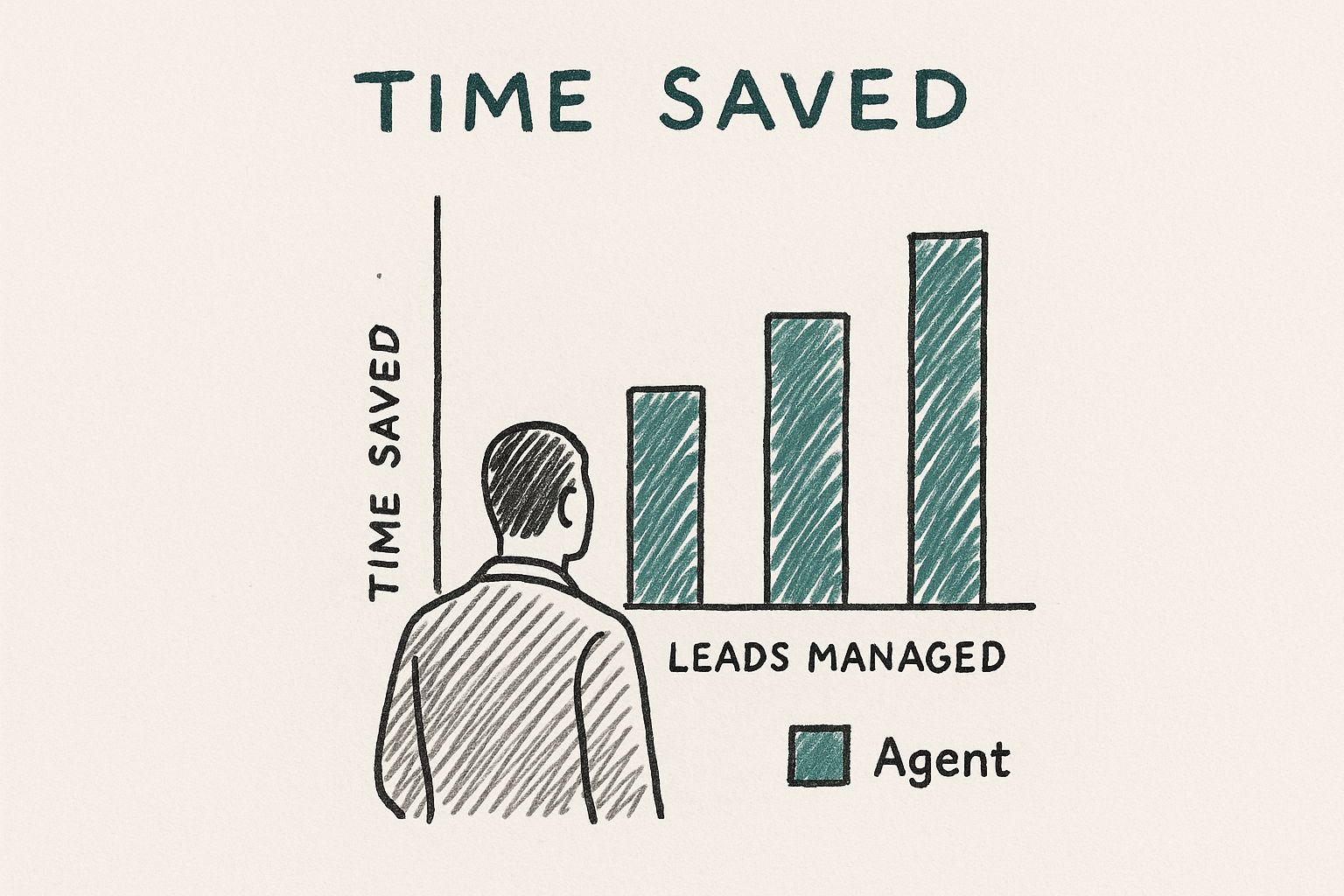
The visual data clearly shows a direct link between adopting an advanced CRM and boosting operational capacity, with significant gains in both efficiency and lead management.
For a broader look at the top tools available, you can also check out rankings of the best software platforms for real estate agents in 2023 to help inform your decision.
Making the Right Choice for Your Agency
Ultimately, the decision hinges on your agency's current needs and future ambitions.
- For solo agents or small teams focused on efficient communication, a tool like LionDesk offers immediate value.
- For agencies seeking an all-in-one solution, Wise Agent provides a cost-effective way to manage core functions.
- For businesses wanting real estate features on an enterprise foundation, Propertybase offers a structured, industry-specific solution.
- For ambitious agencies with complex needs or significant growth plans, Salesforce is the definitive choice, offering a scalable and fully customisable platform that can adapt to any business model.
While niche CRMs solve today's problems, a platform like Salesforce is an investment in your agency's future, providing the foundation to innovate, scale, and outperform the competition.
Advanced Salesforce Features for Commercial Real Estate
The commercial real estate sector operates on a different level, dealing with multi-million dollar assets, complex lease agreements, and long-term tenant relationships. These complexities demand more from a CRM than a standard contact database can provide.
For commercial agencies, a highly configurable platform like Salesforce isn't just a nice-to-have; it's critical infrastructure. Here's a look at the business challenges and how a Salesforce solution addresses them.
Tenant Lifecycle and Lease Management in Salesforce
A key differentiator for a commercial real estate CRM is its ability to manage the entire tenant lifecycle. This goes beyond tracking leads for vacant spaces; it involves managing every interaction from the initial inquiry through lease renewal.
An advanced Salesforce configuration provides workflows for:
- Lease Abstraction: Automatically extracting key dates, clauses, and financial details from lease documents into structured, usable data.
- Automated Reminders: Setting up triggers for crucial dates like rent escalations, renewal options, and insurance expirations.
- Tenant Servicing: Logging and tracking maintenance requests and complaints to improve tenant retention.
This transforms the CRM from a sales tool into a comprehensive property and relationship management system.
For commercial real estate professionals, the real value of a CRM is its ability to provide a portfolio-wide view of revenue, risk, and opportunity. It must connect tenant data with financial performance, enabling strategic decisions based on a complete asset picture.
Portfolio-Wide Financial Reporting with Salesforce
Commercial real estate is about long-term portfolio performance. Decision-makers need to see financial data rolled up across multiple properties to monitor cash flow, vacancy rates, and profitability.
A powerful platform like Salesforce can be configured to generate detailed financial reports that off-the-shelf CRMs cannot. By integrating with accounting systems, it can track rental income, operating expenses, and capital expenditures for each property, providing leadership with a live dashboard for critical investment and management decisions.
The demand for such sophisticated management software is growing. Projections show that by 2025, commercial real estate software will command 63% of the property technology market share. You can read more about this trend in these insights on the real estate software market.
Managing Complex Compliance Requirements
Commercial properties are subject to a web of regulations, from building codes and safety inspections to environmental compliance. Managing these obligations manually across a large portfolio is a significant risk.
A properly configured Salesforce CRM centralises all compliance-related activities. Custom objects can be built to track inspection dates, store certification documents, and automate reminders for deadlines. This creates a clear audit trail, protecting your agency and clients from liabilities and ensuring every asset is managed with precision.
Driving Salesforce CRM Adoption Within Your Real Estate Agency

Investing in powerful CRM software for real estate agents is only the first step. The real return on investment comes when your entire agency uses it consistently. The most sophisticated platform is useless if agents don't log in. This is where the project shifts from technology to people.
From our experience implementing countless Salesforce solutions, we know the biggest hurdles are agent resistance and poor data quality. A successful adoption strategy must answer the one question every agent asks: "What's in it for me?"
Building a Culture of CRM Success
To get everyone on board, position the CRM as a tool that saves time, not one that adds administrative burden. This requires a thoughtful rollout that combines practical training with strong leadership and peer support.
-
Appoint Internal Champions: Identify tech-savvy agents who are excited about the new system. These champions can support their colleagues, share success stories, and act as a bridge between the team and management.
-
Implement a Phased Rollout: Avoid a "big bang" launch. Start with core functionalities like contact and lead management, then gradually introduce advanced features like marketing automation as the team becomes more comfortable.
-
Provide Agent-Centric Training: Focus training on real-world scenarios that solve agents' daily problems. Show them exactly how the CRM can automate follow-ups, prioritise hot leads, and give them back hours in their week.
This approach transforms the CRM from a top-down mandate into a personal productivity tool for every agent.
Making Data Discipline a Habit
Poor data quality will quickly devalue your CRM. The goal is to integrate data entry so seamlessly into the daily workflow that it becomes second nature.
Globally, only about 47% of salespeople use their CRM regularly. A staggering 66% of sales professionals admit they'd rather do something unpleasant, like go to the dentist, than update their CRM.
To combat this, make data entry simple and demonstrate its immediate payoff.
A well-maintained CRM should give more than it takes. When an agent can instantly see a client's entire history and receive automated reminders for critical tasks, the five minutes spent updating records becomes a worthwhile investment in their own success.
Connecting data entry to tangible results is key. By partnering with experts for your implementation, you can design workflows that make sense for your team and drive real results. If your agency is ready to maximise its technology investment, exploring our Salesforce consulting services can provide the strategic guidance needed for a successful rollout and lasting adoption.
Frequently Asked Questions about Salesforce for Real Estate
Choosing the right CRM is a major decision, and it’s normal for questions about cost, suitability, and long-term value to arise. Agency leaders need clear answers to make informed choices. Here, we address common questions from real estate professionals considering a Salesforce implementation.
How Much Should I Expect to Pay For Real Estate CRM Software?
Costs vary widely, so it's essential to look beyond the monthly price. Niche CRMs often start around $30-$50 per user per month for basic tools. Mid-tier options typically range from $80-$150, adding better automation and marketing features.
Enterprise platforms like Salesforce generally start at $150-$250 per user per month for core products. While the initial license cost seems higher, consider the total cost of ownership. A cheaper tool that requires manual workarounds can cost more in lost productivity than a scalable platform that automates key processes. Factor in implementation and customisation costs, as this initial investment is what tailors the platform to your agency's specific workflows.
Can a General CRM Like Salesforce Work for Real Estate?
Absolutely. In many cases, it is the superior long-term solution. While industry-specific CRMs offer convenient out-of-the-box features, a powerful, flexible platform like Salesforce provides unmatched potential for growth and customisation.
With the right configuration from a Salesforce partner, the platform can be perfectly adapted to manage property listings, automate commission calculations, and handle the complex client relationships in diverse residential and commercial portfolios.
The real magic of Salesforce is its scalability and the massive AppExchange ecosystem. It lets you build a unified tech stack that grows with your agency, instead of being boxed in by the fixed features of a niche product.
This adaptability ensures your CRM supports your business strategy for years, easily handling new service lines, larger teams, and more complex operations without needing to be replaced.
What Is The Most Important Factor When Choosing a Real Estate CRM?
While features and price are important, the single most critical factor is user adoption. A sophisticated CRM is worthless if your agents don't use it consistently. Low adoption is the number one reason CRM projects fail to deliver a return on investment.
Prioritise a system that demonstrably saves your agents time and simplifies their work. Look for a clean user interface, excellent mobile access, and automation that eliminates tedious tasks like follow-up reminders and data entry. Involving top-performing agents in the selection process can create internal champions who drive buy-in across the agency.
How Does a CRM Help With Property Marketing?
A modern CRM is the engine for a sophisticated property marketing strategy. It enables a shift from generic email blasts to highly targeted, personalised communication that resonates with potential buyers and sellers.
Your CRM allows you to segment your database based on specific criteria—such as past interest in a certain suburb, property type, or price point. This lets you run focused email and SMS campaigns for new listings that target the most relevant audience.
By integrating your CRM with a marketing automation platform like Salesforce Marketing Cloud Account Engagement (formerly Pardot), you can create automated "nurture journeys." These journeys engage potential clients over the long term by tracking their interactions with your website and scoring them on their engagement level. This ensures your agents focus their time on the most qualified, sales-ready leads.
At Adaptal, we are a Salesforce partner specialising in configuring the platform to meet the unique demands of the Australian real estate market. We help agencies build scalable, efficient systems that drive growth and maximise agent productivity. If you're ready to transform your operations with a CRM that works for you, let's talk.
Explore our Salesforce consulting services and book a consultation today.