
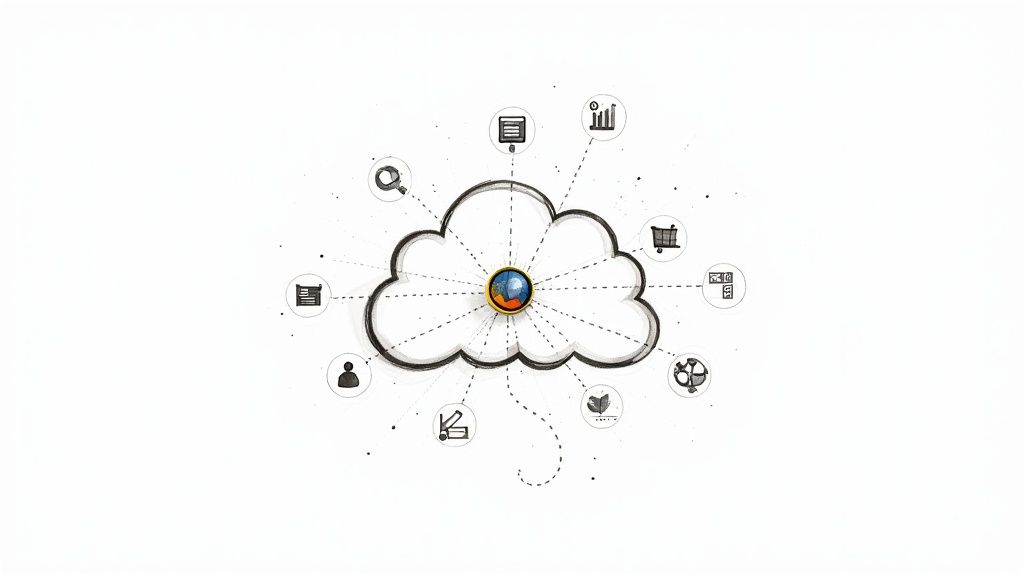
Salesforce Data Cloud is the central nervous system for all your customer information. In a typical organisation, customer data is a messy, disconnected puzzle. Purchase history lives in your e-commerce platform, support tickets are in Service Cloud, and marketing engagement is tracked in Account Engagement (formerly Pardot). This fragmentation leads to disjointed experiences and missed opportunities.
Salesforce Data Cloud solves this business challenge by ingesting, harmonising, and unifying data from countless systems into a single, real-time view of your customer. It’s the engine that powers truly personalised experiences across sales, service, and marketing.
Why a Unified Customer View is a Business Imperative
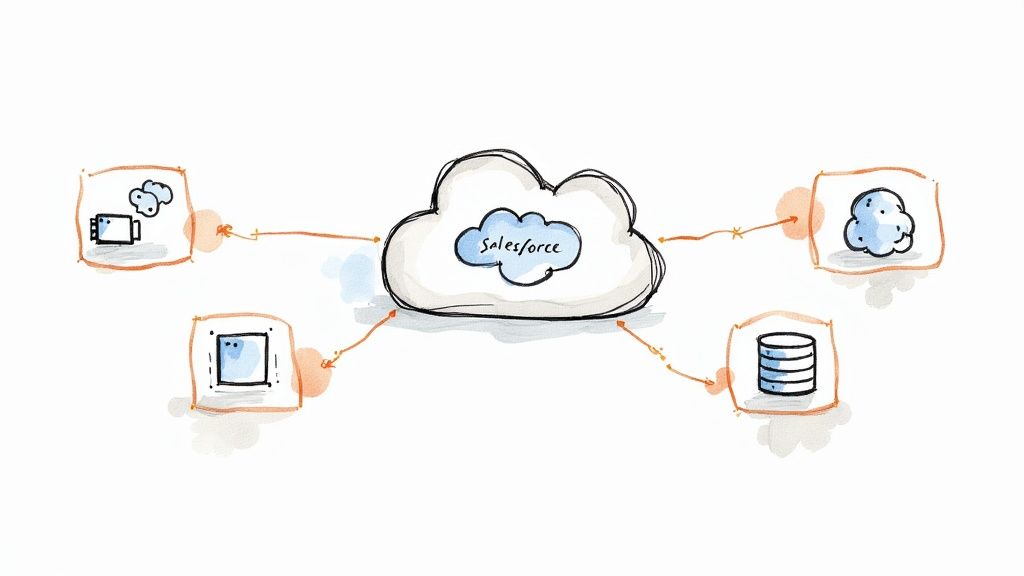
Without a unified view of the customer journey, your teams operate in silos. Marketing can't see recent service interactions, and sales reps lack insight into a customer's latest purchase history. This disconnect prevents the consistent, context-aware interactions that modern customers don’t just want—they expect.
Salesforce Data Cloud tackles this challenge head-on. It acts as a powerful data engine that connects to all your disparate sources, whether they're inside the Salesforce ecosystem or on external platforms. Its core function is to create one single, reliable source of truth for every customer.
From Disconnected Data to Actionable Intelligence
The platform’s role is not just to store data; it's about intelligent unification. It cleans, de-duplicates, and merges records to build a comprehensive profile that updates in real time. This process turns a passive asset—data—into an active driver of business growth.
By creating a live, unified customer profile, Salesforce Data Cloud empowers every department—from marketing to sales and service—to act on the most current and complete information available, transforming how you engage with customers.
A unified profile is the bedrock of any modern customer strategy. It allows your business to move beyond generic campaigns and reactive support, paving the way for proactive and deeply personalised engagement. This shift isn't just a nice-to-have; it's crucial for staying competitive and building lasting customer loyalty.
The platform's significance is reflected in its rapid adoption. Salesforce Data Cloud shot past USD $1 billion in annual recurring revenue globally by early 2025. Here in Australia, where Salesforce holds a commanding 20.7% market share in the CRM space, this trend is especially strong. A massive 60% of Salesforce's Q1 2025 deals in the region included its Data Cloud and AI solutions, a clear signal that Australian businesses are prioritising unified data to fuel their digital transformations.
Ultimately, Salesforce Data Cloud represents a fundamental shift in how businesses activate their most valuable asset. It provides the essential foundation needed to deliver the intelligent, AI-driven experiences that define today's market leaders.
How The Salesforce Data Cloud Architecture Works
To understand what makes Salesforce Data Cloud so effective, you need to look at its architecture. It’s a smartly designed engine built to turn mountains of disconnected information into a single, actionable asset. This process is where the magic happens, turning messy data into clear business value.
The process begins by connecting your data sources using a library of pre-built connectors for your CRM, marketing automation tools, e-commerce platforms, and external data lakes. Rather than moving all data into one giant database, Data Cloud uses data streams to bring information in efficiently. For some sources, it even uses a zero-copy approach, accessing data stored in other platforms without physically duplicating it, which speeds up the entire process immensely.
Harmonising Data with the Customer 360 Data Model
Once connected, the work of harmonisation begins. Data Cloud acts as an expert translator, mapping data from countless formats to a single, consistent structure: the Customer 360 Data Model.
For instance, a 'customer' in your e-commerce system, a 'contact' in your CRM, and a 'subscriber' in your marketing platform all get mapped to a standard 'Individual' object. This crucial step ensures that no matter where the data came from, it all speaks the same language inside the platform.
The diagram below shows how this unified data unlocks real business value, leading to better insights, scalable management, and AI-driven predictions.
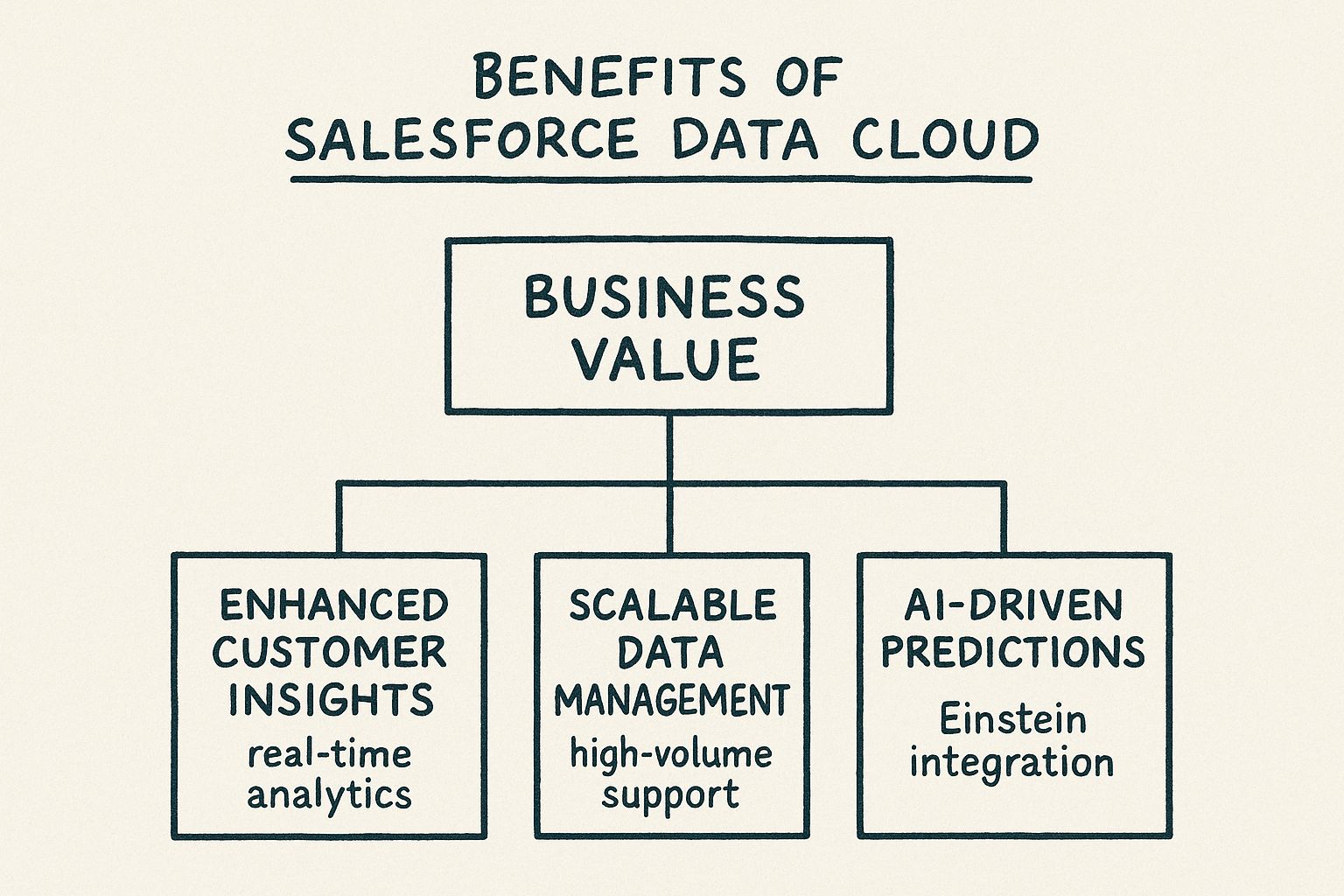
As the graphic illustrates, the platform's architecture is designed to directly support key business outcomes by turning raw data into a genuine strategic asset.
Key Data Cloud Components Explained
| Component | Function | Business Impact |
|---|---|---|
| Connectors & Data Streams | Ingest data from various sources (Salesforce, external apps, data lakes) efficiently, often without copying it. | Faster access to a wider range of customer data, reduced data latency, and lower storage costs. |
| Customer 360 Data Model | A standardised data structure that maps all incoming data to a common language (e.g., 'Individual', 'Account'). | Creates consistency across all data sources, making it easier to analyse and act on information from different systems. |
| Identity Resolution | Intelligently merges duplicate records using rules and AI to identify that different data points belong to the same person. | Builds a single, trustworthy source of truth for each customer, eliminating confusion and enabling true personalisation. |
| Unified Profile | The final, consolidated view of a customer, updated in real-time as new data flows in. | Empowers teams with a complete, up-to-the-minute understanding of every customer for smarter, contextual interactions. |
This table summarises how each piece of the architecture works together, transforming fragmented information into the unified profiles that drive your customer experience.
Building the Unified Profile with Identity Resolution
The final and most critical piece is creating that single, reliable customer profile. Data Cloud uses a sophisticated process called identity resolution to intelligently merge duplicate records from across all connected systems. It analyses identifiers—like email addresses, phone numbers, and loyalty IDs—to determine which records belong to the same person.
Identity resolution is the intelligent process that stitches together fragmented customer data points from multiple systems into one cohesive, trustworthy profile. This unified view is the foundation for genuine personalisation and predictive insights.
For example, it has the intelligence to recognise that "Jon Smith," "Jonathan Smith," and "jsmith@email.com" are all the same person, pulling all their activities into one complete record. To get a deeper look at how different systems can integrate within the Salesforce ecosystem, you can explore case studies on specific Salesforce Integration Architecture.
This unified profile isn’t static; it updates in real time as new data flows in, whether that’s a recent purchase or a new support ticket. This ensures your teams are always working with the most current view of the customer, transforming data from a siloed liability into the engine that powers your entire customer experience strategy.
Key Features That Drive Business Value
Understanding the architecture is one thing, but the real excitement comes from seeing what Salesforce Data Cloud can do for your business. The platform’s true power lies in turning unified data into measurable results for your sales, marketing, and service teams. This is where we move beyond just collecting data and into actively using it to spark growth and build customer loyalty.
Create Hyper-Targeted Audiences with Real-Time Segmentation
One of the most impressive features of Salesforce Data Cloud is its ability to perform real-time segmentation. Legacy segmentation involved pulling static lists from a database—lists that were often outdated the moment they were used. Data Cloud flips that model by letting you build audience segments based on live data as it happens.
This means you can group customers based on their most recent actions. A retailer, for example, could instantly create a segment of customers who have viewed a particular product more than three times in the last 24 hours but still haven't bought it. This closes the gap between customer action and your marketing reaction, ensuring campaigns are always timely and relevant.
Drive Deeper Understanding with Calculated Insights
Data Cloud doesn’t just show you the data you’ve collected; it helps you invent new, more valuable metrics. Calculated Insights is a powerful feature that lets you derive complex metrics on the fly, without needing a team of data scientists.
You can combine data from different sources to answer critical business questions. For instance, you could calculate a customer's lifetime value (LTV) by pulling their complete purchase history from your e-commerce platform and subtracting the costs of their support cases from Service Cloud.
With Calculated Insights, you're turning raw data points into strategic business intelligence. It lets you measure what really matters—like customer profitability or an engagement score—giving you a much clearer picture of who you're talking to.
These insights can then be used to provide premium service to high-value customers or identify churn risks, feeding directly back into your business strategy.
Activate Data Seamlessly Across Every Touchpoint
Perhaps the most critical capability is data activation. A perfect, unified customer profile is useless if it’s just sitting there. Data Cloud was built to push its rich, harmonised data and segments into any system where your teams interact with customers.
This means those hyper-targeted segments you just created can be activated directly in:
- Marketing Cloud to power truly personalised email journeys.
- Sales Cloud to arm your sales reps with the latest customer intel right before a call.
- Service Cloud to give your support agents the full story on a customer's history.
- External platforms like Google Ads or Facebook to ensure your messaging is consistent everywhere.
This seamless activation ensures every customer interaction is guided by the most complete, up-to-the-minute data available. Pulling this off successfully requires a clear strategy, where guidance from experienced Salesforce consulting services can be invaluable in connecting the technology to your business goals.
For example, an online retailer is seeing a high cart abandonment rate. Using Data Cloud, they set up a real-time segment of anyone who adds items to their cart but doesn't check out within 30 minutes. An automated action is triggered, sending this fresh segment straight to Marketing Cloud. Within minutes, each customer gets a personalised email showing the item they left behind with a limited-time free shipping offer. That automated workflow—powered by real-time data activation—turns a likely lost sale into a conversion. That’s the tangible business value Data Cloud delivers.
Putting Data Cloud to Work: Real-World Scenarios
Theory is great, but the real test for any platform is how it performs in the wild. This is where Salesforce Data Cloud moves from being an interesting concept to a game-changing business asset, solving tangible problems for organisations every day. Let's look at common business challenges and see how Data Cloud provides the solution.
From Disconnected Data to Hyper-Personalised Retail Campaigns
The Business Challenge: A typical Australian retail business had customer information scattered everywhere. Purchase history sat in their e-commerce system, loyalty program data was in a separate database, and website browsing behaviour was tracked elsewhere. This meant marketing campaigns were generic and often missed the mark. For instance, a loyal customer who just bought a new suit in-store would annoyingly keep seeing online ads for that very same suit.
The Salesforce Solution Implemented: By implementing Data Cloud, the retailer connected all these scattered data sources into a single, unified customer profile. They then used real-time segmentation to create a dynamic audience of "High-Value Customers Showing Interest in a New Product Line." This segment wasn't static; it updated automatically based on browsing behaviour, previous purchases, and loyalty status.
The Results and Benefits Delivered:
The impact was immediate and powerful.
- Skyrocketing Campaign Engagement: Personalised email campaigns sent to this new, intelligent segment saw a 40% higher open rate and a 25% increase in click-throughs.
- Boosting Customer Loyalty: Customers started getting relevant, timely offers that reflected their interests, strengthening their bond with the brand.
- Slashing Marketing Waste: Being able to exclude recent buyers from campaigns for products they already owned saved thousands in ad spend.
This is a perfect illustration of how a unified view, powered by Salesforce Data Cloud, turns messy data into a direct driver of revenue and happier customers. You can explore more stories of how businesses have achieved similar results by reading through our detailed Salesforce case studies.
Enhancing Client Relationships in Financial Services
The Business Challenge: A financial services firm struggled with disconnected data. Details about a client's mortgage, investment portfolio, and savings accounts were locked away in separate legacy systems. Relationship managers had no single view of their clients' financial world, making it difficult to spot opportunities or provide holistic advice. Ensuring compliance across these siloed systems was a manual, error-prone nightmare.
A unified customer profile in financial services isn't just about sales; it's about trust and compliance. It ensures every piece of advice is based on a complete understanding of the client's situation, building stronger, more valuable relationships.
The Salesforce Solution Implemented: The firm used Data Cloud to harmonise data from all its core banking and investment platforms. This created a single source of truth for each client, updated in real time. They then used Calculated Insights to create a "Potential Cross-Sell Opportunity" score based on account balances, loan-to-value ratios, and investment activity.
The Results and Benefits Delivered:
This unified approach transformed how they operated.
- Uncovering New Revenue Streams: Relationship managers could now instantly see which clients were prime candidates for new products. This led to a 15% uplift in cross-selling conversions in just the first six months.
- Improving Compliance and Reducing Risk: With a single source of truth, audit trails became crystal clear, and regulatory reporting became much simpler.
- Elevating the Client Experience: Clients received proactive, relevant advice that considered their entire financial portfolio, positioning the firm as a trusted partner.
This growth is part of a bigger picture. Australia’s public cloud market, the engine for platforms like Salesforce Data Cloud, was valued at around USD $2.43 billion in 2023 and is forecast to nearly triple by 2030, driven by sectors like finance and retail racing to unify their customer data. You can discover more insights about Australia's public cloud market growth on Grand View Research. These examples make it clear: no matter the industry, unified data drives smarter business.
Your Strategic Guide to a Successful Implementation

Implementing Salesforce Data Cloud is a strategic business initiative, not just a technical task. From our experience delivering Salesforce projects, the most successful implementations begin with a clear roadmap connecting the technology to real business goals. One common misstep is diving into connecting data sources without a solid plan. A successful rollout starts by defining what success looks like for your business.
Define Clear Business Goals First
Before mapping a single data field, you must be clear on what you’re trying to achieve. Is the goal to boost customer lifetime value, reduce marketing spend, or improve first-contact resolution in your service centre?
Setting specific, measurable goals provides a compass for every decision during the project. These goals become your north star, ensuring the project is focused on delivering business value, not just completing a technical checklist. A clear strategy also helps manage scope. Instead of connecting every data source at once, you can prioritise those that will help you achieve your primary goals, allowing a phased approach that delivers value sooner.
Assemble Your Internal A-Team
An implementation is only as good as the team driving it. This isn't just a job for the IT department; you need a cross-functional team including people who will actually use the data.
Your team should ideally include:
- An Executive Sponsor to champion the project and secure resources.
- A Project Manager to keep everything organised and on schedule.
- Data Stewards from key business areas who understand the context and quality of the data.
- A Salesforce Administrator or technical lead who knows the platform's architecture.
This team-based approach ensures the solution is built for the real-world needs of its users, which is essential for user adoption. Strong user adoption also relies on solid data management best practices for governance and quality.
Establish Robust Data Governance
Think of data governance as the rulebook that keeps your data accurate, secure, and consistent. It’s a non-negotiable part of any Salesforce Data Cloud implementation. We've seen projects stumble when this step is overlooked, leading to a "garbage in, garbage out" situation where poor data quality makes the system unreliable.
Data governance is the quality control for your most valuable asset. It clarifies who owns the data, who can access it, and how it should be handled, ensuring every insight is built on a foundation of trust.
This process is fundamental to any successful digital transformation. The local cloud computing market, which powers platforms like Data Cloud, was valued at USD $14.98 billion in 2024 and is forecast to reach USD $60.75 billion by 2030, highlighting how seriously Australian businesses are taking their data infrastructure.
To help you map out your journey, we've put together a high-level checklist for a successful implementation.
Data Cloud Implementation Checklist
| Phase | Key Activities | Expert Tip |
|---|---|---|
| 1. Strategy & Planning | Define business goals, identify key use cases, and assemble your cross-functional project team. | Don't skip this! A clear "why" is the most important factor for success. Get buy-in from all stakeholders early. |
| 2. Data Discovery & Governance | Map all data sources, define data models, and establish clear data governance policies for quality and security. | Start with the data sources that will provide the quickest wins for your primary business goals. A phased approach is best. |
| 3. Technical Implementation | Connect data sources, configure data streams, harmonise data into a unified profile, and set up segmentation rules. | Work closely with your data stewards to ensure the data is being interpreted and mapped correctly. Context is everything. |
| 4. Activation & Integration | Configure activation targets (e.g., Marketing Cloud, Sales Cloud), build initial journeys, and train end-users. | Run a pilot program with a small group of users to gather feedback and refine your processes before a full rollout. |
| 5. Optimisation & Measurement | Monitor performance against your initial goals, analyse results, and identify new opportunities for optimisation. | Implementation is just the beginning. Continuously review your use cases and look for new ways to create value from your unified data. |
This checklist provides a solid framework, but navigating these steps requires a blend of technical skill and strategic vision.
For a more detailed look, check out our comprehensive Salesforce implementation guide for Australian businesses. Working with an experienced Salesforce partner can help you sidestep common pitfalls and ensure your investment delivers the results you’re looking for.
Your Next Steps to Data-Driven Success
We’ve covered how Salesforce Data Cloud is the key to achieving a single, intelligent view of your customer. It’s a strategic investment that powers meaningful personalisation and drives real business growth. But powerful technology is only half the story.
To truly succeed with a platform like Data Cloud, you need a clear strategy and a partner with deep expertise. Without the right guidance, it’s easy to get bogged down in technical details and miss the crucial connection between the platform’s features and your core business goals. This is where real-world project experience makes all the difference.
Partner with Proven Salesforce Experts
As a dedicated Salesforce partner, we don't just install software; we build solutions that deliver tangible, measurable results. We have guided countless Australian businesses on their digital transformation journeys, helping them navigate complexities and maximise the value of their investment. Our team understands the nuances of Salesforce Data Cloud and knows how to tailor it to solve your unique challenges.
Success with Salesforce Data Cloud isn't just about connecting data sources. It’s about creating a strategic asset that fuels smarter decisions, stronger customer relationships, and sustainable growth for your business.
We bring proven methods and best practices learned from over 110 successful Salesforce implementations across a range of industries. This hands-on experience means we can help you sidestep common pitfalls and fast-track your path to becoming a truly data-driven organisation.
If you’re ready to leave fragmented data behind and start crafting experiences that treat customers like individuals, we're here to help. Our team has the strategic guidance and technical expertise to ensure your Salesforce Data Cloud investment delivers exceptional returns.
Ready to see how a unified data strategy can fuel your growth? Contact our team today for a consultation. Let’s discuss your business goals and explore what’s possible with Salesforce Data Cloud.
Common Questions About Salesforce Data Cloud
As businesses explore what Salesforce Data Cloud can do, a few practical questions often arise. Here are answers to common queries to clarify how the platform works and where it fits in your technology stack.
How is Data Cloud Different from a Traditional CDP?
While Salesforce Data Cloud shares some characteristics with a traditional Customer Data Platform (CDP), it operates on a different level. A standard CDP is typically a marketing tool designed to pull in customer data to build audience segments for campaigns.
Data Cloud, however, is a hyperscale data platform built into the core of Salesforce. It doesn't just unify customer data for marketing; it weaves that data through your sales, service, and analytics functions in real time. Think of it less as a marketing tool and more as the central data foundation for your entire customer engagement strategy.
What Skills Does My Team Need to Manage Data Cloud?
A successful Data Cloud implementation requires a cross-functional team. While the platform is designed to be user-friendly for admins, having the right people involved from the start ensures you get the most from your investment.
Your team should include:
- A Salesforce Administrator: Someone who knows the Salesforce ecosystem is vital for handling integrations and user permissions.
- A Data Analyst or Steward: You need someone who deeply understands your business data to map sources and be the guardian of data quality.
- Business Stakeholders: Involving leaders from marketing, sales, and service is non-negotiable. They define the practical use cases and measure success.
If your team is stretched, a Salesforce partner can provide the specialised expertise to guide your implementation and train your team.
How Does Data Cloud Integrate with Other Salesforce Clouds?
This is where Data Cloud truly shines. It is natively built to work with Sales Cloud, Service Cloud, and Marketing Cloud. This deep integration allows you to activate data across every customer touchpoint seamlessly.
For example, you can identify a high-value customer segment in Data Cloud and instantly push it to Marketing Cloud for a personalised email journey. Simultaneously, real-time insights about their latest website activity can appear on their contact record in Sales Cloud, giving your sales team a perfect, contextual conversation starter.
Is Data Cloud a Good Fit For Small or Mid-Sized Businesses?
Absolutely. While it's a powerful platform, Data Cloud is built to scale and delivers enormous value for small and mid-sized businesses (SMBs). The challenge of disconnected data is just as acute for smaller companies, and creating a single customer view can be a significant competitive advantage.
By bringing data together from all your systems, Data Cloud gives smaller teams the power to make smarter, data-driven decisions without needing a large data science department. It helps automate tasks and deliver the personalised experiences that build customer loyalty.
The key is to start with clear, focused use cases that solve your most urgent business problems first. If you have more questions, feel free to check out our comprehensive Salesforce FAQ page.
At Adaptal, we specialise in helping Australian businesses unlock the full potential of their CRM data. Our team has the real-world experience to guide your Salesforce Data Cloud implementation and ensure it delivers measurable results.
Ready to build a unified view of your customer? Contact us for a personalised consultation.
Article created using Outrank
Sample